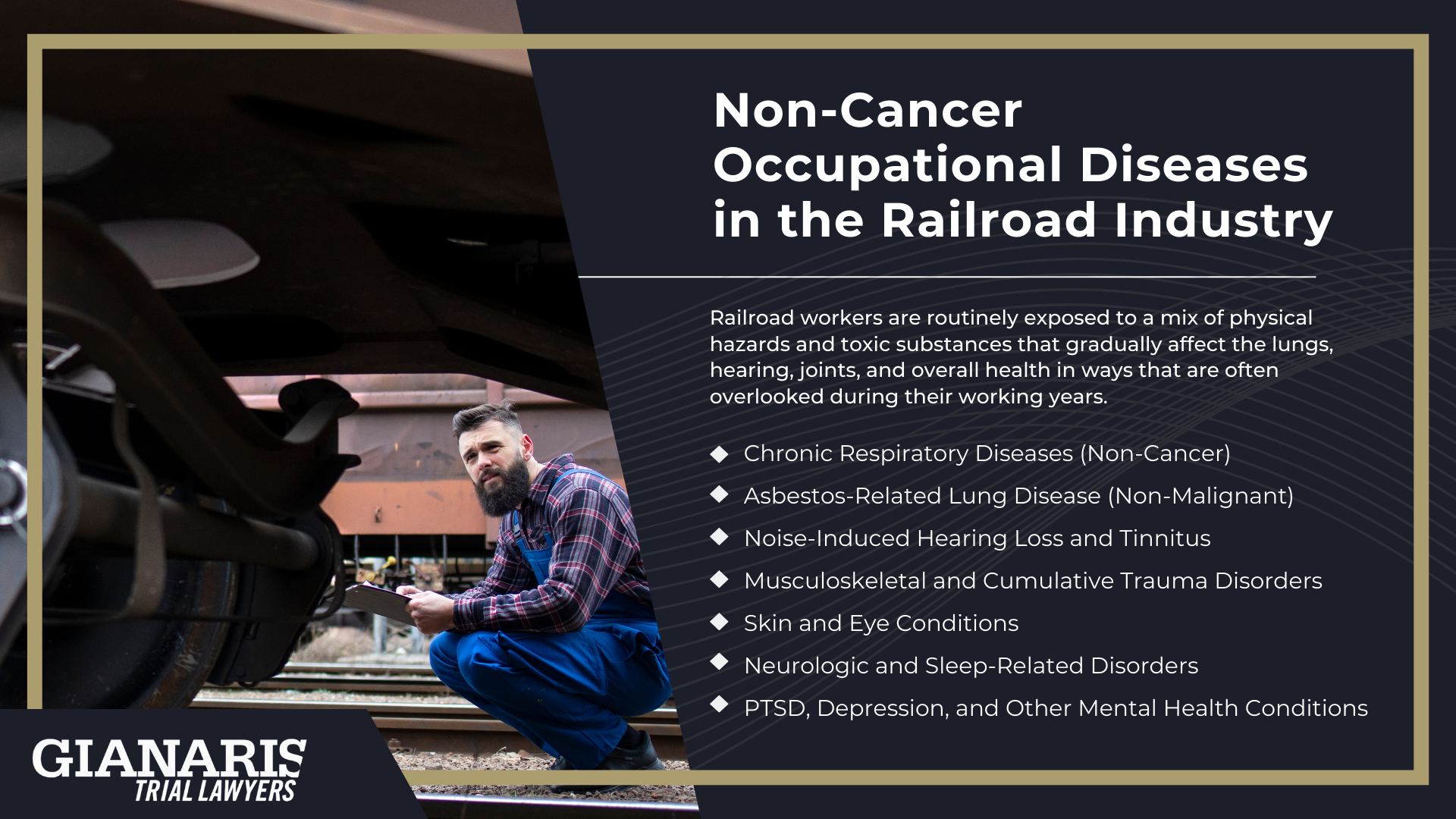
Railroad workers are routinely exposed to a mix of physical hazards and toxic substances that gradually affect the lungs, hearing, joints, and overall health in ways that are often overlooked during their working years.
Even when some safety protocols exist, long-term contact with diesel exhaust, chemical solvents, silica dust, metal particulates, and other railroad toxins creates an increased risk of developing serious non-cancer conditions.
Many of these diseases emerge slowly, presenting first as shortness of breath, persistent pain, sleep disruption, or high blood pressure before progressing into more disabling forms of chronic illness.
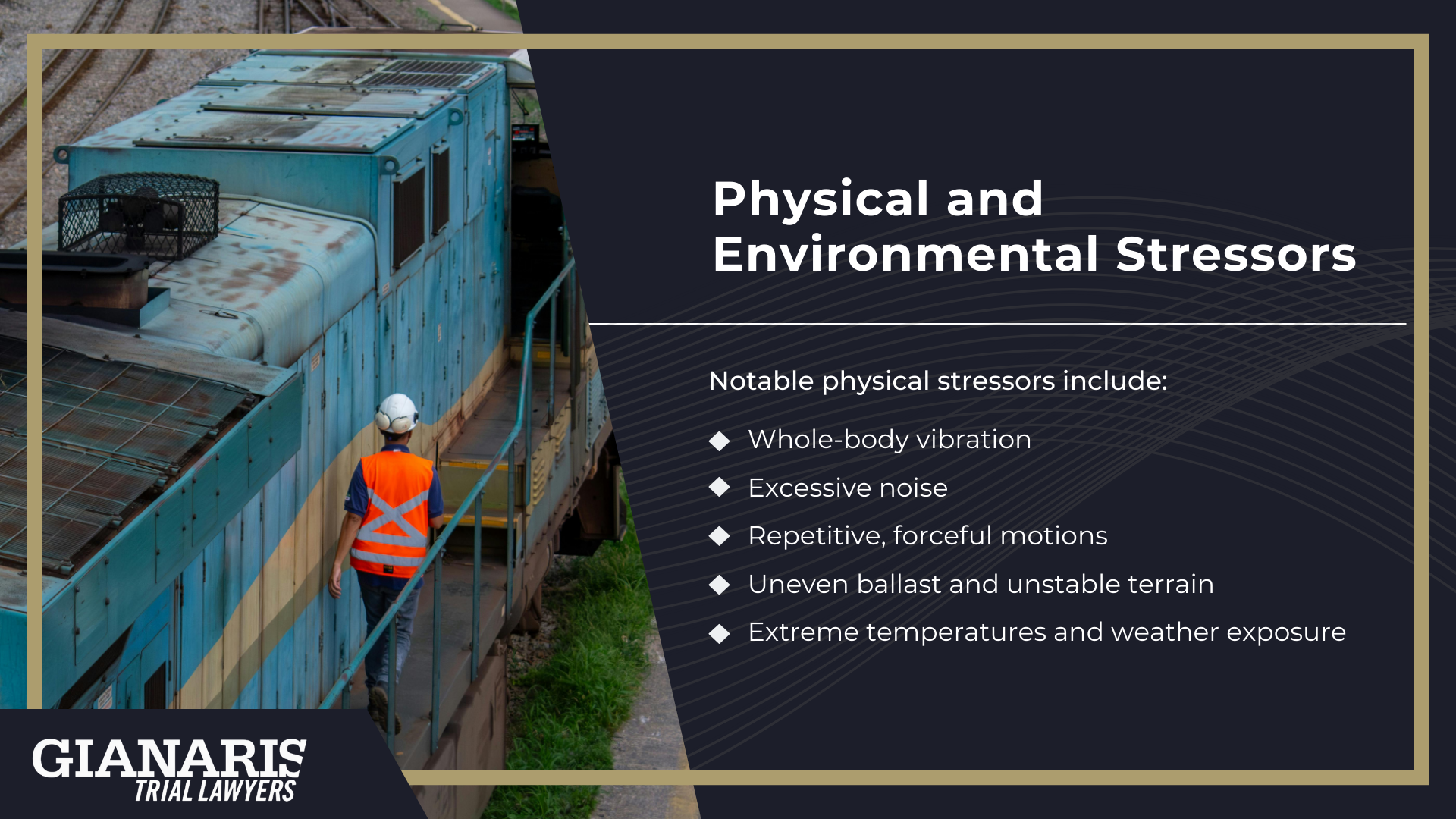
Others arise from the cumulative toll of vibration, noise, extreme temperatures, and demanding physical labor that define railroad operations.
When symptoms appear, they often require extensive medical care, yet the connection to years of occupational exposure is not always immediately recognized.
The sections that follow examine these non-cancer occupational diseases in detail and explain how long-term exposure to toxic substances and harsh working conditions can harm the health of railroad employees.
Chronic Respiratory Diseases (Non-Cancer)
For many railroad workers, the first serious health problems linked to their job show up in the lungs, not as cancer but as slowly progressive breathing disorders.
Years of work around diesel locomotives, dusty ballast, welding fumes, and confined shop air can inflame and scar the airways until routine tasks leave a worker short of breath.
Chronic bronchitis, emphysema, and COPD often appear together, reflecting long-term damage to both the small airways and the air sacs of the lungs.
A case–control study of U.S. railroad workers found that time spent in diesel-exposed jobs was associated with increased mortality from COPD even after accounting for smoking, supporting the link between railroad diesel exposure and chronic non-cancer lung disease.
Cohort and surveillance studies in other industrial sectors also show this pattern, showing higher COPD rates in workers exposed to diesel exhaust, welding fumes, and silica dust compared with less-exposed groups.
Occupational asthma and reactive airway conditions have been documented in transportation and garage workers exposed to diesel exhaust, reinforcing concerns about similar risks in rail yards, shops, and tunnels.
Track and maintenance crews also face concentrated silica dust and other mineral particles from ballast, which are well-recognized causes of silicosis and broader pneumoconioses in dust-exposed workers.
The diseases below represent the main non-cancer respiratory conditions tied to these railroad exposures:
- Chronic Bronchitis
- Emphysema
- Chronic Obstructive Pulmonary Disease (COPD)
- Occupational Asthma
- Reactive Airway Disease / Irritant-Induced Asthma
- Silicosis and Other Pneumoconioses
Asbestos-Related Lung Disease (Non-Malignant)
For decades, the widespread use of asbestos insulation, gaskets, brake linings, and other asbestos-containing components in locomotives, rail cars, and repair shops exposed thousands of railroad workers to one of the most dangerous chemicals ever used in industry.
Even when exposure seemed minimal or occasional (during maintenance, repairs, or brake work), inhaled asbestos fibers could embed in lung tissue or lung lining and remain invisible for decades.
Over time, these fibers may lead not only to cancer, but also to serious non-malignant asbestos-related diseases that impair breathing, restrict lung expansion, and cause chronic respiratory decline.
This risk remains relevant today for anyone who worked around older equipment or in shops where asbestos materials were handled without adequate protection.
Below are the primary non-malignant asbestos-related diseases:
- Asbestosis: A chronic disease in which inhaled asbestos fibers cause progressive scarring (fibrosis) of the lung tissue, reducing oxygen transfer and lung elasticity. Over time, this leads to shortness of breath, persistent cough, wheezing, and decreased lung capacity.
- Pleural Plaques: Pleural plaques are localized areas of thickened or scarred tissue on the pleura (the lining of the lungs) caused by asbestos fiber deposition and the body’s inflammatory response. While pleural plaques are typically non-malignant and often produce no symptoms, they serve as a clear historical marker of asbestos exposure, showing that a person’s lungs were exposed to sufficient fiber load to produce tissue change.
- Diffuse Pleural Thickening (DPT): Diffuse pleural thickening involves more extensive fibrosis of the pleural lining, often affecting broad portions of the lung lining, sometimes with adhesions between pleural layers, rather than the isolated, plaque-like lesions seen in pleural plaques. In DPT, the thickening can restrict lung expansion, reduce lung capacity, and cause breathlessness, chest pain, or reduced exercise tolerance.
Noise-Induced Hearing Loss and Tinnitus
Noise is one of the most consistent hazards in railroad work because it is built into the machinery, movement, and communication demands of daily operations.
Locomotive engines, horns, grinders, tampers, welders, and car-coupling impacts can expose workers to damaging sound levels across entire shifts, often without the clear warning signs that come with more immediate injuries.
Federal regulators recognize this risk as a serious occupational health issue: the Federal Railroad Administration adopted specific noise standards aimed at protecting employees whose predominant noise exposure occurs in the locomotive cab, reflecting how central cab noise is to the job.
A separate federal handbook on railroad noise measurement describes the main sources of rail noise (from yard switching and coupling impacts to horn sound levels and noise inside locomotive cabs) highlighting how many aspects of the railroad environment generate hazardous noise.
This exposure pattern matters because hearing damage is cumulative.
NIOSH reports that approximately 22 million U.S. workers are exposed to hazardous noise at work each year, and noise-induced hearing loss remains one of the most common work-related illnesses in the country.
In NIOSH surveillance data for the transportation and warehousing sector, about 13% of workers report hearing difficulty, about 7% report tinnitus, and about 12% of noise-exposed tested workers have a material hearing impairment, meaning hearing loss severe enough to affect day-to-day functioning.
Those numbers are especially important in railroad work because many rail jobs require workers to hear warnings, radio instructions, equipment changes, and approaching hazards, often while operating in the same loud environment that damages hearing.
When hearing loss develops, workers frequently compensate by straining to understand speech, raising volume levels, or relying on visual cues, which can increase safety risks and intensify fatigue.
Musculoskeletal and Cumulative Trauma Disorders
Musculoskeletal disorders are among the most common occupational illnesses in railroad work because the job repeatedly puts the body under high force, awkward positioning, vibration, and uneven footing.
Unlike an acute injury, these conditions develop through wear and micro-trauma, often after years of lifting, climbing, coupling equipment, handling tools, and working long shifts in environments that are not designed around the worker’s biomechanics.
The Bureau of Labor Statistics defines musculoskeletal disorders (MSDs) as injuries to muscles, tendons, ligaments, joints, cartilage, and spinal discs that are often driven by repetitive motion, overexertion, and sustained awkward postures.
Railroad work includes all of those risk factors, and research focused specifically on U.S. locomotive engineers shows how quickly those exposures translate into measurable harm.
In a study examining whole-body vibration and ergonomic factors among U.S. railroad engineers, time spent being bothered by vibration was significantly associated with increased risk of low back pain, shoulder and neck pain, and sciatic pain, reinforcing that locomotive vibration is not just discomfort, it is a documented occupational hazard.
Related research has reported that serious neck and lower back disorders among locomotive operators were nearly double the prevalence found in a control group, demonstrating an excess burden of disease in railroad jobs with heavy vibration and cab-based ergonomic strain.
Maintenance-of-way workers often face a different pattern of cumulative trauma: repetitive lifting, tool vibration, prolonged bending, and hours spent walking and kneeling on uneven ballast.
A study on work exposures and musculoskeletal disorders in railroad maintenance-of-way crews concluded that the number and severity of these disorders can be reduced with ergonomic design improvements, better tool design, and more accurate reporting, language that reflects a preventable, work-driven disease process rather than an unavoidable consequence of aging.
The physical toll is often compounded by scheduling demands that limit recovery time between shifts, accelerating inflammation, joint degeneration, and chronic pain progression.
Common musculoskeletal and cumulative trauma disorders in railroad workers include:
- Chronic Low Back Pain and Degenerative Disc Disease
- Neck and Shoulder Disorders
- Sciatica and Nerve Compression Syndromes
- Knee, Hip, and Joint Degeneration
- Carpal Tunnel Syndrome and Upper Extremity Cumulative Trauma
Skin and Eye Conditions
Railroad work often involves direct contact with irritants and sensitizers, especially in shops, yards, and maintenance settings where workers are exposed to toxic substances on a routine basis.
Many exposures happen through the skin or eyes, not just inhalation, because fuels, solvents, oils, and treated materials frequently coat tools, components, and work surfaces.
OSHA notes that occupational skin disease is one of the most common workplace illnesses in the U.S., with recordable skin diseases outpacing recordable respiratory illnesses in recent BLS data, evidence that dermal exposure is a serious occupational health issue across industries.
In rail settings, chemical fumes and splash exposure can also inflame the eyes, especially when work occurs in enclosed or poorly ventilated spaces.
Diesel exhaust itself is recognized as a source of eye and nose irritation, and workers in diesel-heavy environments may experience burning eyes, headaches, and respiratory irritation even without a “spill” or acute exposure event.
Over time, repeated contact with toxic materials (including degreasers, solvents, fuels, and creosote-treated ties) can break down the skin barrier and trigger chronic dermatitis, chemical burns, and longer-term tissue damage.
Types of skin and eye conditions linked to railroad work include:
- Contact Dermatitis (Irritant or Allergic)
- Chemical Burns and Corrosive Skin Injury
- Creosote-Related Skin Conditions (Including Phototoxic Dermatitis)
- Eye Irritation and Conjunctivitis from Fumes and Splashes
Neurologic and Sleep-Related Disorders
Railroad work can affect the nervous system in ways that are harder to recognize than lung disease or hearing loss, because symptoms often start as fatigue, headaches, poor sleep, or subtle cognitive changes.
Many of these conditions are tied to chronic exposure to chemical solvents, metal fumes, and other neurotoxic agents used in maintenance and repair environments, particularly when ventilation and respiratory protection are inadequate.
NIOSH has long warned that occupational exposure to organic solvents can cause adverse neurologic effects and recommends engineering controls and protective equipment to reduce exposure.
The EPA similarly notes that chronic solvent exposure has been linked to cognitive and mood impairment, memory problems, and peripheral neuropathy, and that these effects can worsen when solvents are combined with other hazards such as noise.
For workers involved in welding or metal work, neurologic risk can also come from inhaling fine metal particulates; NIOSH explains that welding fumes contain metals and often include manganese, a neurotoxicant associated with parkinsonian symptoms in occupational research.
Sleep and fatigue problems represent a separate but closely connected pathway for neurologic harm.
The Federal Railroad Administration’s Railroaders’ Guide to Healthy Sleep describes shift work disorder as a condition driven by irregular work and sleep timing, often causing insomnia, excessive sleepiness on duty, and impaired concentration, issues with direct safety consequences.
FRA-sponsored research has also documented how railroad scheduling patterns shape fatigue and alertness across multiple job categories, reinforcing that sleep disruption is not incidental in railroad work but structural.
Over time, these patterns can contribute to other serious illnesses, including chronic sleep disorders, anxiety, depression, and cardiovascular strain, especially when fatigue intersects with toxic exposures and high-stress work environments.
Neurological and sleep disorders related to railroad work include:
- Chronic Solvent Encephalopathy (Toxic Encephalopathy)
- Peripheral Neuropathy and Sensory Symptoms
- Parkinson’s Disease and Parkinsonism (Metal Fume Exposure)
- Shift Work Disorder and Chronic Sleep Disruption
PTSD, Depression, and Other Mental Health Conditions
Mental health injuries are a recognized occupational harm in rail work, particularly when a railroad accident or fatal incident forces employees to witness traumatic events they could not prevent.
Train crews may be involved in collisions, derailments, near misses, or “person-under-train” incidents that produce shock, helplessness, guilt, and intrusive memories long after the shift ends.
A systematic review of person-under-train incidents found consistent evidence that these events can lead to post-traumatic stress disorder (PTSD), sickness absence, and other mental health consequences for train drivers.
A prospective study of male train drivers following person-under-train incidents also documented posttraumatic stress symptoms, anxiety, and depression over time, reinforcing that psychological injury can follow a predictable clinical course after traumatic rail events.
U.S. psychiatric literature has similarly described railroad and subway drivers as a high-risk group for PTSD because their job can make them an unintended instrument of death during collisions and track incidents.
These conditions are not limited to one catastrophic event; repeated exposure to serious incidents, combined with long hours, irregular sleep, and constant operational pressure, can erode resilience and make recovery harder.
Depression may emerge through persistent sleep disruption, hypervigilance, and the loss of a worker’s sense of safety and control, while anxiety often becomes tied to the anticipation of future incidents and the fear of returning to the cab.
The Federal Railroad Administration’s Trespass & Suicide Prevention Toolkit explicitly notes that suicide and trespass incidents can negatively affect the mental health and wellbeing of train crews and identifies PTSD, anxiety, and depression as documented outcomes, showing that these harms are recognized at the federal level, not treated as rare exceptions.
When railroads fail to protect workers through meaningful post-incident support, mental health screening, and trauma-informed policies, psychological injuries can become chronic and disabling, affecting work capacity, relationships, and long-term quality of life.