

No fees unless we win.
Get a free consultation
128 Reviews
5.0
★★★★★

The Legal Process for FELA Railroad Cases Explained

Suing Under the Federal Employers Liability Act (FELA)

The legal process for FELA railroad cases follows a structured path designed to prove negligence and recover fair compensation for injured workers.

Each stage, from reporting the injury and gathering evidence to potential trial and appeal, requires careful preparation and legal skill.

The experienced FELA attorneys at Gianaris Trial Lawyers guide clients through every step, protecting their rights and maximizing their chances of success under federal law.

The Legal Process for FELA Railroad Cases Explained; Step 1_ Reporting the Injury and Getting Medical Care; Step 2_ Hiring a FELA Lawyer and Case Evaluation; Step 3_ Investigation and Evidence Collection; Step 4_ Filing the FELA Lawsuit; Step 1_ Reporting the Injury and Getting Medical Care; Step 2_ Hiring a FELA Lawyer and Case Evaluation; Step 3_ Investigation and Evidence Collection; Step 4_ Filing the FELA Lawsuit; Step 5_ Discovery and Pre-Trial Proceedings; Step 6: Settlement Negotiations or Trial; Step 7_ Post-Trial and Appeals Process; How Gianaris Trial Lawyers Supports Injured Railroad Workers

What is the Legal Process for FELA Claims?

The Federal Employers Liability Act (FELA) provides vital protection for railroad employees who suffer injuries or illnesses caused by unsafe working conditions.

In FELA cases, the key question is whether the employer’s negligence played a role (even slightly) in causing harm.

These claims can involve everything from sudden broken bones or crush injuries to long-term occupational diseases and cancer linked to toxic exposure.

Because FELA allows full recovery for medical expenses, lost income, and other damages, it’s one of the most powerful tools available to injured railroad workers and their families.

However, the process for filing and pursuing these claims requires substantial legal expertise and a deep understanding of the railroad industry.

Experienced FELA attorneys know how to investigate accidents, gather evidence, and prove negligence under federal law.

FELA claims can range from traumatic injuries sustained in rail yards to wrongful death actions following long-term exposure or catastrophic accidents.

Understanding how the legal process works is the first step toward securing justice and rebuilding after a serious railroad injury.

If you or a loved one suffered an injury, developed cancer or another occupational disease, or lost a family member due to unsafe railroad conditions, you may have a valid claim under the Federal Employers Liability Act (FELA).

The experienced FELA attorneys at Gianaris Trial Lawyers can help investigate whether your employer’s negligence played a role and pursue compensation for medical expenses, lost income, and other damages.

Contact our firm today to learn how we can help protect your rights and hold negligent railroads accountable.

Step 1: Reporting the Injury and Getting Medical Care

When a railroad worker is injured on the job, the first priority is always medical care.

The inherent dangers of railroad work (heavy machinery, exposure to toxins, and unpredictable job environments) make prompt evaluation and documentation critical.

Injured workers should report the incident immediately to a supervisor and contact their union representative for guidance before giving detailed statements to the company.

Because railroads are common carriers engaged in interstate commerce, they are subject to federal safety standards, and employers can be held liable when those standards are violated.

Proper documentation of the injury, treatment, and cause of the incident is essential to securing fair compensation later.

Medical records not only establish the connection between the injury and the workplace but also help determine whether the employee qualifies for higher compensation due to permanent impairment or physical disability.

Even injuries caused by defective machinery, unsafe conditions, or other equipment used in such commerce may support a valid FELA claim.
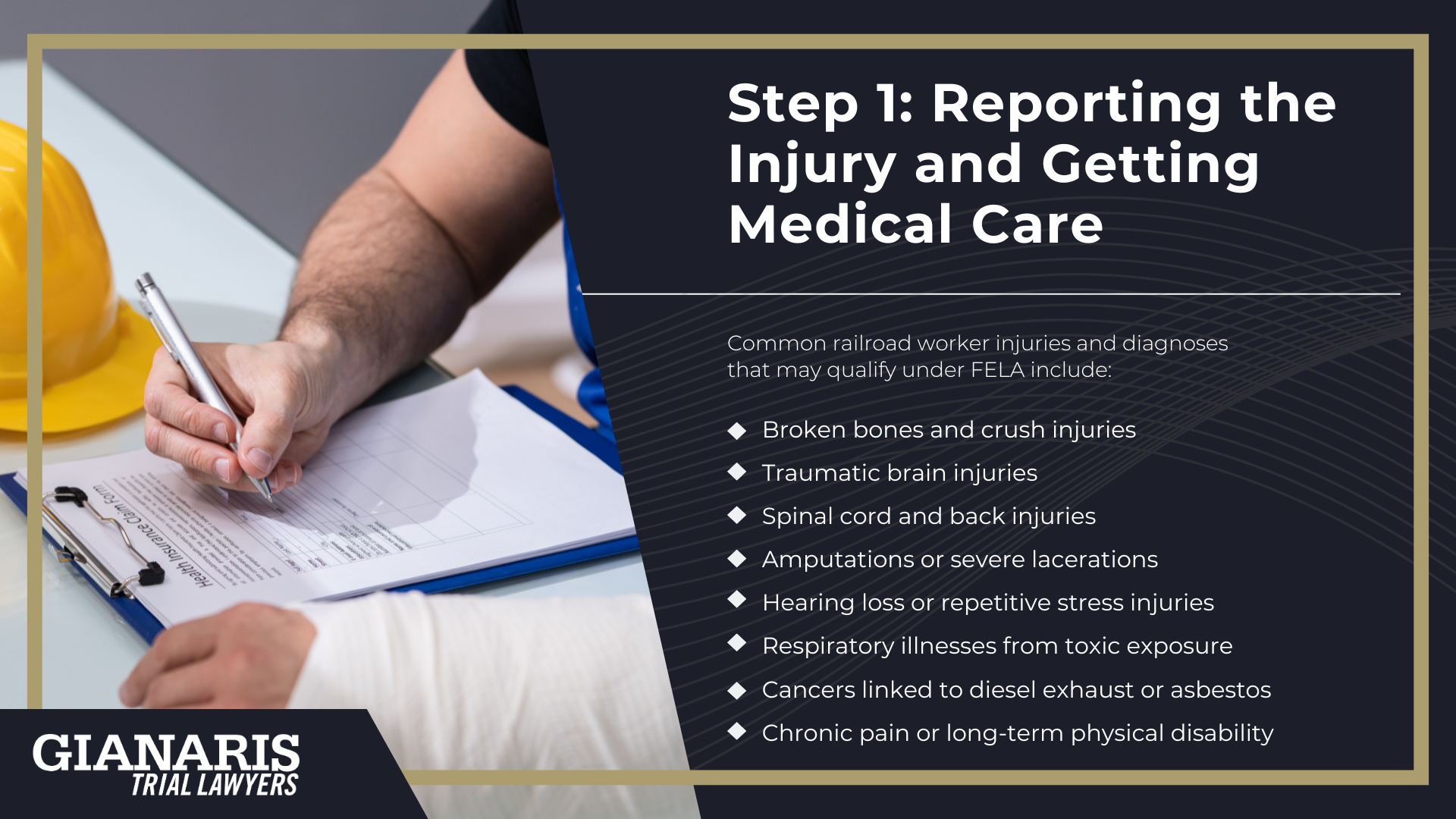
Step 1_ Reporting the Injury and Getting Medical Care

Common railroad worker injuries and diagnoses that may qualify under FELA include:

  • Broken bones and crush injuries
  • Traumatic brain injuries
  • Spinal cord and back injuries
  • Amputations or severe lacerations
  • Hearing loss or repetitive stress injuries
  • Respiratory illnesses from toxic exposure
  • Cancers linked to diesel exhaust or asbestos
  • Chronic pain or long-term physical disability

Timely reporting and immediate treatment protect both health and legal rights, laying the foundation for a strong FELA case.

Step 2: Hiring a FELA Lawyer and Case Evaluation

After an injury, the next critical step for injured railroad employees is to consult a lawyer experienced in handling FELA cases.

Because FELA requires proof that the railroad’s negligence contributed to the injury, having a knowledgeable attorney ensures all legal and factual issues are properly developed from the start.

A qualified lawyer will review medical records, work history, and accident details to determine the best strategy and identify all parties involved, including parent or partner railroad companies.

Since FELA covers workers employed by railroads engaged in interstate commerce, claims can often be filed in one of several states, depending on where the railroad operates or where the injury occurred.

Step 1_ Reporting the Injury and Getting Medical Care; Step 2_ Hiring a FELA Lawyer and Case Evaluation

The attorney will help determine the best venue and file the case in the appropriate court to maximize the worker’s chances of success.

During this phase, the lawyer also evaluates the full extent of damages, including lost earnings, medical expenses, and long-term disability impacts.

Early legal guidance provides a strong foundation for building a case and protecting the injured worker’s right to full compensation under federal law.

Step 3: Investigation and Evidence Collection

Once the case evaluation is complete, the next step is a thorough investigation into how the railroad employer’s negligence caused the injury or illness.

This process focuses on uncovering records, witness statements, and expert opinions that show the company failed to provide a safe workplace.

A FELA attorney works closely with the injured employee, medical providers, and safety professionals to collect evidence proving that the employer violated a duty of care or a safety statute applicable to such carrier.

Because FELA is different from workers compensation, the injured worker must prove fault rather than rely on automatic benefits.

Evidence may also establish the extent of such injury, medical costs, and long-term financial losses that the worker or their family members may be entitled to recover.

In cases involving death resulting from the accident or exposure, the claim may extend to the employee’s parents or kin dependent on the worker for pay and support.

A strong investigation ensures that all damages (economic and non-economic) are accurately documented and presented.

This foundation is crucial for securing fair compensation and holding the railroad accountable under federal law.

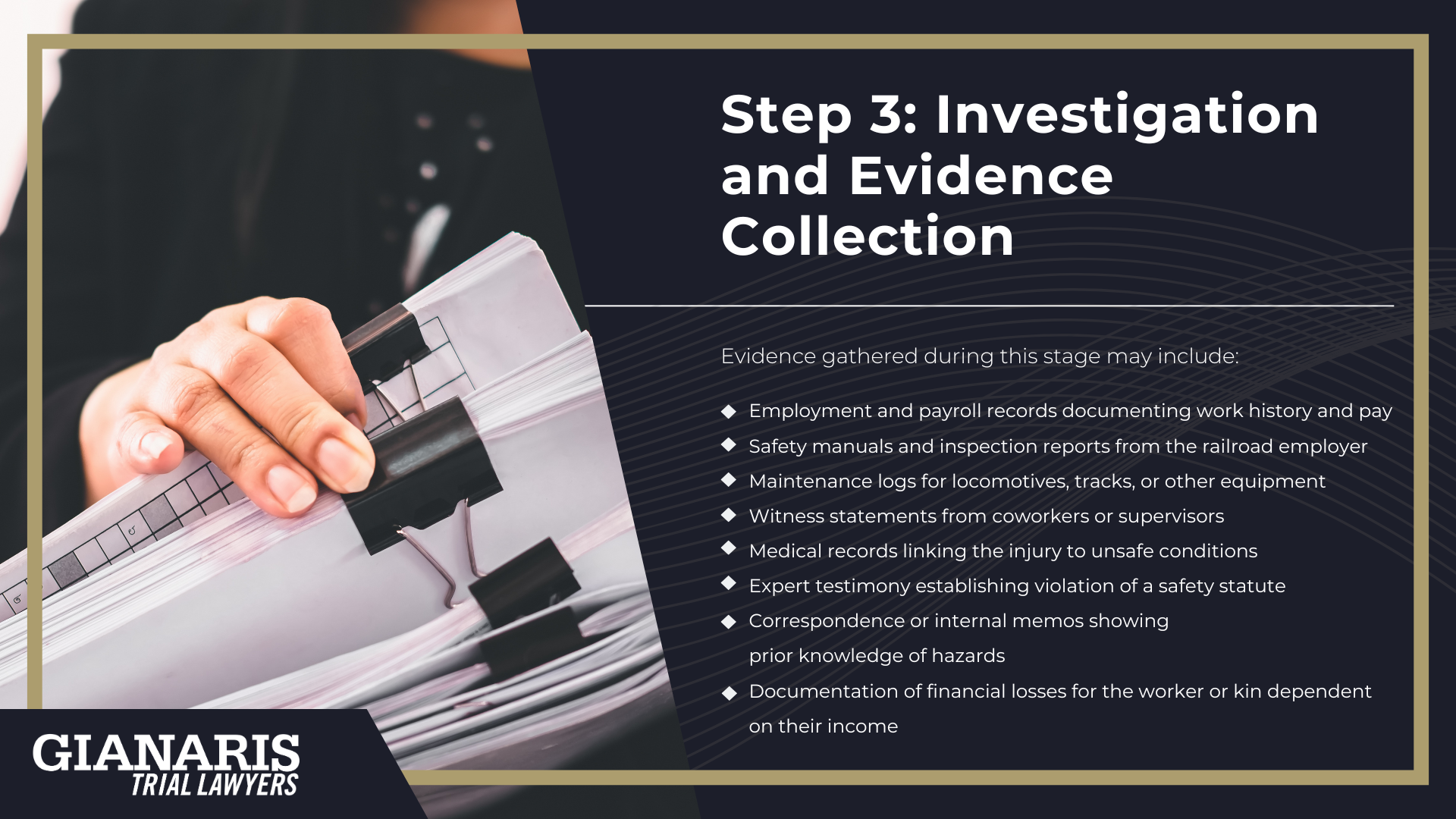
Step 1_ Reporting the Injury and Getting Medical Care; Step 2_ Hiring a FELA Lawyer and Case Evaluation; Step 3_ Investigation and Evidence Collection

Evidence gathered during this stage may include:

  • Employment and payroll records documenting work history and pay
  • Safety manuals and inspection reports from the railroad employer
  • Maintenance logs for locomotives, tracks, or other equipment
  • Witness statements from coworkers or supervisors
  • Medical records linking the injury to unsafe conditions
  • Expert testimony establishing violation of a safety statute
  • Correspondence or internal memos showing prior knowledge of hazards
  • Documentation of financial losses for the worker or kin dependent on their income

Step 4: Filing the FELA Lawsuit

Once the investigation is complete, the next step is to formally file the claim in court.

Most FELA lawsuits are filed in federal court, though some may proceed in state court depending on where the railroad operates and where the injury occurred.

The complaint identifies the person suffering injury, outlines how the railroad’s negligence contributed to the incident, and details the damages sought.

Filing initiates the official legal process, requiring the railroad to respond and begin preparing its defense.

This stage also sets deadlines for discovery, witness depositions, and other pre-trial procedures.

Step 1_ Reporting the Injury and Getting Medical Care; Step 2_ Hiring a FELA Lawyer and Case Evaluation; Step 3_ Investigation and Evidence Collection; Step 4_ Filing the FELA Lawsuit

Because FELA is a federal statute, the filing must meet strict procedural rules that differ from typical personal injury claims.

Having experienced legal representation ensures all documents are properly drafted, filed, and served on the appropriate parties.

For injured railroad workers, this filing marks the formal beginning of their pursuit of justice and financial recovery under the law.

Step 5: Discovery and Pre-Trial Proceedings

After the lawsuit is filed, both sides enter the discovery phase, where evidence and testimony are exchanged to prepare for trial.

This process allows each party to review documents, question witnesses, and request records that support their version of events.

Attorneys for the injured worker gather employment files, safety manuals, and medical attention records to prove the railroad’s negligence and the extent of the injuries.

The defense may also seek access to medical history or other documentation to challenge causation or damages.

During this stage, depositions are taken from the injured worker, coworkers, supervisors, and expert witnesses who can explain how the railroad failed to provide a safe work environment.

Step 1_ Reporting the Injury and Getting Medical Care; Step 2_ Hiring a FELA Lawyer and Case Evaluation; Step 3_ Investigation and Evidence Collection; Step 4_ Filing the FELA Lawsuit; Step 1_ Reporting the Injury and Getting Medical Care; Step 2_ Hiring a FELA Lawyer and Case Evaluation; Step 3_ Investigation and Evidence Collection; Step 4_ Filing the FELA Lawsuit; Step 5_ Discovery and Pre-Trial Proceedings

The legal team calculates financial losses, including lost wages, medical expenses, and projected future costs, supported by economists and vocational experts.

Pre-trial motions may follow, as both sides argue over what evidence and testimony should be allowed at trial.

The discovery process often clarifies the strength of each party’s case and can lead to settlement discussions before a trial date is set.

Step 6: Settlement Negotiations or Trial

After discovery, both sides assess the strength of their evidence and often enter settlement discussions to avoid trial.

Settlement negotiations are guided by the severity of injuries, medical expenses, and projected lost wages, as well as the likelihood of success if the case proceeds.

If a fair settlement cannot be reached, the case moves forward to trial, where a judge or jury determines liability and the amount of compensation.

The outcome depends on how well the attorney presents the evidence gathered during the following steps of investigation and discovery.

Throughout this phase, skilled FELA attorneys work to secure the best possible result for the injured railroad worker and their family.

Step 1_ Reporting the Injury and Getting Medical Care; Step 2_ Hiring a FELA Lawyer and Case Evaluation; Step 3_ Investigation and Evidence Collection; Step 4_ Filing the FELA Lawsuit; Step 1_ Reporting the Injury and Getting Medical Care; Step 2_ Hiring a FELA Lawyer and Case Evaluation; Step 3_ Investigation and Evidence Collection; Step 4_ Filing the FELA Lawsuit; Step 5_ Discovery and Pre-Trial Proceedings; Step 6: Settlement Negotiations or Trial

The settlement or trial process typically includes:

  1. Reviewing all evidence and expert reports from discovery
  2. Calculating damages, including medical costs and lost wages
  3. Conducting settlement conferences or mediation sessions
  4. Preparing witnesses and exhibits for trial presentation
  5. Presenting the case before a judge or jury if negotiations fail

Step 7: Post-Trial and Appeals Process

After a verdict is reached, either side may request a post-trial review if they believe an error affected the outcome.

This may involve motions to alter the judgment, request a new trial, or modify the award amount.

If the losing party files an appeal, the case moves to a higher court where the decision is reviewed for legal or procedural mistakes.

Step 1_ Reporting the Injury and Getting Medical Care; Step 2_ Hiring a FELA Lawyer and Case Evaluation; Step 3_ Investigation and Evidence Collection; Step 4_ Filing the FELA Lawsuit; Step 1_ Reporting the Injury and Getting Medical Care; Step 2_ Hiring a FELA Lawyer and Case Evaluation; Step 3_ Investigation and Evidence Collection; Step 4_ Filing the FELA Lawsuit; Step 5_ Discovery and Pre-Trial Proceedings; Step 6: Settlement Negotiations or Trial; Step 7_ Post-Trial and Appeals Process

During this stage, the injured railroad worker’s legal team continues to protect their rights, arguing to uphold favorable rulings or challenge unfair ones.

Even after the verdict, FELA attorneys at Gianaris Trial Lawyers remain involved to help clients collect payment, negotiate structured settlements, and secure the full compensation they’re owed.

How Gianaris Trial Lawyers Supports Injured Railroad Workers

At Gianaris Trial Lawyers, our mission is to protect the rights of railroad employees who have suffered injuries, illnesses, or wrongful death due to unsafe working conditions.

Our team understands the physical, emotional, and financial toll these cases take on workers and their families.

From the first consultation through trial or settlement, our FELA attorneys handle every aspect of the case: investigating evidence, proving negligence, and pursuing full compensation for medical care, lost income, and long-term suffering.

We’ve built a reputation for meticulous preparation and aggressive advocacy against powerful railroad employers and their insurance teams.

Step 1_ Reporting the Injury and Getting Medical Care; Step 2_ Hiring a FELA Lawyer and Case Evaluation; Step 3_ Investigation and Evidence Collection; Step 4_ Filing the FELA Lawsuit; Step 1_ Reporting the Injury and Getting Medical Care; Step 2_ Hiring a FELA Lawyer and Case Evaluation; Step 3_ Investigation and Evidence Collection; Step 4_ Filing the FELA Lawsuit; Step 5_ Discovery and Pre-Trial Proceedings; Step 6: Settlement Negotiations or Trial; Step 7_ Post-Trial and Appeals Process; How Gianaris Trial Lawyers Supports Injured Railroad Workers

If you or a loved one was injured while working for a railroad, don’t wait to get the legal help you need.

Contact Gianaris Trial Lawyers today for a free consultation and learn how we can help you recover the compensation you deserve under the Federal Employers Liability Act (FELA).

Frequently Asked Questions

Published by:
Share
Picture of Ted Gianaris
Ted Gianaris

With nearly 30 years of legal experience, Attorney Ted Gianaris has secured over $350 million in compensation for Illinois injury victims, car accident victims, and surviving family members of wrongful death victims.

This article has been written and reviewed for legal accuracy and clarity by the team of writers and attorneys at Gianaris Trial Lawyers and is as accurate as possible. This content should not be taken as legal advice from an attorney. If you would like to learn more about our owner and experienced Illinois injury lawyer, Ted Gianaris, you can do so here.

Gianaris Trial Lawyers does everything possible to make sure the information in this article is up to date and accurate. If you need specific legal advice about your case, contact us. This article should not be taken as advice from an attorney.

Other FELA Lawsuits Resources
All
FAQs
Injuries & Conditions
Legal Help
Occupations
Settlements & Compensation
You can learn more about FELA Lawsuits below:
A Complete Guide to FELA Lawsuits for Injured Railroad Workers
Average FELA Settlement Amounts
Common Railroad Worker Injuries
FELA Case Compensation
FELA Claims for Railroad Crush Injuries
FELA Claims for Railroad Derailments and Associated Injuries
FELA Claims for Railroad Slip-and-Fall Accidents
FELA Injury Types
FELA Statute of Limitations
FELA vs Workers Compensation: What is the Difference?
FELA Wrongful Death Lawsuits
How is FELA Compensation Determined?
Important Evidence in FELA Claims
Who Qualifies for a FELA Railroad Claim?

Other FELA Lawsuits Resources

All
FAQs
Injuries & Conditions
Legal Help
Occupations
Settlements & Compensation