No fees unless we win.
Get a free consultation
128 Reviews
5.0
★★★★★

Railroad Shopman Injury Risks [2026 Guide]

Railroad Shopmen: Commonly at Risk of Serious Injuries and Chemical Exposure

A railroad shopman plays a vital role in keeping trains operational by repairing, maintaining, and rebuilding locomotives and railcars.

When serious injuries or illnesses occur as a result of this demanding work, Gianaris Trial Lawyers helps shopmen hold negligent railroad employers accountable.

Our team understands the daily risks shopmen face and builds strong FELA cases to recover the compensation they’re owed.

Physical Injury and Chemical Exposure Risks Faced by Railroad Shopmen; Physical Injury Risks for Railroad Shopmen; Chemical Exposure Risks for Railroad Shopmen; How Do FELA Claims Allow Injured Railroad Workers to Seek Fair Compensation; Gathering Evidence for a Railroad Injury or Exposure Claim; Damages in FELA Lawsuits; Gianaris Trial Lawyers_ Representing Injured Railroad Workers; Railroad Shopman Injury Risks

Did You Suffer Harm Working as a Railroad Shopman?

Railroad shopmen are essential railroad workers responsible for maintaining, repairing, and rebuilding locomotives and railcars, often in harsh, hazardous, and physically demanding environments.

These railroad employees operate in shops filled with heavy machinery, power tools, welding equipment, and chemical agents, placing them at an increased risk of both physical injuries and long-term health conditions.

From falling objects and head injuries to burn injuries and back injuries, the day-to-day tasks of a shopman come with serious safety concerns.

At the same time, prolonged exposure to diesel exhaust fumes, welding fumes, and solvents puts many shopmen at risk of developing occupational illnesses such as chronic obstructive pulmonary disease (COPD) or cancers linked to benzene exposure.

Over time, symptoms like chest pain, shortness of breath, or fatigue may emerge in affected workers, often after years of dedicated service in the railroad industry.

These are not rare events.

They are part of the pattern of common railroad worker injuries that could have been prevented with safer practices and better oversight.

When a railroad company fails to provide a safe working environment or ignores known hazards, injured shopmen may have the right to pursue compensation.

The Federal Employers Liability Act (FELA) allows shopmen to file claims for both traumatic injuries and occupational illnesses caused by employer negligence.

At Gianaris Trial Lawyers, we understand the unique demands of shop work and are committed to helping shopmen and their families recover what they’ve lost.

If you or a loved one worked as a railroad shopman and suffered a serious injury or developed a long-term illness linked to your job, contact Gianaris Trial Lawyers to explore your legal options.

You can also use the chat feature on this page for a free and instant case evaluation to find out if you qualify to join others filing railroad injury or railroad cancer claims.

We’re here to help you seek justice and compensation.

Physical Injury and Chemical Exposure Risks Faced by Railroad Shopmen

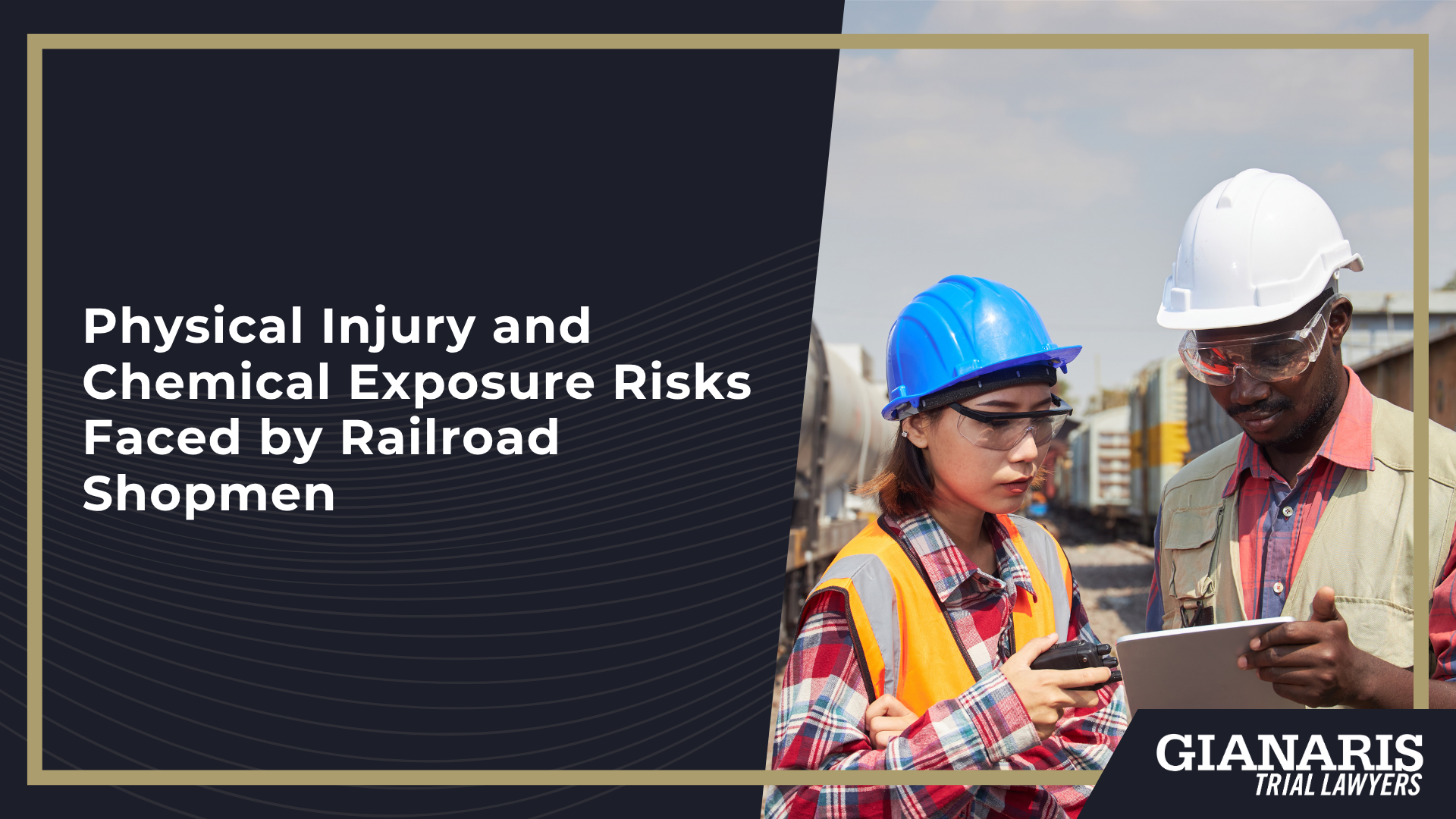
Railroad shopmen are tasked with maintaining the backbone of rail operations (locomotives, cars, tools, and infrastructure) often working under intense conditions in repair shops, rail yards, and industrial settings.

This type of railroad work is hands-on, mechanical, and physically demanding, requiring close interaction with heavy equipment, powerful tools, and complex systems like heating systems and braking components.

Whether repairing damaged railcars or rebuilding parts used in track maintenance, shopmen are constantly exposed to conditions that pose both immediate physical dangers and long-term health risks.

From uneven surfaces and confined spaces to loud machinery and airborne particles, the work environment can be unpredictable and unforgiving.

Many tasks involve grinding, welding, sanding, and cutting: processes that expose workers to fumes, dust, and other toxins that are often invisible but harmful over time.

Workplace exposures may build up over years before symptoms appear, making early detection and prevention especially difficult for many workers in these roles.
Physical Injury and Chemical Exposure Risks Faced by Railroad Shopmen

In addition to general shop duties, some shopmen also work as sheet metal workers, machinists, or mechanics, each role carrying its own unique risks.

Gianaris Trial Lawyers understands the daily responsibilities and pressure placed on shopmen, and how those responsibilities can lead to injury or illness when safety protocols fail.

We know that the railroad industry relies on the skill and endurance of its shop workforce, and we also know how often those workers are left unprotected by the companies they serve.

When those protections fall short, we stand ready to fight for accountability and fair compensation.

Physical Injury Risks for Railroad Shopmen

The physical demands placed on railroad shopmen make them especially vulnerable to a wide range of serious injuries.

Many shop-related accidents result in health issues that can cause permanent disability, require long-term care, or even require surgery. Heavy machinery, sharp tools, poor lighting, and fast-paced environments create the perfect storm for catastrophic incidents.

Rail companies are responsible for maintaining a safe work environment, yet injured workers often face the consequences of poor oversight, malfunctioning equipment, or rushed procedures.

Over time, repeated strain and unsafe conditions can lead to debilitating conditions such as back injuries, hearing loss, and chronic pain.

Gianaris Trial Lawyers is experienced in handling injury claims involving both sudden trauma and long-developing complications linked to unsafe shop environments.
Physical Injury and Chemical Exposure Risks Faced by Railroad Shopmen; Physical Injury Risks for Railroad Shopmen

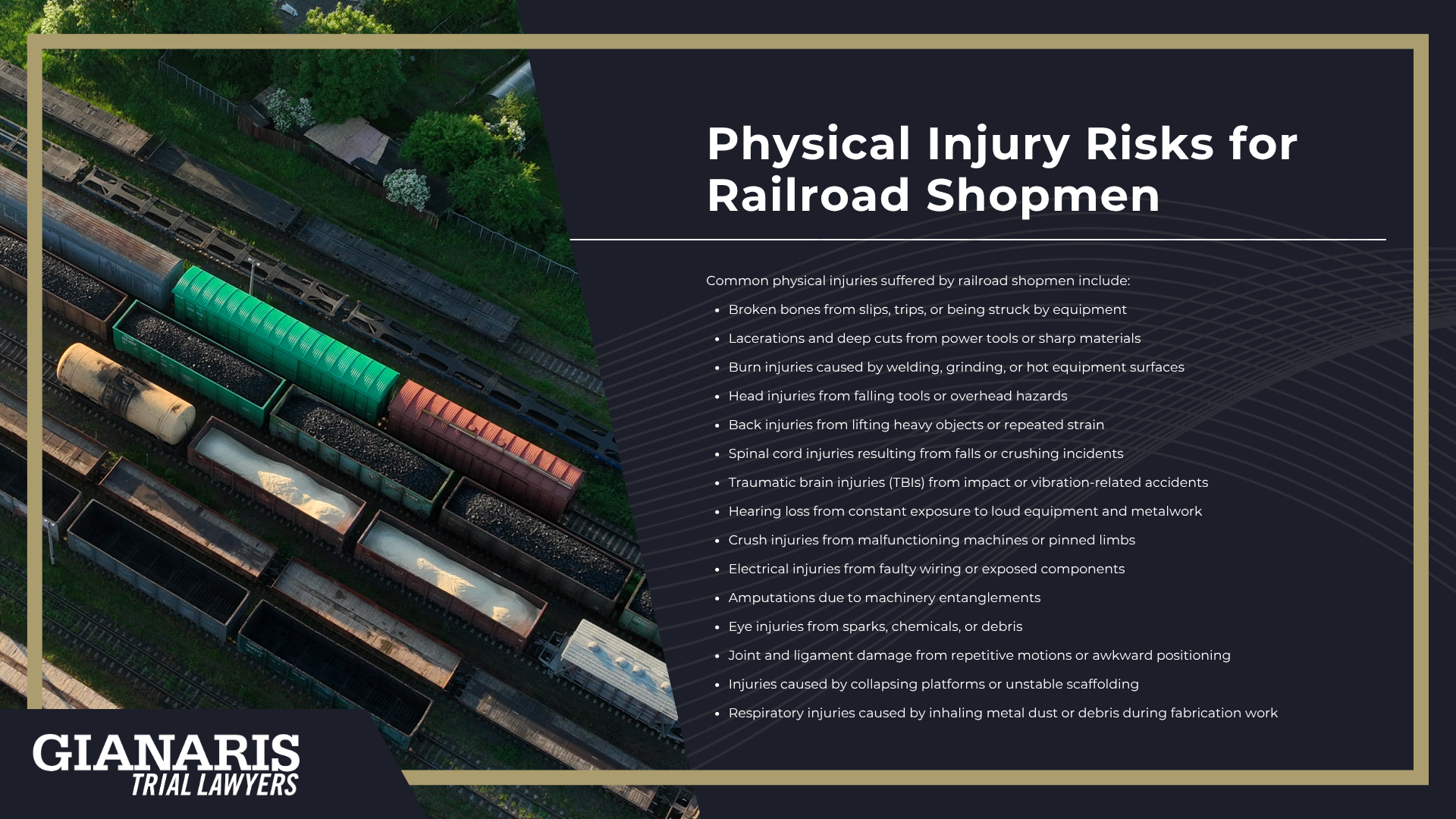
Common physical injuries suffered by railroad shopmen include:

  • Broken bones from slips, trips, or being struck by equipment
  • Lacerations and deep cuts from power tools or sharp materials
  • Burn injuries caused by welding, grinding, or hot equipment surfaces
  • Head injuries from falling tools or overhead hazards
  • Back injuries from lifting heavy objects or repeated strain
  • Spinal cord injuries resulting from falls or crushing incidents
  • Traumatic brain injuries (TBIs) from impact or vibration-related accidents
  • Hearing loss from constant exposure to loud equipment and metalwork
  • Crush injuries from malfunctioning machines or pinned limbs
  • Electrical injuries from faulty wiring or exposed components
  • Amputations due to machinery entanglements
  • Eye injuries from sparks, chemicals, or debris
  • Joint and ligament damage from repetitive motions or awkward positioning
  • Injuries caused by collapsing platforms or unstable scaffolding
  • Respiratory injuries caused by inhaling metal dust or debris during fabrication work

Chemical Exposure Risks for Railroad Shopmen

Railroad shopmen often work in enclosed or poorly ventilated environments where occupational exposure to toxic chemicals is a daily part of the job.

Over time, long-term exposure to diesel byproducts, solvents, and industrial materials can lead to serious health complications, including various cancers and chronic respiratory diseases.

Tasks like repairing running locomotives, cutting metal, or maintaining railroad tracks and railroad ties often involve contact with diesel fuel, benzene exposure, metal dust, and other carcinogens that have been linked to deadly outcomes.

Inhaling diesel fumes, grinding rust, or handling asbestos-containing parts can cause lasting damage to the lungs, skin, and internal organs.

The Federal Railroad Administration has recognized that diesel exposure, asbestos exposure, and other hazardous shop conditions are major contributors to railroad-related illnesses.

Shopmen may develop lung cancer, chronic bronchitis, or unexplained respiratory irritation, often years after the exposure began.

In some cases, workers suffer chemical burns from leaking fluids or direct contact with degreasers and industrial solvents.

Exposure is often cumulative, with symptoms appearing slowly, making it difficult to immediately link cancer diagnosis or other illnesses to workplace conditions without legal and medical support.
Physical Injury and Chemical Exposure Risks Faced by Railroad Shopmen; Physical Injury Risks for Railroad Shopmen; Chemical Exposure Risks for Railroad Shopmen

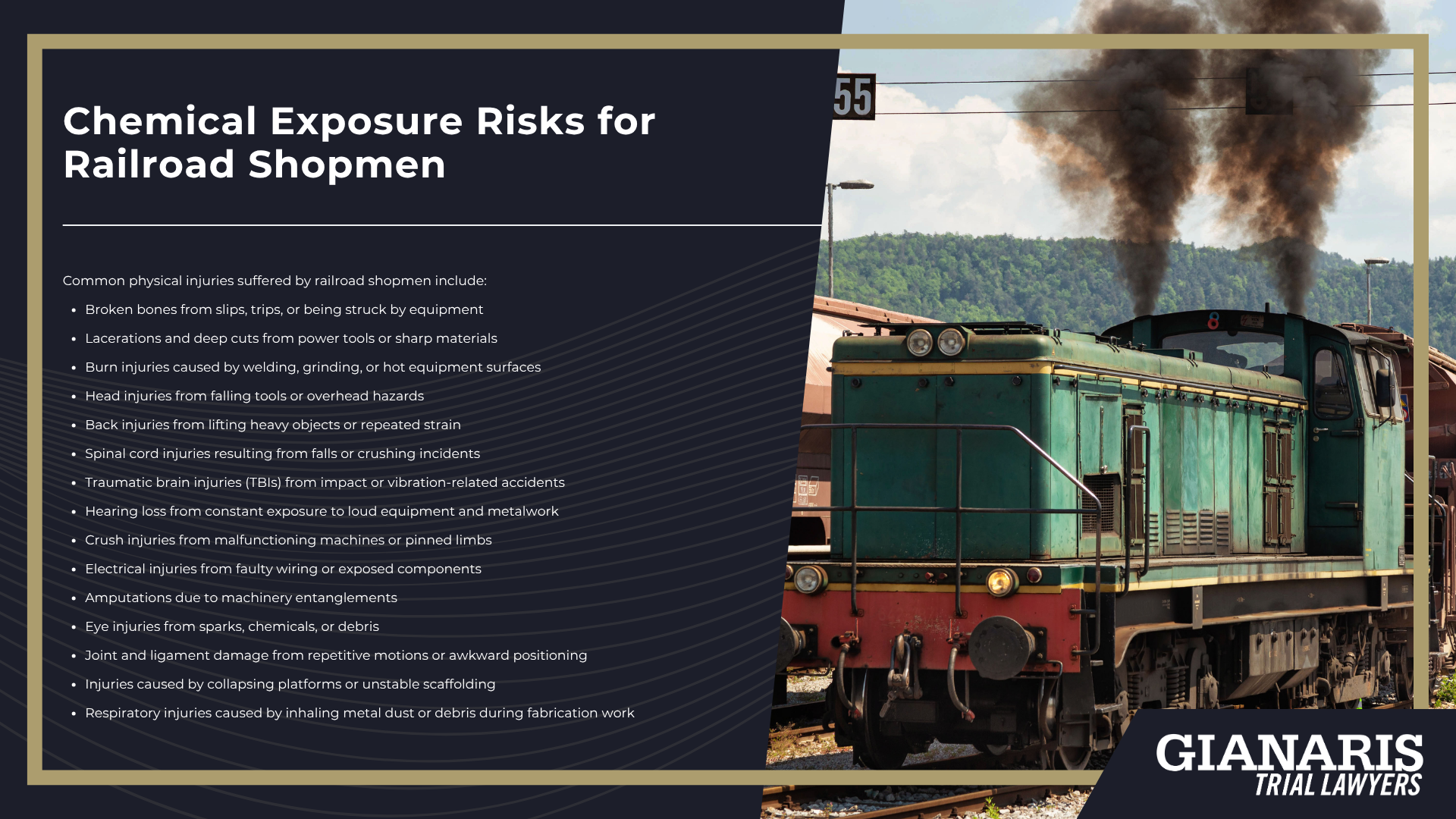
Common chemical exposure risks for railroad shopmen include:

  • Diesel exhaust exposure from working near idling or running locomotives
  • Benzene exposure through cleaning agents, solvents, and degreasers
  • Asbestos exposure from brake pads, insulation, and older engine components
  • Prolonged contact with diesel fuel during repair or fueling operations
  • Inhalation of welding fumes containing heavy metals and toxic gases
  • Exposure to hazardous materials stored or spilled in shop areas
  • Skin contact with solvents, oils, and lubricants causing chemical burns
  • Inhalation of silica dust from grinding or cutting components
  • Repeated contact with pesticides or herbicides used on railroad ties
  • Inhalation of toxic fumes during paint stripping or rust removal processes
  • Exposure to metal dust and airborne particles from fabrication tasks
  • Contact with degreasers and coolants without proper PPE
  • Airborne insulation fibers from engine compartments and piping systems
  • Contact with industrial adhesives or sealants containing VOCs
  • Residual chemical exposure from contaminated work surfaces or equipment

These exposures may result in delayed but life-altering health conditions, and Gianaris Trial Lawyers has the experience to connect those exposures to the employer’s failure to protect its workers.

How Do FELA Claims Allow Injured Railroad Workers to Seek Fair Compensation?

The Federal Employers Liability Act (FELA) was created to give injured railroad workers a legal path to hold their employers accountable when negligence leads to injury or illness.

Unlike workers’ compensation, FELA requires the worker to prove fault.

But it also allows for more complete recovery, including pain and suffering, lost wages, and long-term medical costs.

Whether the harm stems from train accidents, toxic chemical exposure, or unsafe job conditions,

FELA empowers workers to assert their legal rights in court. Cases involving crude oil, asbestos insulation, or prolonged contact with industrial solvents often involve severe and permanent health effects.

In many FELA claims, the damages reflect not just immediate costs, but also lost life expectancy and long-term care needs.

Workers can recover significant compensation, especially when their condition limits their ability to work or impacts their family life.

FELA also allows for legal claims against other parties who contributed to the dangerous conditions, such as third-party contractors or manufacturers of defective equipment.

Physical Injury and Chemical Exposure Risks Faced by Railroad Shopmen; Physical Injury Risks for Railroad Shopmen; Chemical Exposure Risks for Railroad Shopmen; How Do FELA Claims Allow Injured Railroad Workers to Seek Fair Compensation

Because railroads often push back hard on these claims, it’s crucial to work with experienced attorneys who understand the evidence needed to prove causation and liability.

Gianaris Trial Lawyers has a strong track record in these complex cases and can help workers through each stage of the legal process.

Filing a FELA claim is not just about recovering money.

It’s about asserting your right to safety and accountability in a hazardous industry.

Gathering Evidence for a Railroad Injury or Exposure Claim

In railroad injury cases, strong evidence can make the difference between a denied claim and a successful recovery.

At Gianaris Trial Lawyers, our law firm works closely with injured railroaders to gather, retain, organize, and present the documentation needed to prove liability and damages under FELA.

We provide strategic legal counsel and manage the whole process, from the initial investigation to expert reports and trial preparation.

With extensive experience in railroad litigation, our team knows how to uncover key facts, locate critical witnesses, and connect work-related conditions to medical outcomes.

Physical Injury and Chemical Exposure Risks Faced by Railroad Shopmen; Physical Injury Risks for Railroad Shopmen; Chemical Exposure Risks for Railroad Shopmen; How Do FELA Claims Allow Injured Railroad Workers to Seek Fair Compensation; Gathering Evidence for a Railroad Injury or Exposure Claim

Evidence in a FELA claim may include:

  • Medical records showing diagnosis, treatment, and long-term prognosis
  • Job history and employment records detailing duties and locations
  • Safety inspection reports and maintenance logs
  • Incident or accident reports filed with the railroad
  • Statements or testimony from coworkers and witnesses
  • Photographs or video evidence of the scene or equipment
  • Material Safety Data Sheets (MSDS) for chemicals used
  • Documentation of exposure to toxic substances
  • Records of safety violations or previous similar incidents
  • Expert analysis linking the injury or illness to working conditions
  • Personal notes, journals, or calendars documenting symptoms or incidents

Damages in FELA Lawsuits

Accurately assessing damages is one of the most important parts of any FELA lawsuit, especially when injuries or illnesses result in long-term physical, emotional, or financial harm.

A comprehensive damage evaluation allows your railroad injury lawyer to pursue fair compensation that reflects the true cost of your suffering and losses.

At Gianaris Trial Lawyers, we work closely with medical experts, economists, and our clients to ensure no aspect of a claim is undervalued or overlooked.

Whether the injury was immediate or developed over years of exposure, we build a complete damages profile to support the strongest possible case.

Physical Injury and Chemical Exposure Risks Faced by Railroad Shopmen; Physical Injury Risks for Railroad Shopmen; Chemical Exposure Risks for Railroad Shopmen; How Do FELA Claims Allow Injured Railroad Workers to Seek Fair Compensation; Gathering Evidence for a Railroad Injury or Exposure Claim; Damages in FELA Lawsuits

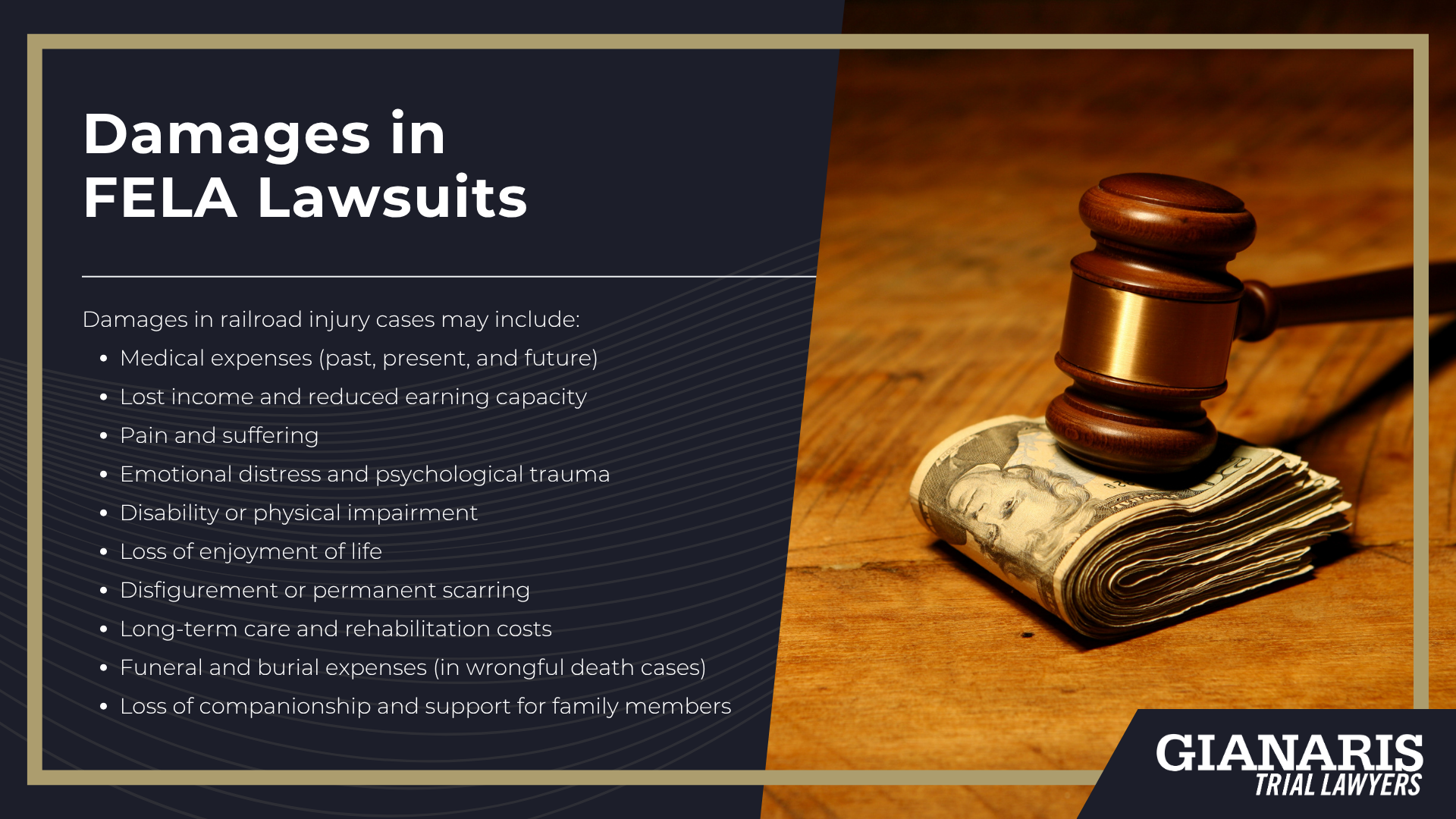
Damages in railroad injury cases may include:

  • Medical expenses (past, present, and future)
  • Lost income and reduced earning capacity
  • Pain and suffering
  • Emotional distress and psychological trauma
  • Disability or physical impairment
  • Loss of enjoyment of life
  • Disfigurement or permanent scarring
  • Long-term care and rehabilitation costs
  • Funeral and burial expenses (in wrongful death cases)
  • Loss of companionship and support for family members

Gianaris Trial Lawyers: Representing Injured Railroad Workers

At Gianaris Trial Lawyers, we understand the physical risks, long-term health consequences, and financial strain that come with a serious railroad injury or illness.

Our legal team is committed to holding railroad employers accountable and helping injured workers pursue the justice they deserve under FELA.

With decades of experience, a deep understanding of railroad operations, and a proven record of results, we fight tirelessly for those who’ve been harmed by unsafe working conditions.

Our client testimonials speak for themselves, reflecting the care, precision, and dedication we bring to every case.

Physical Injury and Chemical Exposure Risks Faced by Railroad Shopmen; Physical Injury Risks for Railroad Shopmen; Chemical Exposure Risks for Railroad Shopmen; How Do FELA Claims Allow Injured Railroad Workers to Seek Fair Compensation; Gathering Evidence for a Railroad Injury or Exposure Claim; Damages in FELA Lawsuits; Gianaris Trial Lawyers_ Representing Injured Railroad Workers

If you or a loved one has suffered a railroad injury or illness, contact Gianaris Trial Lawyers today for a free, confidential consultation.

You can also use the chat feature on this page to find out if you qualify for a railroad injury lawsuit instantly.

Frequently Asked Questions

Published by:
Share
Picture of Ted Gianaris
Ted Gianaris

With nearly 30 years of legal experience, Attorney Ted Gianaris has secured over $350 million in compensation for Illinois injury victims, car accident victims, and surviving family members of wrongful death victims.

This article has been written and reviewed for legal accuracy and clarity by the team of writers and attorneys at Gianaris Trial Lawyers and is as accurate as possible. This content should not be taken as legal advice from an attorney. If you would like to learn more about our owner and experienced Illinois injury lawyer, Ted Gianaris, you can do so here.

Gianaris Trial Lawyers does everything possible to make sure the information in this article is up to date and accurate. If you need specific legal advice about your case, contact us. This article should not be taken as advice from an attorney.

Other Railroad Employees at Risk Resources
All
FAQs
Injuries & Conditions
Legal Help
Occupations
Settlements & Compensation
You can learn more about Railroad Employees at Risk below:
Railroad Brakeman Injury Risks
Railroad Carman Injury Risks
Railroad Conductor Injury Risks
Railroad Electrician Injury Risks
Railroad Employees at Risk of Injury & Chemical Exposure
Railroad Equipment Operator Injury Risks
Railroad Locomotive Engineer Injury Risks
Railroad Machinist Injury Risks
Railroad Pipefitter Injury Risks
Railroad Signal Maintainer Injury Risks
Railroad Track Engineer Injury Risks
Railroad Trackman Injury Risks
Railroad Welder Injury Risks

Other Railroad Employees at Risk Resources

All
FAQs
Injuries & Conditions
Legal Help
Occupations
Settlements & Compensation