
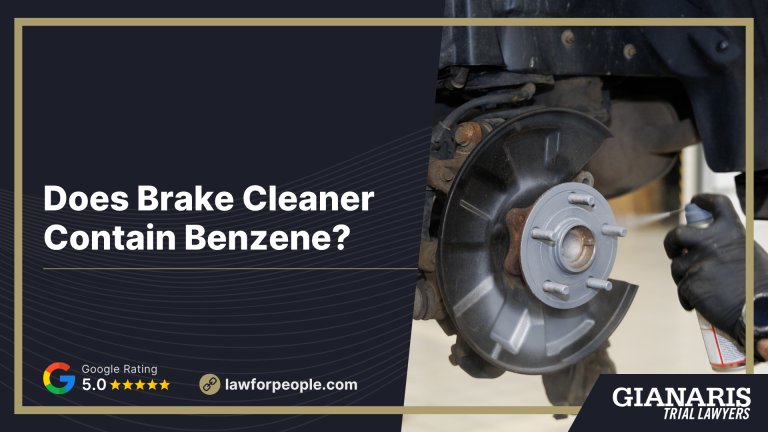
Some brake cleaner products and historical formulations have contained benzene, disclosed benzene, or referenced benzene in regulatory or Safety Data Sheet (SDS) materials, but that does not mean every brake cleaner contains benzene.
Brake cleaner is a broad product category with different chemical formulas that vary by manufacturer, product line, chlorinated versus non-chlorinated formulation, and time period.
Many brake cleaners are built around other solvent systems instead, including perchloroethylene (PCE), acetone, methanol, heptane, petroleum distillates, toluene, xylene, and related hydrocarbons.
The key question in a potential occupational exposure analysis is whether the specific product used during the relevant time period can be connected to benzene through SDS records, product disclosures, regulatory filings, laboratory testing, or other product-identification evidence.
That distinction matters because benzene is a well-established human carcinogen.
The International Agency for Research on Cancer (IARC) classifies benzene as carcinogenic to humans, while the National Toxicology Program classifies benzene as a known human carcinogen.
The Centers for Disease Control and Prevention also identifies benzene as a chemical capable of damaging bone marrow and affecting blood cell production.
Long-term benzene exposure has been associated most strongly with acute myeloid leukemia (AML), though public health agencies and scientific literature have also evaluated associations involving other blood cancers and blood disorders.
In brake cleaner cases, the exposure review usually focuses on repeated workplace use, especially in enclosed or poorly ventilated areas where inhalation exposure to aerosolized solvents may be higher.
Product identity, frequency of use, ventilation conditions, protective equipment, and the worker’s broader occupational exposure history are often central to evaluating whether benzene exposure can be documented in a medically and factually supportable way.
Why the Answer Depends on the Brand, Formula, and Time Period
Two brake cleaners can look similar on a shelf but contain very different chemicals.
The name “brake cleaner” describes the use of the product, not the solvent formula inside the can.
Manufacturers design these products to remove oil, grease, brake dust, and residue, and they may use different solvent systems to achieve that result.
Several details can change the answer:
- Brand: Different manufacturers use different solvent blends, warning language, suppliers, and product lines.
- Product type: Chlorinated and non-chlorinated brake cleaners often rely on different chemical families.
- Product code or SKU: A brand may sell multiple brake cleaners with similar names but different formulas.
- Aerosol versus bulk product: Spray products can create inhalation exposure conditions that differ from liquid products applied by wiping or soaking.
- State-specific formulas: VOC rules and state regulations can lead to different versions of the same product being sold in different places.
- Time period: A brake cleaner used decades ago may not match the version sold today.
- SDS date: A current Safety Data Sheet may not reflect the formulation used during the worker’s actual years of exposure.
- Trace impurities: Benzene may appear as a trace contaminant or petroleum-related impurity even when it is not the main solvent.
This is why a reliable review starts with the exact can, not the general product category.
The most useful evidence includes the brand name, product code, old container, label photographs, purchase records, workplace chemical inventory, and the SDS version from the relevant time period.
Use conditions also matter.
A mechanic who sprayed brake cleaner daily inside a poorly ventilated service bay may have a different exposure profile than someone who used the product occasionally outdoors.
The analysis should account for how often the product was used, whether it was aerosolized, whether vapors accumulated, whether skin contact occurred, and what protective equipment or ventilation was available.