
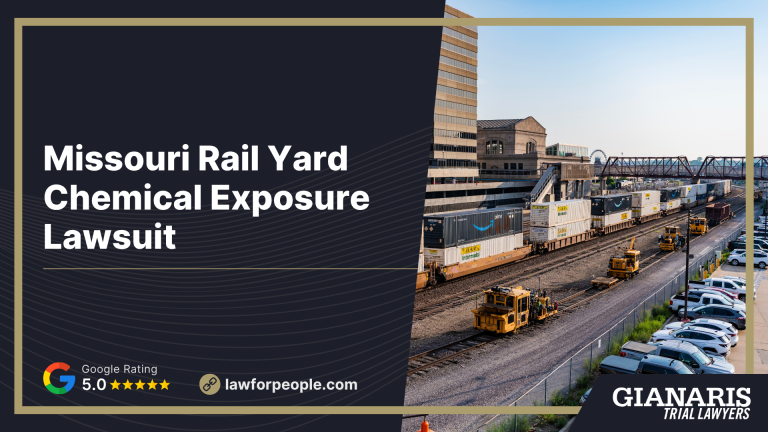
Missouri’s rail system includes freight yards, intermodal terminals, switching yards, passenger terminals, maintenance shops, service tracks, and corridor-support operations.
MoDOT reports that Missouri has about 3,800 miles of track, 2,500 miles of yard track, and 20 freight railroads operating in the state.
Kansas City and St. Louis are major national rail transportation centers.
Different facility types can create different exposure conditions.
A worker assigned to a locomotive service area may have a different exposure profile than a worker in a car shop, intermodal terminal, switching yard, or track maintenance crew.
For FELA claims, the focus is not the facility type alone.
The claim usually turns on the worker’s actual duties, the hazards present, the railroad’s safety practices, and whether the exposure history is consistent with the diagnosis.
Major Missouri Railroad Locations
Missouri railroad exposure claims do not arise from one yard or one carrier, but from a statewide network anchored by the Kansas City and St. Louis rail hubs.
MoDOT describes both cities as top national rail centers, which helps explain why rail activity is distributed across multiple kinds of sites rather than concentrated in one place.
For injured railroad employees, these locations matter because the exposure profile in an intermodal yard can differ from a diesel-heavy switching yard or a shop environment, and that can affect how railroad cancer claims are evaluated.
Major Missouri railroad locations and facility examples include:
- Kansas City rail hub (MO side): A major rail center where multiple carriers converge and where terminal operations are coordinated through systems like the Kansas City Terminal Railway.
- NS Kansas City Intermodal Terminal (Voltz Yard), Kansas City, MO: The Mid-America Freight Coalition notes the Kansas City intermodal terminal is also referred to as Voltz Yard.
- Union Pacific Neff Yard Intermodal Terminal (NEF), Kansas City, MO: Mid-America Freight Coalition identifies UP’s Kansas City TOFC/COFC facility as the Neff Yard Intermodal Terminal.
- CPKC Knoche Yard, Kansas City, MO: CPKC identifies its U.S. Operations Center as located at Knoche Yard in Kansas City, Missouri.
- St. Louis rail hub (City of St. Louis): A major national rail center supporting freight and interchange activity across the region.
- Norfolk Southern Luther Intermodal Yard, City of St. Louis: The St. Louis Regional Freightway identifies the Luther Yard as an intermodal yard located in the City of St. Louis.
The practical point is that a cancer diagnosis (including lung cancer and other forms of railroad cancer) is typically assessed against a worker’s detailed job history and facility assignments, the duration and intensity of exposures, and what the railroad company did to reduce contact with dangerous substances.
This is why railroad cancer lawyers usually start with exposure records and medical documentation before discussing outcomes.