
No fees unless we win.
Get a free consultation
128 Reviews
5.0
★★★★★

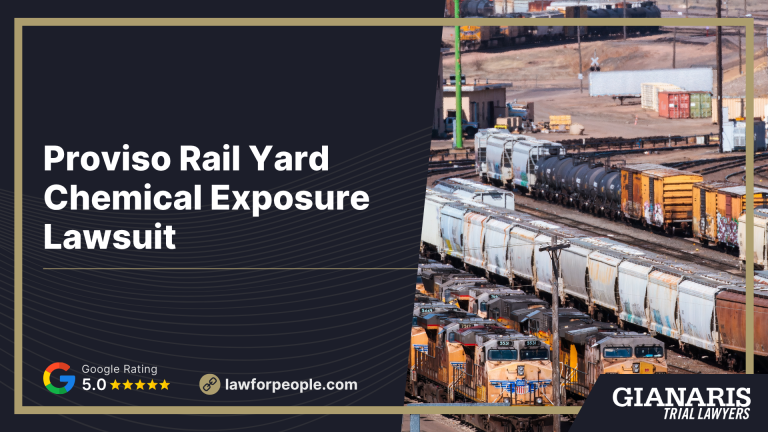
Proviso Rail Yard Chemical Exposure Lawsuit [2026 Investigation]

Were You Exposed to Toxic Substances at Proviso Yard? Contact Us

The Proviso Rail Yard Chemical Exposure Lawsuit investigation focuses on whether years of work in this freight-yard environment may have contributed to cancer, lung disease, and other serious illnesses in railroad employees.

Workers at Proviso Yard may have been exposed to diesel exhaust, fuel-related chemicals, solvents, asbestos-containing materials, and other industrial substances associated with switching, locomotive, repair, and yard operations.

Long-term exposure to these substances has been linked to lung cancer, respiratory injury, blood disorders, and other serious health conditions.

Gianaris Trial Lawyers is reviewing potential claims for current and former railroad workers, as well as families of deceased workers, who believe occupational chemical exposure at Proviso Yard contributed to a serious diagnosis or wrongful death.

Proviso Rail Yard Chemical Exposure Lawsuit

Workplace Exposures at Proviso Yard May Be Linked to Cancer and Other Serious Health Problems

Proviso Yard is a major freight rail facility in the Chicago area, long associated with switching operations, locomotive activity, railcar handling, and other heavy railroad work tied to a large terminal environment.

Railroad employees spent years working around yard tracks, locomotives, repair areas, and other active parts of the property.

Unlike an enclosed passenger terminal, Proviso presents a freight-yard exposure setting shaped by diesel-powered equipment, constant yard movement, fuels, solvents, welding activity, and older railroad materials.

Workers at Proviso may have faced repeated occupational exposure to diesel exhaust, benzene-containing petroleum products, degreasers, lubricants, asbestos-containing materials, welding fumes, and other substances used or generated in railroad operations.

In some cases, those exposures may become relevant when current or former railroad employees are later diagnosed with lung cancer, leukemia, lymphoma, mesothelioma, or other serious illness raised in railroad toxic-exposure litigation.

Cases like these reflect the day-to-day realities of yard work: where the employee worked, what duties they performed, what substances were present, and whether the railroad used adequate warnings, protective measures, monitoring, or safer work practices.

The Federal Employers’ Liability Act, or FELA, allows railroad employees to pursue claims when employer negligence played a part in causing occupational disease.

Gianaris Trial Lawyers is investigating potential claims involving Proviso Yard and the broader work environment surrounding long-term freight-yard operations.

Those matters may involve current or former railroad employees, as well as families seeking answers after a serious diagnosis or death following years of railroad work.

If you or a loved one worked at Proviso Yard, later developed cancer or another serious illness, and believe occupational exposure may be involved, you may have grounds to pursue a FELA lawsuit.

Gianaris Trial Lawyers is reviewing Proviso rail yard chemical exposure lawsuit claims and other cases involving toxic exposure in railroad workplaces.

Contact us today, or use the chat feature on this page to get in touch with our FELA attorneys.

Proviso Rail Yard Overview: History, Railroad Companies, and More

Proviso Yard is a major freight rail complex in Melrose Park, just west of Chicago, and it has remained an important part of the region’s rail network for decades.

The yard developed during the Chicago & North Western era and remained an important freight property after Union Pacific took control of Chicago & North Western in 1995.

Its role in the Chicago rail network did not end with that transition.

Proviso has remained an active freight site tied to terminal operations, locomotive activity, railcar movement, and nearby intermodal traffic.

Historic records show Proviso operating as a large classification yard with substantial railroad infrastructure, including locomotive and freight-handling facilities.

More recent rail improvements around the yard were designed to increase train capacity and routing flexibility, which reflects the yard’s continued operational importance rather than a decline in use.

Global II, Union Pacific’s nearby intermodal facility, is part of that broader Proviso terminal environment.

That history gives useful context for exposure claims involving long-term railroad work.

Proviso was not a brief-stop commuter setting.

It was a working freight yard where employees could spend years around locomotives, switching operations, railcars, repair activity, fuels, and other industrial conditions tied to terminal service.

Depending on the job, that environment may have involved repeated contact with diesel exhaust, welding fumes, solvents, dust, and other substances generated by railroad operations over time.

For workers who later developed cancer or another serious illness, the central questions usually involve where they worked, what duties they performed, what conditions were present in those work areas, and whether the railroad used adequate warnings, monitoring, protective measures, or safer work practices.

History of Proviso Rail Yard

Proviso Yard has been part of Chicago-area freight rail operations for decades.

Its history reflects continuous use as a working freight property tied to classification activity, locomotive facilities, railcar movement, and, more recently, adjacent intermodal operations connected to the broader Proviso Terminal.

Historic records and modern rail-planning materials both show that Proviso remained an active part of the Chicago freight network rather than a short-lived or obsolete yard.

A timeline of the history of Proviso rail yard:

  • 1929: Proviso Yard opened as a Chicago & North Western facility in Melrose Park and became one of the railroad’s landmark freight properties.
  • 1942–1943: Proviso was operating as a major classification yard with hump service, a roundhouse, coal and freight infrastructure, and extensive yard operations.
  • 1960: Proviso remained part of the Chicago & North Western Chicago Terminal Division.
  • 1995: Union Pacific Railroad completed its acquisition of Chicago & North Western, bringing Proviso into the UP system.
  • 2017: Union Pacific described Proviso as part of a massive Chicago-area terminal environment that includes Global II.
  • 2018: Union Pacific shut down the hump at Proviso and shifted operations away from traditional hump classification there.
  • 2020s: CREATE and Union Pacific projects around Proviso increased capacity and routing flexibility for trains moving through the western Chicago terminal.

What Railroad Companies Have Operated at Proviso Rail Yard?

Proviso Yard developed as a Chicago & North Western freight property in Melrose Park and remained part of that railroad’s Chicago terminal operations through much of the twentieth century.

Historic records from the 1940s and 1960 show Proviso operating under Chicago & North Western as a major classification yard with extensive freight infrastructure.

After Union Pacific acquired Chicago & North Western in 1995, Proviso became part of Union Pacific’s Chicago-area network and has remained tied to active freight and terminal operations into the modern era.


What Kind of Railroad Work Has Taken Place at Proviso Rail Yard?

Proviso Yard has long functioned as a freight-rail worksite within Union Pacific’s Chicago terminal environment.

The yard developed as a classification property tied to train movement, car handling, locomotive activity, and terminal operations, and that role continued into the Union Pacific era.

Nearby Global II adds intermodal traffic and container-related operations to the broader Proviso setting.

Types of work at Proviso Yard include:

  • Freight Switching and Yard Operations: Proviso developed as a classification yard, and freight movement remained central to its function. Yard crews may have spent shifts breaking down incoming trains, building outbound trains, moving railcars through the property, lining switches, and working around active tracks and locomotives.
  • Locomotive Servicing and Mechanical Work: Proviso has also been tied to locomotive and mechanical activity for decades. Historic records show roundhouse operations at the yard, and Union Pacific identifies the Proviso Locomotive Shop as part of its Illinois operations. Work in those settings may include inspection, repair, servicing, and other mechanical duties performed in and around active railroad equipment.
  • Intermodal and Rail Support Activity: The broader Proviso terminal environment includes Global II, an intermodal facility adjacent to Proviso Yard. That setting adds container-handling and terminal-support activity to the surrounding work environment and shows that Proviso was part of a larger freight complex rather than a standalone yard.

Chemical Exposure Risks at Proviso Yard: Overview

Proviso Yard has operated as a freight and locomotive environment where a range of industrial substances may have been present as part of daily railroad work.

The site is best understood as a working rail yard shaped by running locomotives, fuel use, mechanical activity, and continuous freight movement.

In that setting, employees may have been regularly exposed to diesel-powered equipment, maintenance products, airborne particulates, and other byproducts associated with railroad operations.

Exposure conditions at a yard like Proviso are not uniform.

They depend on where a worker spent time, the type of work performed, and how often those duties placed them near active equipment or mechanical processes.

Over time, repeated contact with certain substances may contribute to long-term health concerns, including an increased risk of cancer diagnosis in some occupational settings.

Chemical exposure risks may include:

  • Diesel Exhaust and Locomotive Emissions: Diesel exhaust exposure is one of the most common conditions associated with railroad work. Running locomotives, yard engines, and other diesel-powered equipment generate exhaust that can remain present in work areas throughout the day. Workers assigned near active tracks or idling power may have been regularly exposed to diesel particulate matter over extended periods.
  • Fuel-Related Chemicals, Including Benzene: Rail yard operations involve fuels and petroleum-based products that can release chemical vapors during handling, storage, and use. Benzene, a component of many fuel-related substances, may be present in these environments. Workers who spent time around fueling activity or equipment maintenance may have encountered these exposures as part of routine work.
  • Solvents, Degreasers, and Maintenance Chemicals: Mechanical and maintenance work often involves the use of solvents, degreasers, lubricants, and other chemical products. These substances may be used during cleaning, inspection, and repair tasks. Repeated use in enclosed or high-activity areas can contribute to ongoing workplace exposure.
  • Welding Fumes and Mechanical Shop Exposure: Repair work involving welding, cutting, grinding, and metal fabrication can produce fumes, smoke, and fine particulate matter. Employees working in or around these activities may have been regularly exposed to airborne contaminants generated during equipment repair and maintenance.
  • Dust, Particulate Matter, and Industrial Byproducts: Freight-yard operations can generate dust and particulate matter from ballast, rail movement, braking systems, and general maintenance work. In some cases, workers may also have worked around railroad ties, creosote-treated materials, and other sources of industrial pollution associated with rail infrastructure. These conditions contribute to a work environment where airborne particles and residue may be present over long periods of time.

Railroad Jobs That May Have Involved Exposure at Proviso Rail Yard

The work performed at Proviso Yard was carried out by employees in many different crafts, and the type of exposure could vary from one job to another.

Some workers spent most of their time on active tracks, some worked directly on locomotives or railcars, and others performed repair, cleanup, and support duties in mechanical areas.

Railroad jobs potentially exposed include:

  • Conductors, Brakemen, and Switchmen: Conductors, brakemen, and switchmen often worked in the middle of yard operations. They lined switches, coupled and uncoupled cars, rode movements, and walked active tracks near idling or moving engines. In many railroad cases, these workers describe repeated exposure to diesel exhaust and other airborne contaminants during ordinary assignments.
  • Engineers and Hostlers: Engineers and hostlers worked even closer to locomotives. They often spent hours operating, moving, staging, or servicing engines in active terminal conditions. Some older units had long nose configurations, but the larger point is that these jobs placed employees close to engine emissions and fuel-related substances for extended periods.
  • Machinists, Electricians, and Carmen: Machinists, electricians, and carmen are among the railroad jobs most often associated with mechanical and repair-related exposure. These employees may have handled inspections, brake systems, electrical work, parts replacement, and repairs involving oils, solvents, gaskets, insulation, and, in older eras, asbestos and other known carcinogens.
  • Laborers, Welders, and Mechanical Workers: Laborers, welders, and other mechanical workers may have encountered some of the broadest industrial exposures in the yard. Their duties can involve cutting, grinding, torch work, shop cleanup, and contact with byproducts such as welding fumes, metal dust, silica dust, and chemical residues. These roles can be important in a later occupational claim because they often combine physical cleanup with repair support over many years.

Illnesses and Diseases Linked to Chemical Exposure in the Railroad Industry

Occupational exposure cases in the railroad industry often involve a familiar group of illnesses that appear in toxic-tort and FELA litigation.

These cases usually focus on whether long-term workplace exposure to diesel emissions, asbestos, solvents, fuels, or other known carcinogens may have contributed to a serious diagnosis.

Not every illness leads to the same kind of case, and not every worker’s history is the same.

In practice, the outcome often depends on the diagnosis, the worker’s medical history, the nature of the exposure evidence, and whether expert testimony supports a connection between the job and the condition.

These include:

  • Cancers: The cancers most commonly raised in railroad chemical-exposure litigation include lung cancer, mesothelioma, leukemia, lymphoma, non hodgkin’s lymphoma, multiple myeloma, bladder cancer, kidney cancer, liver cancer, and colon cancer. A worker who is later diagnosed with one of these illnesses may investigate whether occupational exposure to diesel emissions, benzene, asbestos, or other known carcinogens played a role.
  • Blood Disorders: Not every serious occupational illness is a solid-tumor cancer. Railroad exposure cases can also involve blood disorders and blood-related malignancies tied to benzene and similar toxic substances. These cases often require detailed medical analysis because immune-system effects, marrow involvement, and latency may not be obvious at the outset.
  • Chronic Respiratory Conditions: Railroad exposure cases can also involve chronic respiratory disease after years around diesel exhaust, shop emissions, and airborne particulates. Not every worker develops cancer, but long-term exposure to these conditions can still be relevant where a worker later develops serious breathing problems, impaired lung function, or another pulmonary condition. Those outcomes may affect long-term treatment, future work capacity, and even life expectancy, which is why they can still support a significant claim.

Do You Qualify for a FELA Claim for Chemical Exposure?

Railroad employees who develop occupational disease or other serious illnesses after years in a hazardous workplace often pursue relief under the Federal Employers’ Liability Act, or FELA.

Under the statute, a railroad may be held liable when an employee’s injury or illness results in whole or in part from the railroad’s negligence.

In practical terms, that means a worker does not have to show that the job was the only cause of the condition, but the worker still must prove that the railroad’s conduct played a role.

For a yard-specific page like Proviso, the real question is usually whether the worker’s diagnosis can be tied to years of harmful exposure during ordinary yard operations.

That can include work around diesel fumes, benzene, asbestos, maintenance chemicals, and other carcinogens associated with railroad equipment, shops, and repair activity.

Whether someone qualifies depends on the nature of the work, the length of time the person was present in those conditions, the medical proof, and the available evidence of railroad negligence.

Diesel exhaust is classified by IARC as carcinogenic to humans, benzene is linked by NCI to leukemia and related blood disorders, and OSHA states that asbestos exposure can cause lung disease, mesothelioma, and asbestosis.

How FELA Applies to Railroad Workers

FELA is the federal law that typically governs on-the-job injury and occupational-disease cases for railroad workers.

Unlike ordinary workers’ compensation systems, FELA is a negligence-based statute.

That means a railroad worker who later developed cancer or another serious condition after years in the railroad industry may bring a lawsuit against the railroad, but the plaintiff must still show negligent conduct by the employer.

Contributory negligence may reduce damages, but it does not automatically bar recovery.

That framework can apply whether the worker is still employed or retired, so long as the claim is timely and supported by evidence.

In practice, these cases often focus on whether the railroad failed to reduce known hazards, warn workers, monitor air quality, provide safer components or equipment, or take reasonable steps to protect employees from long-term workplace exposure.

Evidence in FELA Railroad Cancer Lawsuits

In most railroad cancer cases, it is not enough to show that a worker got sick.

The case usually requires evidence of both harmful exposure and railroad negligence.

Lawyers look at whether the worker was regularly around diesel fumes, benzene, asbestos, shop chemicals, or other conditions, and whether the railroad had the knowledge and ability to reduce those risks but failed to do so.

Medical records, work histories, and expert testimony are often central because these cases usually involve latency, multiple risk factors, and questions about causation.

Evidence in these cases may include:

  • Employment records showing where the worker was assigned, what yard or shop the worker served, and how long the work continued.
  • Testimony about daily duties involving locomotives, repair, switching, fueling, shop work, or time spent in a locomotive cab.
  • Medical records confirming the diagnosis, treatment history, and the date the worker was first diagnosed.
  • Industrial hygiene or medical expert testimony addressing diesel exhaust, benzene, asbestos, or other carcinogens.
  • Co-worker testimony describing visible smoke, dust, fumes, poor ventilation, or repeated exposure during normal operations.
  • Internal railroad documents, manuals, safety materials, or other proof showing what the railroad knew about the hazard and when it knew it.
  • Evidence about the worker’s symptoms, limits, and how the condition changed daily life and future work capacity.

Damages in Railroad Cancer Claims

Damages are the categories of loss a worker may seek in a FELA case.

In a railroad cancer claim, lawyers usually assess damages by reviewing the worker’s medical condition, treatment, wage history, expected future losses, and the effect the disease has had on daily life.

The goal is to identify the full harm tied to the illness, including both economic and non-economic loss.

The ultimate value of a case can vary widely depending on the diagnosis, the strength of liability proof, the worker’s age and work history, and whether the matter resolves through settlement or verdict.

Damages in these lawsuits may include:

  • Past and future medical expenses.
  • Lost wages and reduced future earning capacity.
  • Physical pain and suffering.
  • Mental and emotional distress tied to the disease and treatment.
  • Loss of normal enjoyment of life.
  • Out-of-pocket expenses connected to care, travel, and treatment.
  • In some cases, wrongful-death-related losses for surviving family members when the worker has died from the condition.

Gianaris Trial Lawyers: Investigating Chemical Exposure Claims at Proviso Yard

At Proviso Yard, the factual focus is usually on the worker’s actual job history and the broader freight-yard environment.

That includes time spent around locomotives, mechanical work, switching activity, and shop or maintenance conditions that may have involved diesel fumes, benzene, asbestos, and other hazardous substances.

A legal team investigating these claims would typically gather employment records, medical proof, co-worker evidence, and expert review to determine whether the railroad may be legally liable for the worker’s condition.

Gianaris Trial Lawyers is investigating chemical-exposure claims involving railroad workers who later developed cancer or other serious illnesses after years in freight-yard and mechanical environments.

If you or a family member worked in or around Proviso Rail Yard and later developed cancer, breathing problems, or another serious health condition, an experienced FELA attorney from Gianaris Trial Lawyers may be able to help.

An attorney can review your work history, medical records, and any available air-quality or safety information to determine whether a claim is worth pursuing.

There is no obligation to move forward, and speaking with a lawyer can help you understand your options for seeking accountability and potential compensation.

Frequently Asked Questions

  • Where is Proviso Rail Yard located?

    Proviso Yard is in Melrose Park, Illinois, west of downtown Chicago.

    Union Pacific describes the entrance to the yard as being about 18 miles west of downtown Chicago in Melrose Park, and public Illinois records place the facility on West Lake Street in Northlake/Melrose Park as part of the broader Proviso/Global 2 complex.

    Proviso Yard is a major Chicago-area freight yard in the near-west suburbs, not a downtown passenger terminal.

  • What railroad companies have operated at Proviso Yard?

    Proviso Yard was a Chicago & North Western yard.

    Library of Congress records identify it as “Chicago & North Western’s Proviso Yard” in the early 1940s, showing that it was already a major freight facility at that time.

    Today, it is operated by Union Pacific, which describes Proviso Terminal as a major Chicago freight operation that includes Proviso Yard and Global II.

  • What toxic chemicals might railroad workers be exposed to?

    Railroad workers in a freight-yard environment may be exposed to diesel exhaust, fuel-related chemicals such as benzene, asbestos, solvents, degreasers, welding fumes, and other airborne particulates depending on the job and era.

    IARC classifies diesel engine exhaust as carcinogenic to humans, the National Cancer Institute says benzene exposure may increase the risk of leukemia and other blood disorders, and OSHA and NCI both recognize serious health risks from asbestos exposure, including lung cancer and mesothelioma.

    The exact substances and level of exposure can vary based on whether a worker was assigned to switching, locomotive service, mechanical repair, railcar work, or intermodal operations.

  • Can railroad workers file a lawsuit for chemical exposure?

    Yes.

    Railroad workers typically bring occupational-disease claims under the Federal Employers’ Liability Act (FELA) rather than ordinary workers’ compensation systems.

    Under FELA, a railroad may be liable when an employee’s injury or illness results in whole or in part from the railroad’s negligence, so a worker who develops cancer or another serious disease after harmful workplace exposure may have a claim if the evidence supports both exposure and negligence.

Published by:
Share
Picture of Ted Gianaris
Ted Gianaris

With nearly 30 years of legal experience, Attorney Ted Gianaris has secured over $350 million in compensation for Illinois injury victims, car accident victims, and surviving family members of wrongful death victims.

This article has been written and reviewed for legal accuracy and clarity by the team of writers and attorneys at Gianaris Trial Lawyers and is as accurate as possible. This content should not be taken as legal advice from an attorney. If you would like to learn more about our owner and experienced Illinois injury lawyer, Ted Gianaris, you can do so here.

Gianaris Trial Lawyers does everything possible to make sure the information in this article is up to date and accurate. If you need specific legal advice about your case, contact us. This article should not be taken as advice from an attorney.

Additional Railyard Chemical Exposure Lawsuits resources on our website:
All
FAQs
Injuries & Conditions
Legal Help
Occupations
Settlements & Compensation
You can learn more about Railyard Chemical Exposure Lawsuits below:
54th Yard Chemical Exposure Lawsuit
Bedford Park Railyard Chemical Exposure Lawsuit
Bensenville Rail Yard Chemical Exposure Lawsuit
Chicago Union Station Chemical Exposure Lawsuit
Dupo Yard Chemical Exposure Lawsuit
Illinois Railyard Chemical Exposure Lawsuit
Madison Yard Chemical Exposure Lawsuit
Railyard Chemical Exposure Lawsuits
Rose Lake Yard Chemical Exposure Lawsuit

Other Railyard Chemical Exposure Lawsuits Resources

All
FAQs
Injuries & Conditions
Legal Help
Occupations
Settlements & Compensation