

No fees unless we win.
Get a free consultation
128 Reviews
5.0
★★★★★

FELA Claims for Railroad Crush Injuries

Overview for FELA Claims for Railroad Crush Accidents

The Federal Employers’ Liability Act (FELA) is a critical protection for railroad employees who suffer crush injuries on the job.

FELA allows injured workers to pursue compensation when a railroad’s negligence contributes to a crushing event, such as unsafe switching practices, inadequate lockout procedures, poor communication, defective equipment, missing safeguards, or rushed operations.

FELA requires carriers to provide a reasonably safe workplace, proper training, tools, and supervision.

Gianaris Trial Lawyers represents injured railroad workers and their families in FELA crush injury claims, building trial-ready cases to hold railroads accountable and pursue full, fair recovery.

FELA Claims for Railroad Crush Injuries

FELA Lawyers for Railroad Crush Accidents

Railroad crush injuries are among the most severe injuries a railroader can suffer, and they are never “routine.”

A crush injury can occur in seconds when a worker is pinned between railcars, caught in a coupling, trapped by shifting equipment, or pulled into a moving mechanism.

A crush injury is trauma caused by intense pressure that compresses the body and can lead to fractures, internal damage, nerve injury, or even limb loss.

Crush injuries are especially dangerous in rail yards and industrial settings because the forces involved are enormous and medical complications can develop quickly.

Under the Federal Employers Liability Act, injured railroad employees may pursue a FELA claim when the railroad’s negligence played any part in causing the incident.

A FELA lawyer can identify safety failures such as unsafe switching practices, poor communication, missing safeguards, defective equipment, or rushed operations that left workers exposed to crushing hazards.

Our lawyers investigate the circumstances of the event, review policies and training, and work with qualified experts to document the full medical and financial impact of the injury.

If the evidence supports it, we prepare the case for a lawsuit designed to hold the railroad accountable and seek full, fair compensation.

If you suffered railroad crush injuries, contact Gianaris Trial Lawyers today to speak with a FELA attorney about your options.

You can also use the chatbot on this page to see if you qualify immediately.

The History And Purpose Of The Federal Employers Liability Act (FELA)

The Federal Employers Liability Act was enacted to protect railroad workers in a demanding railroad industry where serious railroad accidents and preventable hazards were common.

Instead of limiting recovery to fixed benefits like workers compensation or workers comp, the law gives injured railroad workers the right to pursue damages when a railroad’s negligence contributes to an on the job injury.

In practice, FELA is both a compensation system and a safety pressure valve.

It makes railroad employers accountable for unsafe practices that injure railroad employees.

Today, FELA remains the backbone of many railroad injury cases, including devastating railroad crush injuries tied to unsafe switching, defective equipment, or missing safeguards.

You may also see it described as the employers liability act FELA, especially in older materials and summaries.

These are federal laws, and they apply regardless of the state where the injury occurred.

Who is Covered Under FELA?

FELA generally covers railroad employees who work for railroads engaged in interstate commerce, which includes many major carriers.

Coverage is based on employment and job duties, not job title, so train crews, yard workers, mechanical departments, track maintenance, and other roles in railroad work may qualify.

If you are an injured railroader hurt while performing your job, you may be eligible to bring FELA claims even if the railroad disputes fault.

Independent contractors are not automatically covered, and coverage questions can be fact-specific, especially when multiple companies are present at the site.

Benefits through the Railroad Retirement Board may be relevant to a worker’s overall situation, but they are not the same as pursuing a negligence-based FELA case.

Legal Requirements Under FELA

Under FELA, railroad employers must provide a reasonably safe workplace, which includes safe methods of work, adequate staffing and training, proper tools, and realistic operating practices.

The railroad’s duty extends to identifying hazards and addressing them before workers are hurt, especially hazards that create crushing risks during switching, coupling, braking, and movement of equipment.

Additional safety statutes can matter, including the Safety Appliance Act and the Locomotive Inspection Act, which set standards related to equipment conditions and safety features.

When those duties are ignored, the result can be catastrophic, including railroad crush injuries that change a worker’s life in seconds.

Proving that a railroad failed to follow safe procedures or maintain equipment can be a powerful part of a FELA case.

Proving Negligence and Establishing Liability

To win under the federal employers liability act, an injured worker must show that the railroad’s negligence played a role in causing the injury.

Negligence may involve unsafe switching practices, poor communication, lack of lockout procedures, missing safeguards, defective equipment, inadequate training, or a rushed work pace that predictably leads to injury.

Evidence in railroad injury cases often includes incident reports, photographs, inspection and maintenance records, safety rules, training materials, radio logs, video, and coworker statements.

In crush cases, timing and mechanics matter, so the investigation frequently focuses on where the worker was positioned, what moved, who controlled movement, and what the railroad knew about the risk.

An experienced lawyer can preserve evidence early and counter attempts to shift blame to the worker after the fact.

Strong proof is what turns a tragic railroad injury into a claim that forces accountability.

Damages and Recoverable Damages Under FELA

FELA allows injured workers to seek a broad range of damages, including past and future medical costs, lost wages, diminished earning capacity, and compensation for pain, suffering, and disability.

Crush injuries often require surgeries, rehabilitation, assistive devices, and long-term care, so damages must reflect both immediate expenses and future needs.

The goal is fair compensation that matches the real impact of the injury on work, independence, and long-term health.

While people sometimes talk about maximum compensation, there is no preset cap in the way many benefit systems operate.
Recovery depends on the strength of the evidence and the documented losses.

This is a key difference from workers compensation systems, which typically limit benefits and do not pay for the full range of human losses.

An experienced lawyer will also evaluate how benefits and reporting issues intersect with the worker’s broader financial picture, including what may be handled through the Railroad Retirement Board versus what must be proved in court.

FELA Statute of Limitations

Most FELA claims must be filed within three years of the date of the injury.

In crush injury cases, that clock usually starts on the day the accident occurred, which makes early action important.

Waiting can weaken the case because equipment gets repaired, conditions change, video gets overwritten, and witnesses become harder to track down.

If you believe you have a claim, speaking with a law firm that handles FELA lawsuits can help you confirm the deadline and preserve the evidence needed to move forward.

The sooner an investigation begins, the easier it is to protect the facts that prove what happened.
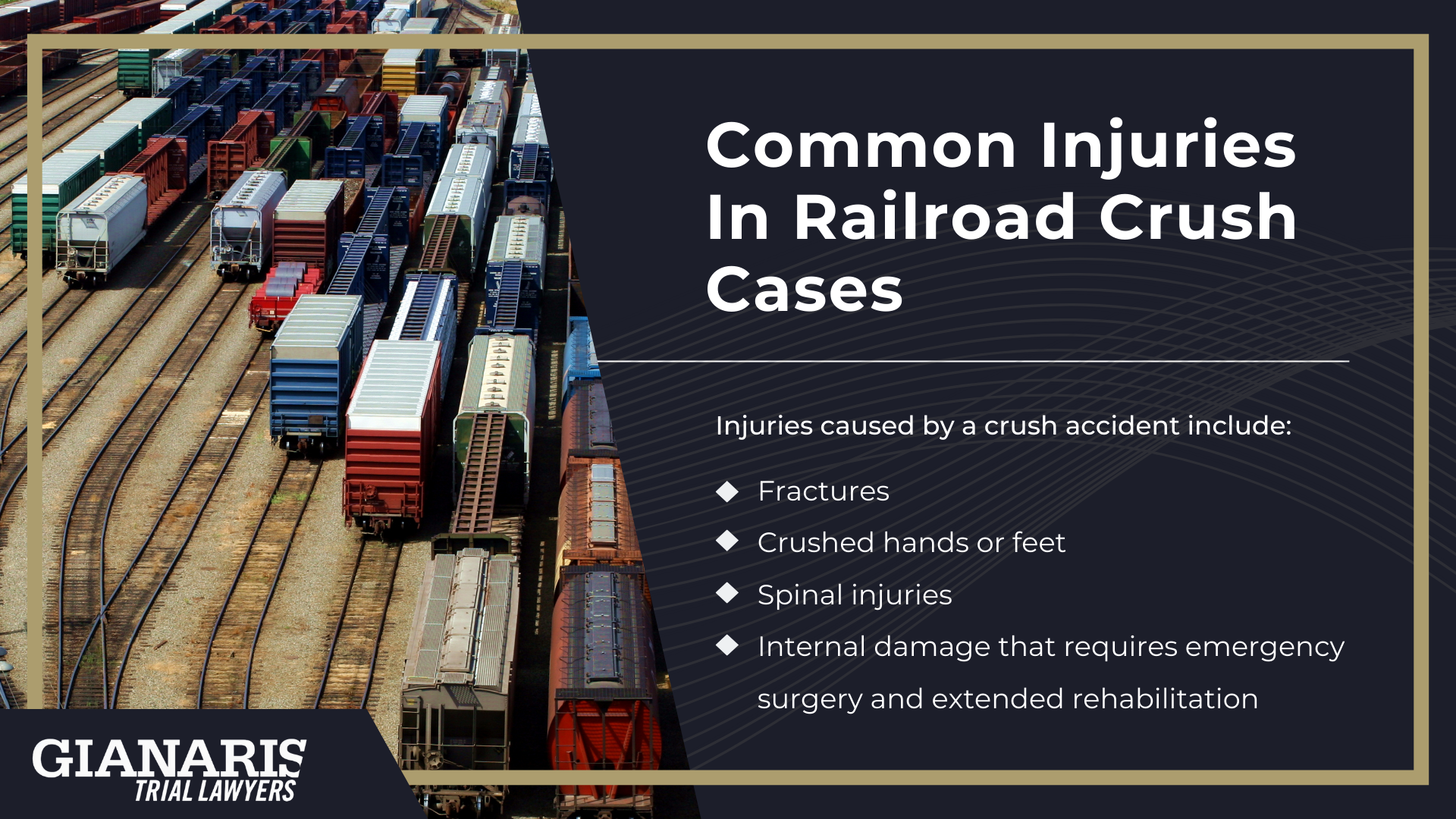
Common Injuries In Railroad Crush Cases

Railroad crush cases often involve severe trauma because the force of rail equipment can overwhelm the body in seconds.

Injuries caused by a crush accident include:

  • Fractures
  • Crushed hands or feet
  • Spinal injuries
  • Internal damage that requires emergency surgery and extended rehabilitation

A crush injury caused by pinning or entrapment can also trigger complications like nerve damage, loss of function, or tissue death, and those issues may not be fully apparent on day one.

These injuries commonly lead to prolonged time away from the job, lost wages, and difficult decisions about whether a worker can ever return to the same role.

That is why early documentation matters: clear medical records and a consistent timeline of symptoms often become the backbone of a FELA claim.

When a crush event results in death, a family member may have legal rights under law to pursue recovery on behalf of the family.

A railroad crush attorney can help identify the correct legal steps and preserve evidence before the railroad changes conditions or controls the narrative.

Physical Injuries Common in Railroad Crush Claims

Physical injuries in railroad crush claims often include crushing fractures, amputations, severe soft-tissue damage, and traumatic injuries to the back and neck.

Workers may also suffer internal bleeding or organ damage when the torso is compressed, along with long-term nerve injury that affects grip strength, mobility, or sensation.

In many cases, the injury is made worse by hazardous conditions like poor lighting, rushed switching, tight clearances, or limited escape routes around moving equipment.

Because these cases can be medically complex, thorough medical records help show not only the initial harm, but the long-term limitations, future care needs, and how the injury changed daily function.

A strong case also includes workplace proof: incident photos, equipment information, and witness statements from employees who saw what happened or knew the risk existed.

The goal is to present a clear, factual explanation of the accident and the lasting consequences, without letting the railroad minimize the severity of the injury.

Causes of Railroad Crush Accidents

Railroad crush accidents often happen when the railroad fails to control predictable hazards around moving equipment.

Common causes include:

  • Unsafe switching practices
  • Miscommunication between crew members
  • Defective couplers or braking systems
  • Missing safeguards
  • Procedures that prioritize speed over safety

Crush injuries also occur when workers are ordered to work in hazardous conditions, such as congested yards, poor footing, or inadequate lighting, where a small mistake can turn into a catastrophic accident.

In FELA cases, the key question is whether negligence by the employer played any part in the injury, even if the railroad argues the worker shares fault.

Some claims involve major carriers, such as Norfolk Southern, Union Pacific Railroad, and others, but the legal standard remains the same: if the railroad was negligent and that negligence contributed to the harm, the worker may be entitled to compensation.

Taking prompt legal steps can make a major difference, because evidence disappears quickly and early statements often shape the direction of the case.

A focused attorney can gather witness statements, secure records, and position the case to recover damages that support long-term financial security for the injured worker and their family.

Do You Qualify For a Railroad Crush Accident Lawsuit?

You may qualify if you were hurt in a railroad crush accident while working for a railroad and the company’s negligence contributed to what happened.

Crush incidents often involve moving equipment, tight clearances, rushed switching, or missing safeguards, and you don’t have to prove the railroad was “mostly” at fault, only that its negligence played a role.

If you suffered severe trauma, needed emergency treatment, or experienced complications like shock, that medical documentation can help show the true impact of the injury.

Your case may also involve ongoing suffering, long-term restrictions, or future medical costs that affect how you work and live.

A lawyer can evaluate the facts, explain what evidence is needed to prove your claim, and help you pursue the best possible outcome.

Gianaris Trial Lawyers: Assisting Injured Railroad Workers From Crush Accidents

Gianaris Trial Lawyers represents clients across the country who were hurt in serious railroad crush incidents and need a professional legal team to fight for accountability.

Our lawyers investigate the equipment involved, the safety procedures that were ignored, and the decisions the company made before the injury occurred.

We work to document the full impact of the trauma, including treatment needs, lost income, and the way the injury changed your life, so your claim reflects what you are truly entitled to recover.

If the railroad refuses to take responsibility, we prepare each case with a jury in mind, because leverage comes from being ready to prove the facts in court.

Our goal is a result that supports your recovery and protects your future, not an outcome that leaves you paying for someone else’s wrongdoing.

Contact Gianaris Trial Lawyers today to speak with a FELA attorney about your options.

You can also use the chatbot on this page to see if you qualify immediately.

Frequently Asked Questions

  • Does FELA Cover Railroad Crush Accidents?

    Yes.

    FELA can cover railroad crush accidents when you are a railroad employee and the railroad’s negligence played any part in causing the incident.

    That negligence may involve unsafe switching practices, poor communication, defective equipment, missing safeguards, or policies that rush work in a way that predictably puts people in danger.

    A FELA lawyer can review the facts and explain whether you have a viable claim based on what happened and who controlled the safety conditions.

  • What Should I Do After a Railroad Crush at work?

    Get emergency medical care immediately, even if adrenaline makes the injury feel manageable at first.

    Report the incident to your supervisor and make sure an accident report is created, then write down exactly what occurred while the details are still clear.

    If you can do so safely, document the scene with photos, identify witnesses, and preserve any relevant messages or radio communications.

    Before giving detailed recorded statements or signing paperwork, speak with a FELA attorney so your rights are protected from the start.

  • What Injuries Are Common in FELA Crush Claims?

    Crush injuries often include fractures, crushed hands or feet, severe soft-tissue damage, nerve injury, and back or neck trauma.

    Many workers also face complications like compartment syndrome, internal injuries, infections, or permanent loss of function that require surgery and long-term rehabilitation.

    These cases frequently involve extended time off work, significant medical care, and lasting limitations that affect both earning capacity and daily life.

    Early diagnosis and consistent treatment records are critical because crush injuries can worsen over time.

  • How Do You Prove Negligence in a FELA Crush Case?

    You prove negligence by showing the railroad failed to provide a reasonably safe workplace and that failure contributed to the crushing event.

    Evidence often includes maintenance and inspection records, safety rules, training materials, incident reports, photos or video, equipment condition documentation, and witness statements from coworkers who observed the hazard or the work practices.

    In crush cases, the timeline and mechanics matter, who controlled movement, what signals were given, what procedures were required, and what safeguards were missing.

    An experienced FELA lawyer builds the case early to preserve evidence before conditions change or the railroad controls the narrative.

  • How Long Do I Have to File a FELA Claim for a Crush Accident?

    In most cases, you have three years from the date of the crush accident to file a FELA claim.

    Waiting can make it harder to prove the case because equipment gets repaired, video footage is overwritten, and witnesses can be harder to locate.

    Starting early also helps ensure your medical records, wage loss documentation, and workplace evidence are collected while they are still available.

    A FELA attorney can confirm the deadline for your specific situation and help you take the right steps before time runs out.

Published by:
Share
Picture of Ted Gianaris
Ted Gianaris

With nearly 30 years of legal experience, Attorney Ted Gianaris has secured over $350 million in compensation for Illinois injury victims, car accident victims, and surviving family members of wrongful death victims.

This article has been written and reviewed for legal accuracy and clarity by the team of writers and attorneys at Gianaris Trial Lawyers and is as accurate as possible. This content should not be taken as legal advice from an attorney. If you would like to learn more about our owner and experienced Illinois injury lawyer, Ted Gianaris, you can do so here.

Gianaris Trial Lawyers does everything possible to make sure the information in this article is up to date and accurate. If you need specific legal advice about your case, contact us. This article should not be taken as advice from an attorney.

Other FELA Lawsuits Resources
All
FAQs
Injuries & Conditions
Legal Help
Occupations
Settlements & Compensation
You can learn more about FELA Lawsuits below:
A Complete Guide to FELA Lawsuits for Injured Railroad Workers
Average FELA Settlement Amounts
Common Railroad Worker Injuries
FELA Case Compensation
FELA Claims for Railroad Derailments and Associated Injuries
FELA Claims for Railroad Slip-and-Fall Accidents
FELA Injury Types
FELA Statute of Limitations
FELA vs Workers Compensation: What is the Difference?
FELA Wrongful Death Lawsuits
How is FELA Compensation Determined?
Important Evidence in FELA Claims
The Legal Process for FELA Railroad Cases Explained
Who Qualifies for a FELA Railroad Claim?

Other FELA Lawsuits Resources

All
FAQs
Injuries & Conditions
Legal Help
Occupations
Settlements & Compensation