No fees unless we win.
Get a free consultation
128 Reviews
5.0
★★★★★

Illinois Railyard Chemical Exposure Lawsuit

Illinois Railroad Workers Exposed to Toxic Substances Deserve Justice and Compensation

Illinois railyard chemical exposure lawsuit claims may center on railroad workers who spent years in diesel-heavy yards, terminals, and rail operations before later developing cancer or other serious illnesses.

Those risks can include repeated exposure to diesel exhaust, asbestos, benzene, solvents, silica dust, creosote, and other toxic substances that accumulate in shops, along tracks, and around idling locomotives over the course of a railroad career.

Gianaris Trial Lawyers is reviewing claims and accepting cases from railroad workers in Illinois who have been diagnosed with cancer after toxic exposure on the job.

Illinois Railyard Chemical Exposure Lawsuit

Do You Qualify for a Railroad Workers Cancer Lawsuit?

Illinois sits at the center of the national railroad industry, with about 9,982 miles of track, 41 operating railroads, and all six North American Class I railroads serving the state.

Chicago is the country’s busiest rail hub, and more than 1,300 freight, passenger, and commuter trains move through the Chicago region each day, while East St. Louis serves as another major Illinois rail center.

That scale of activity depends on a wide range of rail operations, including classification yards, switching yards, intermodal terminals, passenger terminals, maintenance facilities, and service tracks where locomotives and train cars are inspected, fueled, repaired, and staged for departure.

Illinois has dozens of rail yards and terminals, with 82 yards in and around Chicago alone, giving us a rough sense of how many separate rail facilities workers may pass through over the course of a career.

At these locations, railroad employees may face workplace exposures to diesel fumes, asbestos exposure, benzene, solvents, silica dust, creosote, and other hazardous materials released through daily rail operations and maintenance work.

For current and former railroad workers, those exposures can build over years spent in yards, shops, terminals, and around train cars, sometimes ending in a cancer diagnosis or another serious occupational illness.

When that happens, railroad cancer claims often turn on whether railroad companies failed to reduce known risks or allowed unsafe exposure conditions to continue.

Gianaris Trial Lawyers reviews legal options for current and former railroad workers in Illinois who may seek compensation after being diagnosed with cancer or another serious illness tied to toxic workplace exposures in the railroad industry.

If you or a loved one worked in an Illinois railyard, terminal, shop, or other railroad operation and later developed cancer or a serious illness after years of exposure to diesel fumes, asbestos, or other toxic substances, you can contact Gianaris Trial Lawyers to discuss a potential railroad cancer claim.

Reach out to Gianaris Trial Lawyers today for a free consultation.

You can also use the chat feature on this page to get in touch with our railroad cancer attorneys.

Types of Illinois Railyards and Railroad Operations

Illinois rail infrastructure is not built around a single type of facility, but around a network of freight yards, passenger terminals, intermodal hubs, repair shops, and corridor-support operations that keep trains moving across the state.

Illinois has nearly 10,000 miles of rail line and 41 operating railroads, which helps explain why rail activity is spread across so many different kinds of sites rather than concentrated in one place.

Chicago sits at the center of that system, with more than 1,300 freight, commuter, and passenger trains moving through the region each day, while other parts of Illinois support major freight flows tied to manufacturing, agriculture, chemicals, and intermodal shipping.

Metropolitan Chicago is also North America’s leading freight hub, with about 25 percent of all U.S. freight trains and 50 percent of all intermodal trains passing through the region, which means yards and terminals in Illinois handle extraordinary traffic density.

That larger system depends on classification yards that sort freight cars, intermodal terminals that transfer containers, passenger terminals that turn and service trains, and maintenance facilities that inspect and repair locomotives and railcars.

Illinois rail operations are also shaped by geography, with the Chicago terminal functioning as a national interchange point and other rail centers, including the East St. Louis region, supporting freight movement beyond the Chicago core.

Major Illinois Railroad Locations

Illinois railroad exposure claims do not arise from one yard or one carrier, but from a statewide network of freight yards, intermodal terminals, passenger terminals, and rail-served industrial corridors.

Illinois has nearly 10,000 miles of track and 41 operating railroads, while the Chicago region alone has dozens of active yards and terminals, making it one of the most concentrated rail environments in North America.

Chicago is the center of that system, but major Illinois railroad activity also extends into the St. Louis metro east side, the Joliet-Elwood logistics corridor, western Illinois hubs like Galesburg, and downstate centers tied to freight, repair, and interchange traffic.

For workers, these locations matter because each type of facility creates a different exposure profile, from diesel-heavy switching yards and intermodal terminals to enclosed passenger terminals and long-running maintenance operations.
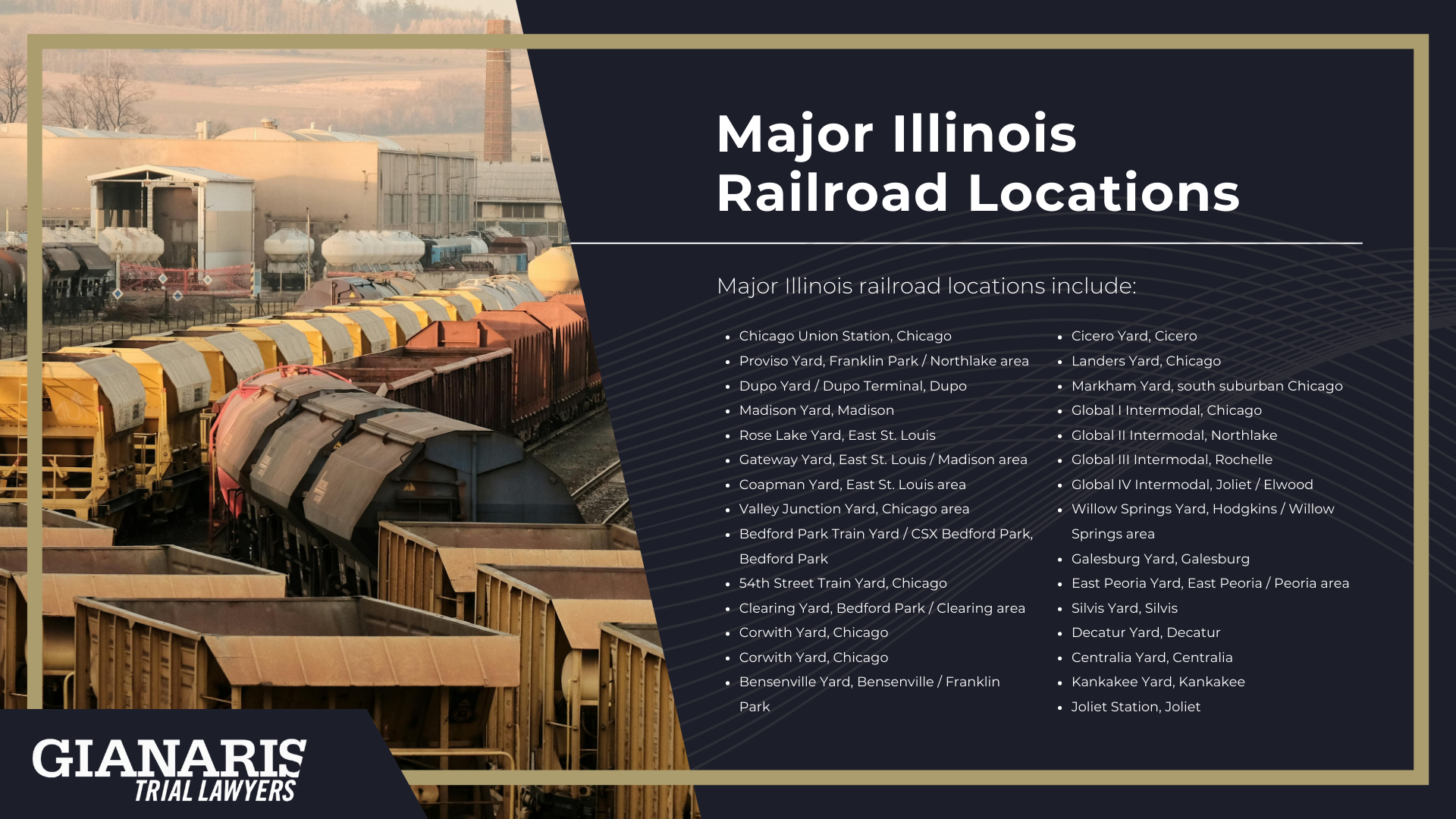
Major Illinois railroad locations include:

  • Chicago Union Station, Chicago: Major passenger terminal in downtown Chicago and a central hub for Amtrak and Metra operations, with enclosed platform and terminal environments that differ from open freight yards.
  • Proviso Yard, Franklin Park / Northlake area: One of the major Chicago-area freight yards in the western suburbs, long associated with large-scale classification and freight handling in the region.
  • Dupo Yard / Dupo Terminal, Dupo: Union Pacific’s major St. Louis-area Illinois terminal across the river from St. Louis, serving one of the state’s most important southern freight corridors.
  • Madison Yard, Madison: A major Terminal Railroad Association of St. Louis yard on the northeastern side of the East St. Louis rail complex.
  • Rose Lake Yard, East St. Louis: CSX’s East St. Louis intermodal terminal, commonly referred to as Rose Lake Yard, serving the St. Louis metro freight network.
  • Gateway Yard, East St. Louis / Madison area: A major east-metro St. Louis rail location tied to the historic gateway freight complex serving interchange traffic across multiple carriers.
  • Coapman Yard, East St. Louis area: East St. Louis-area freight yard associated with the broader multi-yard terminal district on the Illinois side of the St. Louis gateway.
  • Valley Junction Yard, Chicago area: Chicago-region yard tied to the dense web of crossings, junctions, and yard operations that support the metro freight network.
  • Bedford Park Train Yard / CSX Bedford Park, Bedford Park: One of CSX’s two Chicago intermodal terminals and the largest intermodal facility in CSX’s network, located near I-55 and I-294.
  • 54th Street Train Yard, Chicago: South-side Chicago rail facility within the broader belt of freight and terminal operations west and southwest of downtown.
  • Clearing Yard, Bedford Park / Clearing area: One of the best-known major classification yards in the Chicago terminal district and a longstanding freight-sorting center.
  • Corwith Yard, Chicago: BNSF’s Corwith intermodal terminal on Chicago’s southwest side, one of four BNSF intermodal terminals in the Chicago area.
  • Bensenville Yard, Bensenville / Franklin Park: CPKC freight and switching yard northwest of Chicago, historically one of the larger marshaling yards in the metro area.
  • Cicero Yard, Cicero: BNSF’s Cicero intermodal hub, a major trailer-and-container terminal just west of Chicago.
  • Landers Yard, Chicago: Norfolk Southern’s Chicago-Landers intermodal terminal on the Western Avenue corridor, one of NS’s four Chicago intermodal terminals.
  • Markham Yard, south suburban Chicago: A major freight yard in the south suburban belt, part of the broader Chicago freight complex.
  • Global I Intermodal, Chicago: Union Pacific’s Global I terminal near 14th Street, part of UP’s Chicago-area intermodal network.
  • Global II Intermodal, Northlake: Union Pacific terminal in Northlake, one of five UP intermodal terminals in the Chicago area.
  • Global III Intermodal, Rochelle: Major Union Pacific intermodal location in Rochelle, serving western Illinois freight and truck-rail transfers as part of the Chicago-oriented network.
  • Global IV Intermodal, Joliet / Elwood: Union Pacific terminal at the CenterPoint Intermodal Center, one of the anchors of the massive Joliet-Elwood logistics corridor.
  • Willow Springs Yard, Hodgkins / Willow Springs area: BNSF’s Chicago Willow Springs intermodal terminal, known for expedited intermodal traffic and proximity to UPS’s regional consolidation hub.
  • Galesburg Yard, Galesburg: Large BNSF classification yard in western Illinois and one of the most important historic railroad junction points in the state.
  • East Peoria Yard, East Peoria / Peoria area: Central Illinois freight location tied to the Peoria rail corridor and broader downstate industrial rail operations.
  • Silvis Yard, Silvis: Major Quad Cities-area rail location historically associated with freight and shop activity in western Illinois.
  • Decatur Yard, Decatur: Downstate rail center tied to Decatur’s long industrial and railroad history.
  • Centralia Yard, Centralia: Southern Illinois rail hub connected to the state’s long-established north-south freight routes.
  • Kankakee Yard, Kankakee: Rail facility in the Kankakee corridor, part of the south-of-Chicago freight and interchange geography.
  • Joliet Station, Joliet: Passenger rail location in the Joliet area, relevant to commuter and intercity rail operations rather than classic freight-yard activity.

This list is not exhaustive, and many Illinois workers spent time at more than one yard, terminal, or intermodal facility over the course of a railroad career.
Chemical Exposure Risks in Illinois Rail Operations

Chemical exposure risks in Illinois rail operations stem from the fact that railroad employees often work around diesel-heavy yards, enclosed terminals, repair shops, and service tracks where dangerous substances are part of the daily environment.

Workers may spend years around railroad equipment that releases exhaust, dust, fumes, and chemical residues during fueling, switching, maintenance, and cleaning operations.

In many cases, the harm does not come from one accident or one spill, but from prolonged exposure that builds over time across different jobs and locations.

That cumulative exposure can leave workers facing serious respiratory disease, blood disorders, and devastating cancer diagnoses years after their heaviest time on the railroad.

Before looking at the specific chemicals involved, it is important to understand that Illinois rail operations can expose workers to a broad mix of toxic hazards over the course of a railroad career.
Common Toxic Substances in Illinois Railroad Work

Common toxic substances in Illinois railroad work reflect the mix of old rail infrastructure, diesel-powered operations, and industrial maintenance that define many yards, terminals, and shops across the state.

Common carcinogens that railroad workers are exposed to include diesel exhaust, asbestos, and benzene, and many employees are frequently exposed to those substances over the course of daily work around locomotives, train cars, fueling areas, and repair facilities.

Asbestos exposure remains a serious concern because asbestos containing materials were widely used in railroad parts, insulation, brake systems, and older buildings, placing sheet metal workers and other shop employees at an elevated risk when those materials are cut, removed, or disturbed.

Illinois rail operations can also involve welding fumes, creosote used to treat railroad ties, solvents, fuels, and other dangerous chemicals, while nearby communities may also face air, water, and soil contamination tied to long-term exposure from rail lines and yard activity.

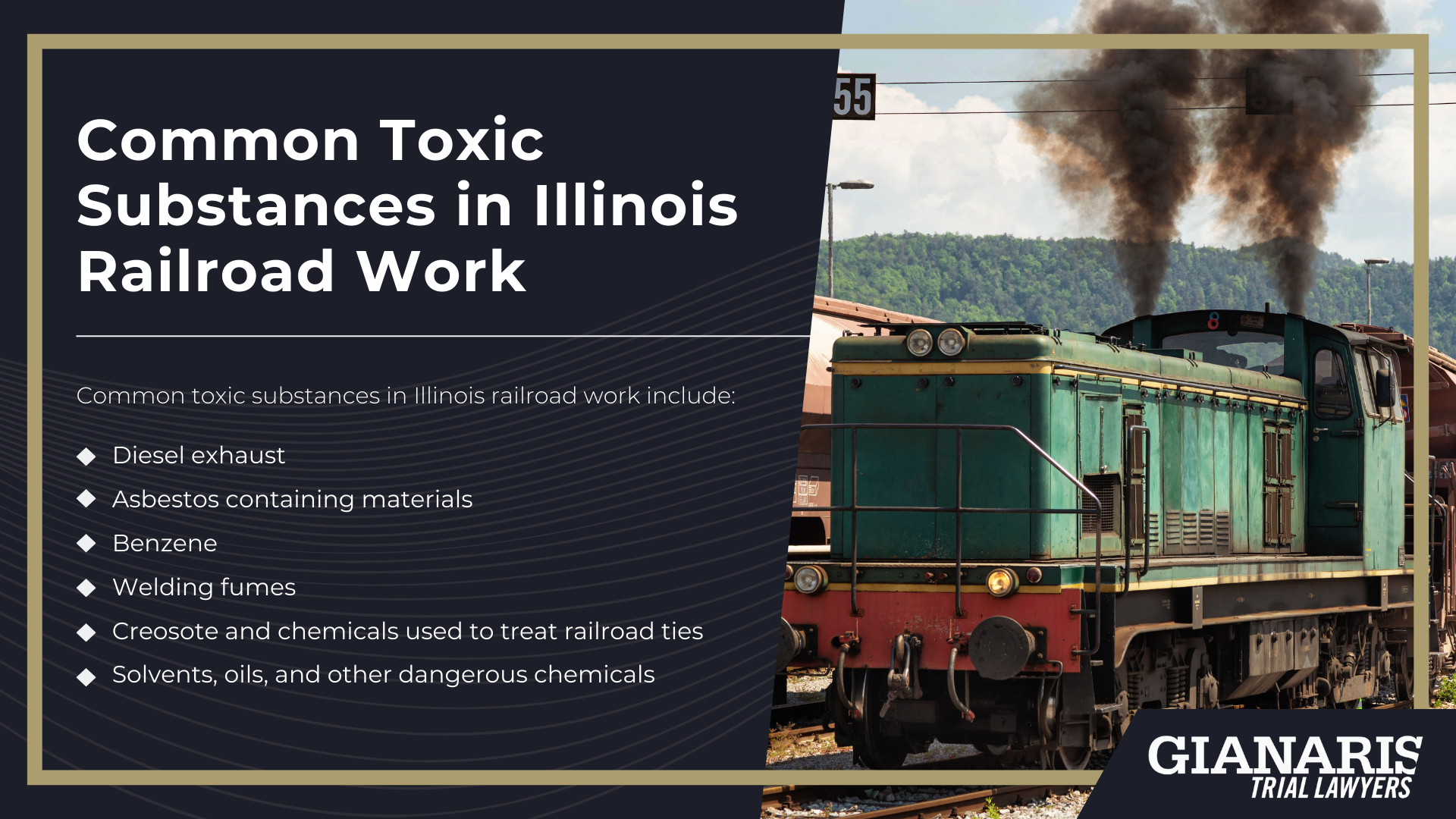
Common toxic substances in Illinois railroad work include:

  • Diesel exhaust: Produced by locomotives, yard engines, trucks, and support equipment, diesel exhaust can build up in yards, terminals, and shops, and long-term exposure has been linked to lung cancer and chronic respiratory disease.
  • Asbestos containing materials: Asbestos was used for insulation, brake components, gaskets, cement products, and other railroad parts and building materials, creating a serious hazard when fibers are released during maintenance, demolition, or repair.
  • Benzene: Found in fuels, solvents, and degreasers, benzene can expose workers through inhalation or skin contact and is one of the best-known toxic chemicals associated with blood-related cancers.
  • Welding fumes: Welding, torch cutting, and metal fabrication in shops can release fumes and fine particulates that add to the respiratory burden already present in rail facilities.
  • Creosote and chemicals used to treat railroad ties: Maintenance-of-way crews and others handling treated ties may come into contact with creosote and related preservatives through skin contact, dust, and vapors.
  • Solvents, oils, and other dangerous chemicals: Cleaning agents, degreasers, lubricants, and industrial fluids used in rail shops and service areas can create additional long-term exposure concerns for mechanics, electricians, pipefitters, and sheet metal workers.

Health Risks of Chemical Exposure in Illinois Railroad Work

Health risks of chemical exposure in Illinois railroad work extend far beyond short-term irritation, especially for workers with years of occupational exposure in yards, terminals, shops, and along the tracks.

The World Health Organization’s cancer agency, IARC, has classified diesel engine exhaust as carcinogenic to humans, and major occupational studies have tied diesel exhaust exposure to an increased risk of lung cancer.

Railroad worker studies have found about a 40% increase in lung cancer mortality in jobs associated with diesel locomotive service, which makes diesel exhaust one of the most important cancer risks in many railroad jobs.

Benzene exposure has also been conclusively linked to blood cancers such as leukemia and multiple myeloma, adding another layer of danger for workers who handled fuels, solvents, and degreasers over long careers.

In practical terms, many railroad workers face cancer diagnoses and chronic disease at rates that reflect years of repeated exposure to toxic substances rather than a single event or accident.

Diesel-heavy work can also contribute to chronic obstructive pulmonary disorder (COPD), chronic bronchitis, and other long-term respiratory damage that leaves workers with permanent breathing limitations.

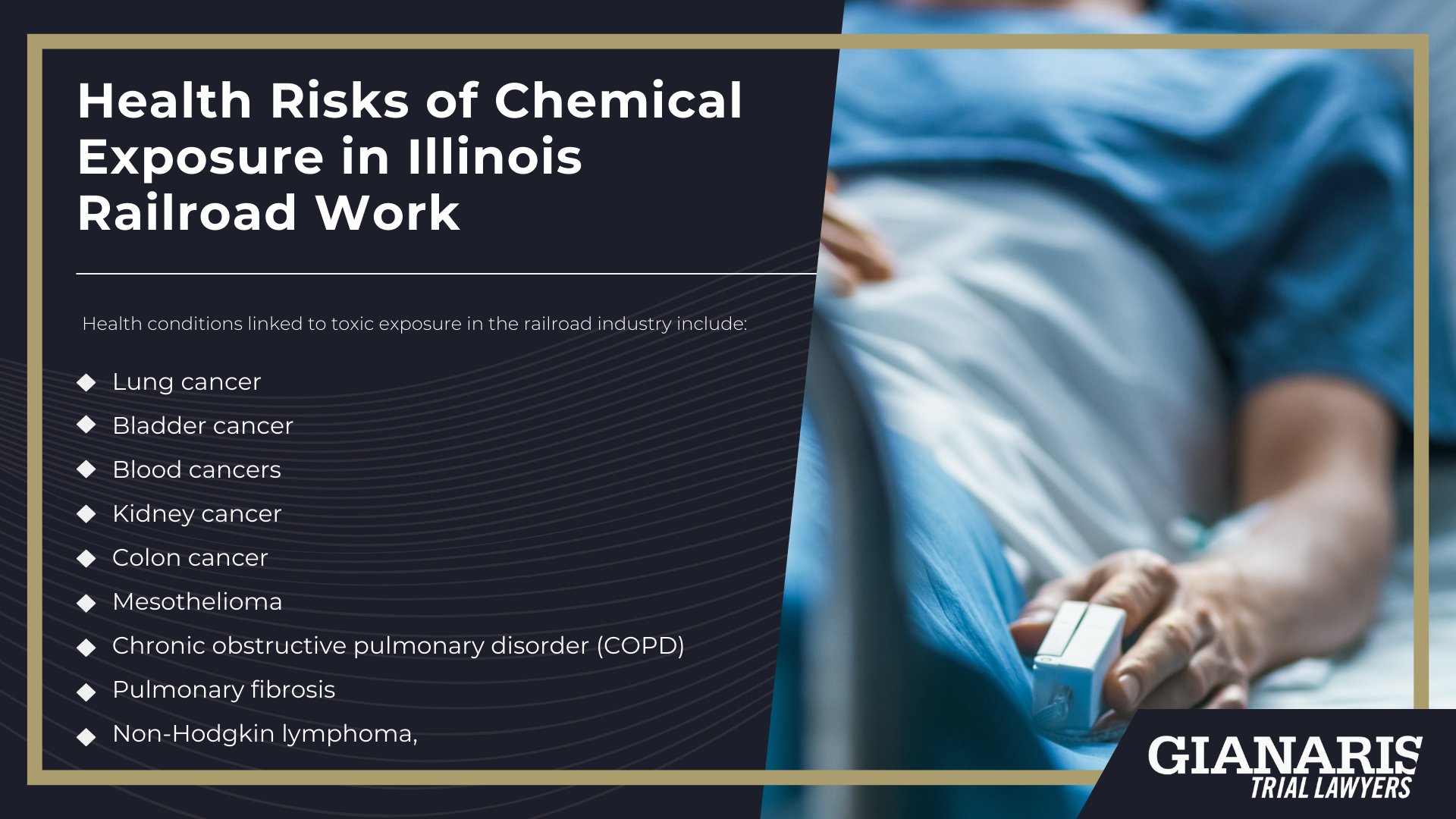
Health conditions linked to toxic exposure in the railroad industry include:

  • Lung cancer, strongly associated with long-term diesel exhaust exposure in railroad occupations
  • Bladder cancer, which some occupational sources also associate with diesel exhaust and related petroleum exposures
  • Blood cancers, including leukemia and multiple myeloma, which are linked to benzene exposure
  • Kidney cancer, reported in some toxic-exposure litigation and occupational case patterns involving long-term chemical contact
  • Colon cancer, which may appear in broader railroad toxic-exposure cases where workers had multiple overlapping exposures
  • Mesothelioma, caused by exposure to asbestos-containing insulation, brakes, and other railroad materials
  • Chronic obstructive pulmonary disorder (COPD) and chronic bronchitis, both associated with years of inhaling diesel fumes and other airborne contaminants
  • Pulmonary fibrosis and other chronic lung disease, sometimes reported after prolonged inhalation of particulates, fumes, and dust in rail environments
  • Non-Hodgkin lymphoma, which may be investigated where pesticide, solvent, or benzene-related exposure histories are present

These conditions do not affect every worker the same way, because cancer risks depend on the kind of railroad jobs performed, how long the worker was exposed, and which substances were present at specific Illinois facilities.

What makes railroad cases especially serious is that many of these diseases develop slowly, often appearing years after the period of heaviest exposure has ended.

For workers diagnosed with lung cancer, bladder cancer, kidney cancer, colon cancer, blood cancers, or severe chronic lung disease, that occupational history can become a critical part of understanding whether toxic exposure in Illinois railroad work played a role.

How Railroad Workers in Illinois Can Seek Justice for Chemical Exposure

Railroad workers in Illinois who develop cancer or other serious illnesses after years of toxic exposure may have legal options when those exposures occurred on the job.

Many railroad cancer lawsuits focus on whether a worker’s disease can be traced to long-term contact with diesel exhaust, asbestos, benzene, solvents, or other hazardous substances in yards, shops, terminals, and along the tracks.

These cases often examine whether the railroad’s conduct made the work environment more dangerous than it should have been, including a failure to warn workers about known chemical risks.

When the evidence supports that connection, injured workers may be able to pursue compensation for the medical, financial, and personal harm caused by a life-changing diagnosis.

In fatal cases, surviving family members may also have the right to bring claims based on the same workplace exposures and the losses that followed.

Illinois railroad workers are not without recourse when serious illness follows years of toxic work conditions.

What is the Federal Employers Liability Act (FELA)?

The Federal Employers Liability Act, or FELA, is the federal law that gives railroad workers the right to seek compensation for work-related injuries and illnesses caused by employer negligence.

Under the statute, a railroad engaged in interstate commerce is liable when its negligence played any part in producing an employee’s injury or disease, which is why FELA is the main legal framework for occupational cancer and toxic-exposure cases in the railroad industry.

Unlike standard workers’ compensation systems, FELA is fault-based, so affected workers must prove that railroad employers or their agents acted negligently, whether through unsafe practices, poor ventilation, failure to address known hazards, or other forms of corporate negligence.

That makes the process more complex than a no-fault claim, but it also opens the door to broader damages when employer negligence can be shown. FELA follows a comparative-negligence model, which means a worker’s own fault, if any, can reduce damages rather than automatically bar recovery.

To pursue fair compensation under FELA, railroad workers who develop cancer or another occupational illness usually need work records, medical documentation, and other proof showing how on-the-job exposure relates to the diagnosis.

Workers generally must file suit within three years of when they knew, or reasonably should have known, that the injury or illness was work-related.

When a claim succeeds, damages can include medical expenses, lost wages, pain and suffering, and loss of enjoyment of life, which is one reason FELA remains so important in serious workplace injuries and occupational disease cases involving railroad employers.

Key points about FELA include:

  • It covers railroad workplace injuries and occupational illnesses: FELA applies to injuries and diseases caused by negligence in railroad employment, not just sudden accidents.
  • It requires proof of negligence: To recover, a worker must show that employer negligence contributed to the illness or serious injury.
  • It uses comparative negligence: If a worker was partly at fault, damages may be reduced rather than eliminated.
  • It is broader than ordinary workers’ compensation: FELA allows claims for pain and suffering and other non-economic losses that many workers’ comp systems do not provide.
  • It has a three-year filing period: A claim usually must be brought within three years from when the worker knew or should have known the condition was tied to railroad work.
  • It is central to railroad cancer cases: Workers who develop cancer after asbestos, diesel, benzene, or other toxic exposure may pursue claims against railroad employers if they can prove negligence.

Evidence for an Illinois FELA Exposure Claim

Gathering evidence is one of the most important parts of an Illinois FELA exposure claim, because a worker must connect a serious illness to both railroad work and the railroad’s negligence.

In practice, that means showing where the worker was assigned, what substances were present, how often the exposure happened, and when the diagnosis was made.

Medical records, employment records, and testimony from co-workers or experts often work together to show that long-term exposure in Illinois rail operations was not just possible, but real and medically significant.

The stronger the evidence is, the better positioned a worker or family may be to obtain compensation through a well-supported claim.

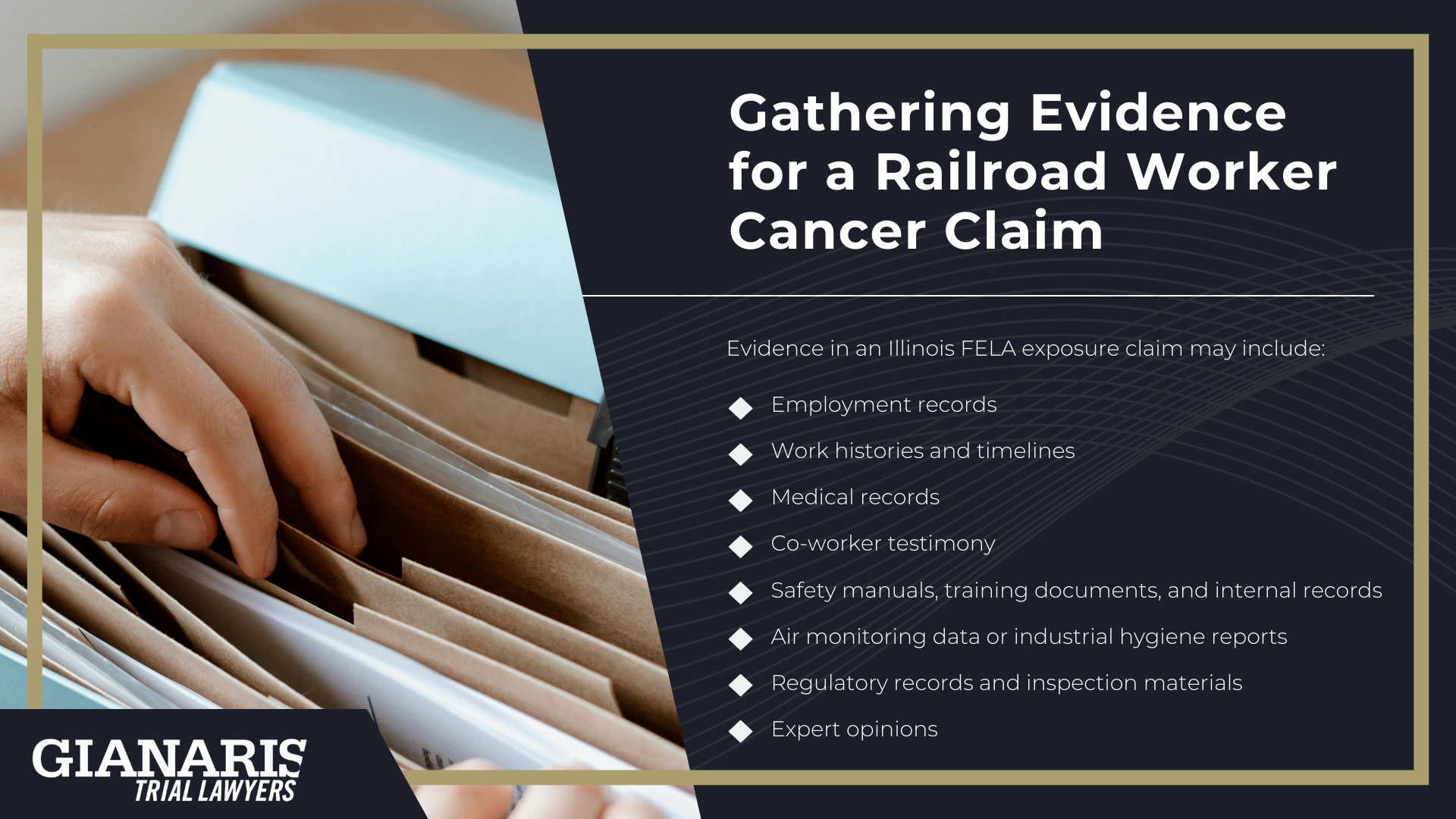
Evidence in an Illinois FELA exposure claim may include:

  • Employment records showing job titles, years of service, craft, and assignments at Illinois yards, terminals, shops, or intermodal facilities
  • Work histories and timelines identifying where the worker spent time, what equipment they worked around, and when the heaviest exposure likely occurred
  • Medical records including pathology reports, imaging, oncology notes, pulmonary testing, and treating-physician documentation tying the illness to occupational exposure
  • Co-worker testimony describing visible diesel smoke, poor ventilation, chemical use, asbestos handling, or other hazardous conditions at the same facility
  • Safety manuals, training documents, and internal records showing what the railroad knew about toxic substances and what warnings or protections were provided
  • Air monitoring data or industrial hygiene reports documenting diesel exhaust, benzene, asbestos fibers, welding fumes, or other contaminants in work areas
  • Regulatory records and inspection materials reflecting hazardous conditions, exposure concerns, or recordkeeping tied to rail facilities and employee exposure records
  • Expert opinions from industrial hygienists, occupational medicine physicians, or economists who can explain how the exposure happened, how it relates to the diagnosis, and what losses followed

Damages in Illinois FELA Claims

Damages in an Illinois FELA claim are the losses a worker or family may recover when toxic railroad exposure led to cancer, lung disease, or another serious illness.

Lawyers assess damages by reviewing medical records, employment history, pay records, and expert opinions to understand how the diagnosis affected the worker’s health, ability to earn a living, and daily life.

They then calculate both past and future harm, including medical bills already incurred, expected treatment costs, lost income, and the personal toll of pain, limitations, and emotional distress.

That analysis helps attorneys advocate for a fair railroad cancer settlement by presenting a clear picture of what the illness has already cost and what it is likely to cost in the future.

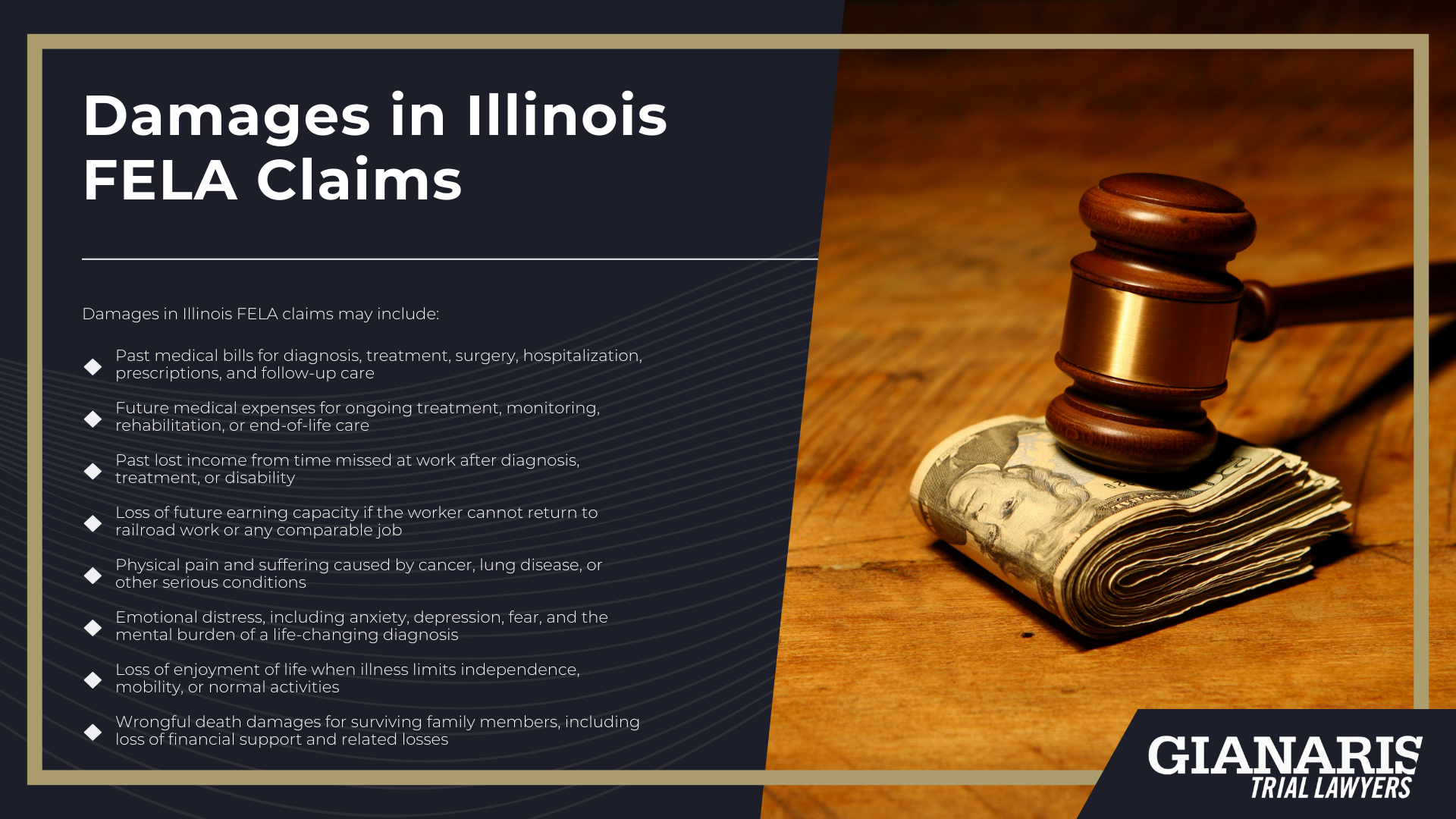
Damages in Illinois FELA claims may include:

  • Past medical bills for diagnosis, treatment, surgery, hospitalization, prescriptions, and follow-up care
  • Future medical expenses for ongoing treatment, monitoring, rehabilitation, or end-of-life care
  • Past lost income from time missed at work after diagnosis, treatment, or disability
  • Loss of future earning capacity if the worker cannot return to railroad work or any comparable job
  • Physical pain and suffering caused by cancer, lung disease, or other serious conditions
  • Emotional distress, including anxiety, depression, fear, and the mental burden of a life-changing diagnosis
  • Loss of enjoyment of life when illness limits independence, mobility, or normal activities
  • Wrongful death damages for surviving family members, including loss of financial support and related losses

Gianaris Trial Lawyers: Investigating Illinois Railyard Chemical Exposure Claims

Gianaris Trial Lawyers investigates Illinois railyard chemical exposure claims with a focus on how real working conditions in yards, terminals, shops, and intermodal facilities may have contributed to cancer and other serious illnesses.

Our firm reviews each case closely, including the worker’s job history, the Illinois locations involved, the substances present, and whether the railroad failed to protect employees from known hazards such as diesel exhaust, asbestos, benzene, or other toxic materials.

When the facts support it, that investigation becomes the basis for pursuing accountability from railroad employers and seeking compensation for the harm done.

If you or a loved one worked in Illinois rail operations and later developed cancer, lung disease, or another serious condition after years of toxic exposure, Gianaris Trial Lawyers can review your situation and explain your options.

Our firm represents current and former railroad workers, as well as families whose loved one died after a railroad-related occupational illness.

Contact Gianaris Trial Lawyers today to discuss a potential Illinois railyard chemical exposure claim.

Frequently Asked Questions

  • What Illinois railyards and operations are under investigation?

    Illinois locations under investigation generally include major freight yards, intermodal terminals, and passenger-terminal operations where workers may have faced long-term diesel, asbestos, solvent, benzene, and other toxic exposures.

    The focus is strongest in the Chicago rail hub, the East St. Louis metro freight complex, the Joliet-Elwood logistics corridor, and several large downstate freight centers because those regions concentrate heavy rail traffic and yard activity.

    Chicago alone has an unusually dense yard network, with one rail guide listing 82 yards in and around the metro area, while statewide rail planning sources describe Illinois as one of the country’s most important freight and passenger rail states.

    Intermodal and terminal facilities are also part of the picture, because sites like Global II, Global III, Global IV, Rose Lake, Bedford Park, Cicero, Corwith, Willow Springs, and Landers are active freight hubs with constant locomotive, truck, and equipment movement.

    Passenger-terminal operations such as Chicago Union Station and Joliet Station are relevant as well, since exposure questions can arise in covered terminals, servicing areas, and adjacent rail operations rather than only in classic classification yards.

    The list below is best understood as a working set of major Illinois railroad locations tied to current review, not a claim that every facility has the same exposure history or legal posture.

    Major Illinois railroad locations under investigation include:

    • Chicago Union Station — major passenger terminal in downtown Chicago
    • Proviso Yard — large western Chicago-area freight yard; Global II is co-located with Proviso Yard
    • Dupo Yard — major Union Pacific terminal in the St. Louis metro east area
    • Madison Yard — major East St. Louis / Madison freight yard
    • Rose Lake Yard — CSX East St. Louis intermodal terminal, also referred to as Rose Lake Yard
    • Gateway Yard — key East St. Louis gateway freight area
    • Coapman Yard — East St. Louis-area freight yard
    • Valley Junction Yard — Chicago-area rail junction / yard location
    • Bedford Park Train Yard — major CSX intermodal location in the Chicago area
    • 54th Street Train Yard — Chicago freight yard area
    • Clearing Yard — major Chicago classification yard
    • Corwith Yard — major BNSF Chicago intermodal terminal
    • Bensenville Yard — major northwest suburban Chicago freight yard
    • Cicero Yard — major BNSF Chicago intermodal hub
    • Landers Yard — Norfolk Southern Chicago-Landers intermodal terminal
    • Markham Yard — major south suburban Chicago freight yard
    • Global I Intermodal — Union Pacific Chicago intermodal terminal
    • Global II Intermodal — Union Pacific Northlake terminal, co-located with Proviso Yard
    • Global III Intermodal — Union Pacific Rochelle terminal
    • Global IV Intermodal — Union Pacific Joliet terminal at CenterPoint Intermodal Center
    • Willow Springs Yard — major BNSF Chicago-area intermodal terminal
    • Galesburg Yard — major western Illinois freight yard
    • East Peoria Yard — central Illinois rail yard area
    • Silvis Yard — Quad Cities-area freight / shop location
    • Decatur Yard — downstate Illinois freight yard
    • Centralia Yard — southern Illinois rail hub
    • Kankakee Yard — freight location in the Kankakee corridor
    • Joliet Station — passenger rail and terminal operation in the Joliet area
  • What if I worked at multiple Illinois yards?

    Working at multiple Illinois yards does not prevent you from bringing a claim, and in many cases it helps explain the full scope of your exposure history.

    Railroad workers often spent years moving between yards, terminals, intermodal facilities, and shops, so a diagnosis may reflect cumulative exposure across several locations rather than one single site.

    In an Illinois railroad cancer case, lawyers look at your entire work history, including the railroads you worked for, the jobs you held, the years involved, and the kinds of substances present at each location.

    That broader timeline can help show repeated exposure to diesel exhaust, asbestos, benzene, solvents, creosote, and other hazardous materials over the course of a railroad career.
    It can also help identify which yards created the heaviest exposure and whether different railroad employers contributed to the unsafe conditions.

    The important thing is not isolating one perfect location at the start, but building a clear record of where you worked and how those combined Illinois rail operations may have contributed to your illness.

  • Can Illinois railroad workers still file after retirement?

    Yes, Illinois railroad workers can still file after retirement in some cases.

    Under FELA, the usual time limit is three years from when the worker knew, or reasonably should have known, that the illness was related to railroad work, not simply three years from the retirement date.

    45 U.S.C. § 56 sets the three-year limitations period, and occupational disease claims often turn on that later discovery date.

    That matters because cancers, lung disease, and other toxic-exposure illnesses may not be diagnosed until years after a worker leaves the railroad.

    Courts commonly describe this as the discovery rule for FELA occupational disease cases.

    Whether a specific retired worker can still file depends on the diagnosis timeline, when the work connection became reasonably clear, and the evidence linking the disease to railroad exposure.

Published by:
Share
Picture of Ted Gianaris
Ted Gianaris

With nearly 30 years of legal experience, Attorney Ted Gianaris has secured over $350 million in compensation for Illinois injury victims, car accident victims, and surviving family members of wrongful death victims.

This article has been written and reviewed for legal accuracy and clarity by the team of writers and attorneys at Gianaris Trial Lawyers and is as accurate as possible. This content should not be taken as legal advice from an attorney. If you would like to learn more about our owner and experienced Illinois injury lawyer, Ted Gianaris, you can do so here.

Gianaris Trial Lawyers does everything possible to make sure the information in this article is up to date and accurate. If you need specific legal advice about your case, contact us. This article should not be taken as advice from an attorney.

Additional Railyard Chemical Exposure Lawsuits resources on our website:
All
FAQs
Injuries & Conditions
Legal Help
Occupations
Settlements & Compensation
You can learn more about Railyard Chemical Exposure Lawsuits below:
Railyard Chemical Exposure Lawsuits

Other Railyard Chemical Exposure Lawsuits Resources

All
FAQs
Injuries & Conditions
Legal Help
Occupations
Settlements & Compensation