

No fees unless we win.
Get a free consultation
128 Reviews
5.0
★★★★★

Railyard Chemical Exposure Lawsuits

Understanding Toxic Exposure in the Railroad Industry

Railyard chemical exposure lawsuits often center on railroad workers who spent years in diesel-heavy yards and later developed cancers, lung disease, or other serious illnesses linked to their working conditions.

In these environments, employees may be exposed to diesel exhaust, asbestos, industrial solvents, welding fumes, creosote, silica dust, and other toxic substances on a daily basis.

Gianaris Trial Lawyers investigates railroad cancer claims involving exposure at railyards, focusing on whether unsafe conditions and corporate decisions contributed to a worker’s diagnosis or death.

Railyard Chemical Exposure Lawsuits

Railroad Employees at Risk of Prolonged Exposure to Toxic Substances

Railyard cancer lawsuits often arise from the way railyards function as dense hubs of rail operations, maintenance, and fueling activity concentrated into a single industrial site.

In these environments, workers can routinely suffer from diesel exhaust exposure, asbestos exposure, industrial solvents, welding fumes, creosote, silica dust, and other toxic chemicals that accumulate over years of service.

Diesel exhaust and fine particulate matter are strongly linked to lung cancer and chronic lung disease, while asbestos, creosote, and certain solvents are associated with additional cancers and serious blood or immune disorders.

Affected workers include engineers, conductors, yard crews, mechanics, carmen, maintenance-of-way employees, and even clerical staff whose jobs keep them close to locomotives, repair tracks, or enclosed shop buildings.

Many railyards also store or handle hazardous materials such as fuels, degreasers, pesticides, and contaminated soil, increasing the risk that spills, leaks, or poor ventilation will intensify long-term exposure.

When railroad companies fail to modernize equipment, control emissions, maintain safe ventilation, or warn employees about known dangers, those decisions can form the basis of claims that working conditions were unreasonably unsafe.

Over time, these unsafe practices can leave workers and their families facing not only medical bills and lost wages but also permanent disability and loss of life tied to occupational disease.

Gianaris Trial Lawyers investigates railyard chemical exposure cases, focusing on whether preventable hazards in these facilities contributed to cancer and other serious illnesses in current and former railroad workers.

If you or a loved one worked in or around railyards and later developed lung cancer, another cancer, or a serious respiratory illness after years of diesel exhaust exposure, asbestos exposure, or contact with other hazardous substances, you can contact Gianaris Trial Lawyers to discuss a potential railroad cancer lawsuit.

Contact us today for a free consultation.

You can also use the chat feature on this page to find out if you qualify for a railroad cancer lawsuit.

Types of Railyards and Railroad Operations

Railyards and railroad operations fit together like pieces of a larger machine, forming the backbone of the national freight and passenger rail system.

In the United States, freight railroads operate on nearly 140,000 route miles of track, moving roughly 1.8 billion metric tons of goods a year, from coal and chemicals to cars and grain, across a network that spans 49 states.

Passenger service layers onto that network: Amtrak now carries about 34.5 million riders annually to more than 500 destinations, often sharing tracks and facilities with freight carriers.

Behind those statistics are specific facilities where this activity is organized, including classification yards, intermodal terminals, passenger yards, and dedicated maintenance and fueling complexes.

These railyards are where trains are built, broken down, refueled, inspected, and repaired, and where locomotives may idle for long periods while crews work around them.

Each type of operation, from flat switching in a local yard to container transfers at an intermodal hub, creates its own pattern of noise, traffic, and industrial emissions.

For workers, the kind of yard and the role they perform determine how often they are near running engines, hazardous materials, and toxic chemicals, which is why understanding yard types is critical in evaluating long-term exposure risk.
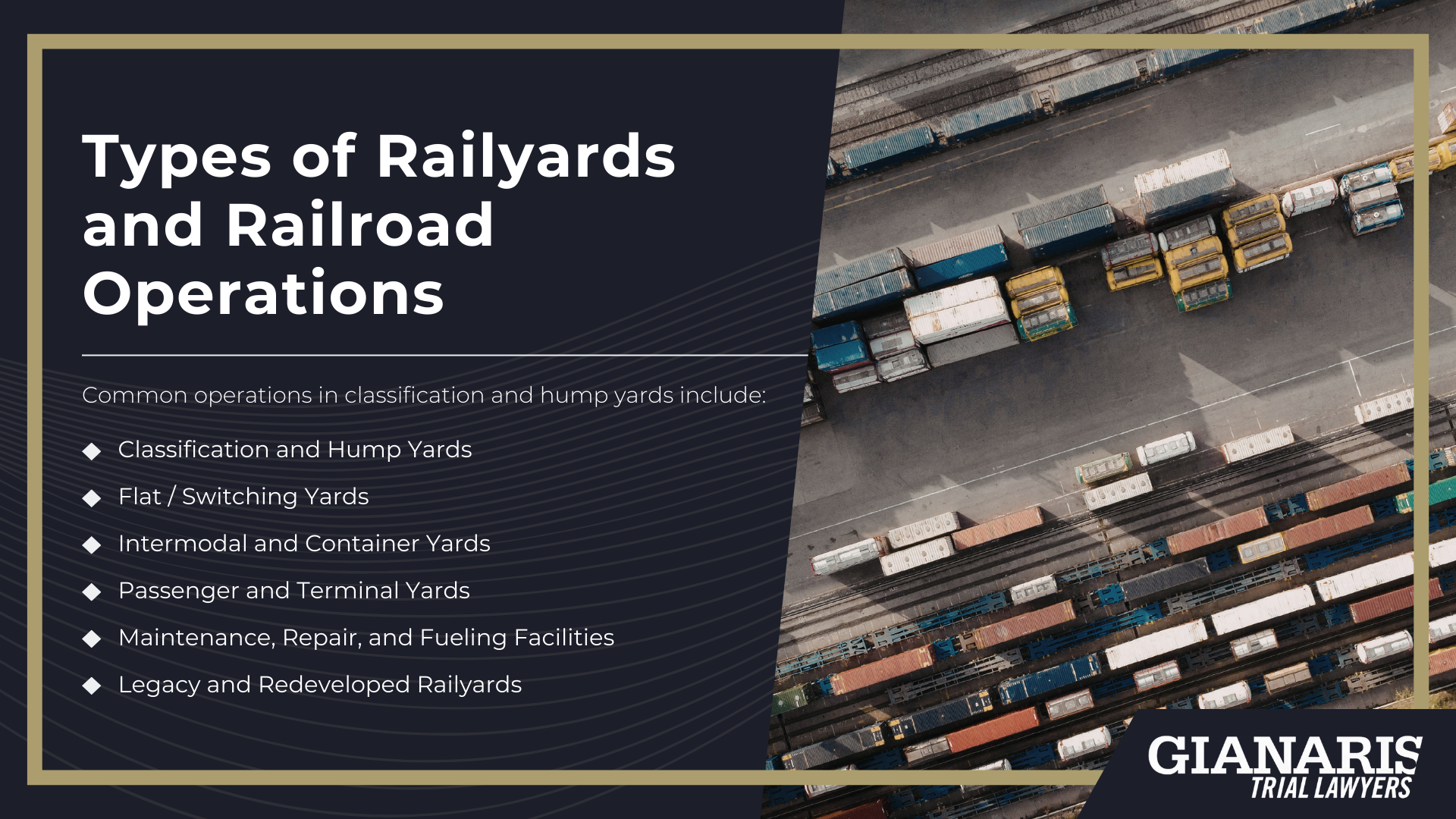
Classification and Hump Yards

Classification and hump yards are large rail facilities where incoming freight trains are broken down and individual railcars are sorted onto different tracks to form new outbound trains.

In a traditional hump yard, locomotives push cars up a man-made hill, and then gravity carries each car down over the “hump” through switches and retarders to the correct classification track.

Modern classification yards can span thousands of acres and handle thousands of railcars per day, making them some of the busiest and most complex industrial sites in the railroad system.

These yards often operate around the clock, with constant switching, braking, and idling that create heavy diesel exhaust, noise, and vibration for crews working nearby.

Common operations in classification and hump yards include:

  • Breaking down arriving freight trains into blocks of cars based on destination or cargo type
  • Pushing cuts of cars over a hump so they roll by gravity into assigned classification tracks
  • Using switch engines, retarders, and control towers to direct cars safely and efficiently
  • Inspecting railcars and brake systems before they are added to new outbound trains
  • Refueling, servicing, and staging locomotives used in switching and road service
  • Performing minor repairs or sending damaged cars to dedicated shop tracks

Because cars are constantly moving and locomotives spend long periods idling, workers in classification and hump yards may experience frequent, close-range diesel exhaust exposure during every shift.

The sheer size of these yards means employees can walk or ride through multiple emission hot spots just to perform routine duties.

Over years of work, that pattern of toxic chemical exposure can become a central issue in chemical exposure and cancer claims tied to yard operations.

Flat / Switching Yards

Flat or switching yards are rail facilities where cars are sorted and assembled without the use of a hump, relying instead on switch engines to move cuts of cars between arrival, classification, and departure tracks.

These yards are common in urban and regional networks, where space or traffic patterns do not justify a large hump yard but constant local switching and short-haul moves are still needed.

Switch crews, conductors, brakemen, and yard engineers spend much of their shifts on or near the ground, coupling and uncoupling cars, lining switches, and riding on moving equipment as cuts of cars are shoved and pulled through the yard.

In this environment, diesel fumes from idling and low-speed locomotives can hang over work areas, creating workplace exposures that may be intense even if the yard itself is smaller than a major classification hub.

Common operations in flat / switching yards include:

  • Breaking down arriving trains into smaller blocks of cars for local delivery or interchange
  • Assembling outbound trains from cars gathered from industries, branch lines, or other yards
  • Using yard locomotives to shove and pull cuts of cars through a network of ladder tracks and switches
  • Spotting cars at industry tracks, team tracks, or interchange points with other railroads
  • Performing basic inspections, air brake tests, and minor repairs before cars leave the yard
  • Handling unit trains of commodities such as coal, grain, or chemicals, which can add dust and cargo-related hazards to general diesel exhaust

Because work often takes place directly beside running locomotives and moving trains, flat yard employees may be exposed to short, repeated bursts of concentrated diesel fumes during every shift.

In yards that handle coal trains or other bulk commodities, coal dust, grain dust, or chemical residues can add to the mix of airborne hazards workers breathe.

Over a career, these combined exposures in flat and switching yards can play a significant role in cancer and lung disease claims for railroad workers.

Intermodal and Container Yards

Intermodal and container yards are specialized facilities where freight containers and trailers are transferred between trains, trucks, and sometimes ships, concentrating heavy equipment and cargo-handling in one location.

Workers in these yards operate and work around locomotives, yard trucks, cranes, and lifting equipment that produce constant noise, exhaust, and occasional chemical fumes when loads leak or are mishandled.

Because many containers carry hazardous chemicals, corrosive substances, fuels, and other regulated materials, even routine operations can involve additional risks when spills or damaged cargo occur.

Common operations in intermodal and container yards include:

  • Lifting containers on and off railcars using gantry cranes, side-loaders, or reach stackers
  • Transferring containers and trailers between trains and trucks in tight, high-traffic work zones
  • Staging and storing hazardous materials and corrosive substances under specific handling and segregation rules
  • Inspecting, sealing, and documenting containers, including those holding dangerous goods or leaking cargo
  • Operating diesel-powered hostlers, yard tractors, and support vehicles throughout the terminal

For workers, this mix of locomotive exhaust, truck emissions, and potential releases from hazardous cargo can create complex exposure profiles that go beyond diesel alone.

When accidents, poor ventilation, or lax safety practices allow chemical fumes or spills to persist in work areas, those conditions can become central issues in intermodal yard exposure and injury claims.

Passenger and Terminal Yards

Passenger and terminal yards are facilities where passenger trains are stored, cleaned, inspected, and prepared between trips, often located near major stations and urban neighborhoods.

In these yards, crews work around idling locomotives and auxiliary power units that produce significant diesel exhaust, along with shop areas where cleaning agents, lubricants, and other dangerous chemicals are routinely used.

Older equipment and infrastructure can also contain heavy metals, asbestos, and legacy contaminants that add to the long-term exposure risks for workers who spend their careers in these environments.

Common operations in passenger and terminal yards include:

  • Storing passenger trains between runs and moving them to and from station platforms
  • Cleaning interiors, emptying waste systems, and restocking supplies on passenger cars
  • Inspecting brake systems, couplers, wheels, and electrical systems before the next trip
  • Performing minor repairs and sending cars or locomotives to shops for more extensive work
  • Refueling locomotives and servicing onboard power or HVAC systems in confined service tracks
  • Using industrial cleaners, solvents, paints, and other dangerous chemicals in shops and maintenance areas

Because much of this work occurs near idling engines or in partially enclosed tracks and shop buildings, workers can experience repeated diesel exhaust exposure in addition to contact with heavy metals and other contaminants.

Over time, that combination of emissions and chemical use in passenger and terminal yards can contribute to serious health problems that form the basis of railroad exposure and cancer claims.

Maintenance, Repair, and Fueling Facilities

Maintenance, repair, and fueling facilities are the places where locomotives and railcars are refueled, inspected, and rebuilt, concentrating some of the heaviest industrial activity in the rail system.

Mechanics, carmen, electricians, pipefitters, hostlers, and fueling crews often work just feet from running engines, so exposure to diesel exhaust is a daily reality rather than an occasional inconvenience.

In addition to fuels like diesel and crude oil, many shops handle solvents, degreasers, cutting oils, and other products that can create benzene exposure and contact with a wide range of toxic compounds.

Common operations in maintenance, repair, and fueling facilities include:

  • Refueling locomotives and handling bulk fuel lines, hoses, and storage tanks that may contain diesel and crude oil
  • Performing routine inspections, brake work, wheel truing, and component replacement on locomotives and cars
  • Using solvents, degreasers, and cleaning agents on parts and equipment, increasing the risk of benzene exposure and other chemical contact
  • Welding, cutting, and grinding metal components, creating metal fumes and fine particulates in enclosed shop spaces
  • Running diagnostic tests and engine work with locomotives idling indoors or under partial cover, leading to concentrated exposure to diesel exhaust
  • Managing waste oils, contaminated rags, filters, and other hazardous shop byproducts that can spill or aerosolize in the work area

Because these facilities combine fuel handling, hot work, and engine testing in tight spaces, workers can be exposed to complex mixtures of vapors, fumes, and exhaust during every shift.

Over years of service, that pattern of exposure in maintenance, repair, and fueling yards can play a major role in railroad cancer and lung disease claims tied to chemical hazards on the job.

Legacy and Redeveloped Railyards

Legacy and redeveloped railyards are former industrial sites linked to railroad operations that often carry a long history of fuel spills, creosote use, solvents, and other persistent contaminants in the soil and groundwater.

For decades, workers at these yards may have been routinely exposed to contaminated ballast, stained soils, chemical vapors, and residual diesel residues without clear warnings about long-term health risks.

When railroads downsize or abandon these facilities, the land is sometimes converted into housing, parks, or commercial developments, raising new questions about exposure for construction workers and future residents.

Environmental investigations at legacy railyards can uncover plumes of petroleum products, creosote, heavy metals, and volatile organic compounds that migrated far beyond the original yard boundaries.

Those findings matter for former employees with cancer or serious lung disease, because they help document the specific contaminants present while they were working and how long those hazards remained on site.

They also shape modern claims when people living or working on redeveloped property later learn that their neighborhood sits on or next to a contaminated rail facility linked to railroad operations.
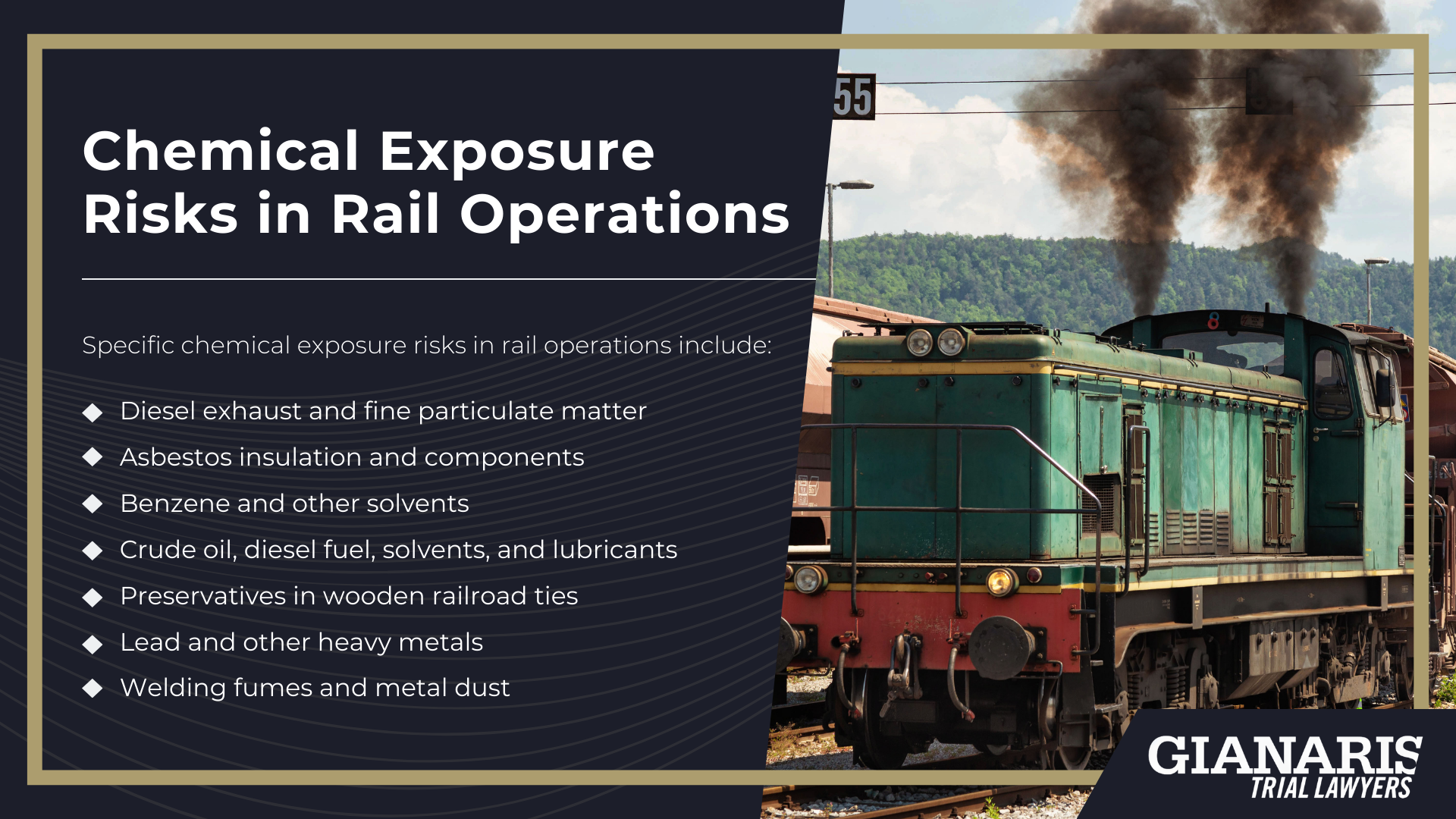
Chemical Exposure Risks in Rail Operations

Chemical exposure risks in rail operations arise from the way trains, yards, and maintenance facilities concentrate fuels, exhaust, and industrial materials in the same places where many railroad workers spend their entire careers.

Locomotives and yard engines emit diesel fumes that contain fine particulates and gases linked to lung cancer, chronic obstructive pulmonary disease (COPD), and other serious lung diseases in long-term studies of exposed workers.

Railroad employees have historically worked around asbestos insulation in locomotives, brake components, and shop buildings, and asbestos was widely used on the railroads before it was recognized as a potent cause of mesothelioma, an aggressive cancer of the lining around the lungs.

Workers in railyards and shops may also come into contact with benzene and other volatile organic compounds in fuels, solvents, and degreasers, as well as crude oil residues on equipment and trackside surfaces.

Preservatives used in wooden railroad ties, including creosote and related chemicals, can introduce additional skin and inhalation exposures, especially for maintenance-of-way crews handling and cutting ties.

Lead-based paints and legacy equipment can contribute to lead poisoning risk, particularly when grinding, cutting, or disturbing older structures and rolling stock.

Even when safety regulations exist on paper, real-world conditions in busy yards and shops can allow hazardous materials to accumulate in the air, soil, and dust where people work.

Many of these illnesses develop slowly, with symptoms emerging years or even decades after initial exposure, which makes understanding specific risk factors and past working conditions critical for workers and families trying to make sense of a diagnosis.

Specific chemical exposure risks in rail operations include:

  • Diesel exhaust and fine particulate matter: Long-term contact with diesel exhaust fumes around locomotives, yard engines, and idling trains can damage the lungs and has been linked to lung cancer, COPD, and chronic bronchitis in many railroad workers who spent years in that environment.
  • Asbestos insulation and components: Asbestos was widely used in insulation, brake linings, and other parts on locomotives and in shop buildings; fibers released during maintenance, cutting, or demolition can be inhaled and later cause mesothelioma and other asbestos-related lung diseases.
  • Benzene and other solvents: Benzene and related solvents appear in fuels, cleaning agents, and degreasers used on engines and parts, and repeated skin contact or inhalation can increase the risk of blood disorders and certain cancers.
  • Crude oil, diesel fuel, solvents, and lubricants: Residues from crude oil, diesel, and heavy lubricants or solvents can contaminate equipment, floors, and ballast, exposing workers who refuel locomotives, repair rolling stock, or walk tracks through stained and oily areas.
  • Preservatives in wooden railroad ties: Chemicals used to preserve wooden railroad ties, such as creosote, can be absorbed through the skin or inhaled as vapors or dust when ties are cut, handled, or burned, adding another layer of toxic exposure for track crews.
  • Lead and other heavy metals: Lead-based paints, solder, and legacy components can release lead and other metals when sanded, ground, or cut, raising the risk of lead poisoning and other metal-related health problems if dust controls are poor.
  • Welding fumes and metal dust: Welding, cutting, and grinding in shops and on the line produce fumes and fine metal particles that can irritate the lungs and contribute to long-term respiratory and neurological issues when repeated over years.

In practice, a single railroad job can involve several of these hazards at once, such as diesel exhaust exposure on the ground combined with benzene-containing solvents in the shop and contact with creosote-treated railroad ties along the track.

Many railroad workers spend entire careers moving between yards, mainline assignments, and maintenance facilities, which layers these exposures over decades.

Even when serious accidents or spills never occur, the day-to-day background of fumes, dust, and residues can create an increased risk of cancer, lung disease, and other chronic health conditions later in life.

Understanding which substances were present, how often they were encountered, and whether safety regulations were actually followed is essential for identifying which illnesses may be tied to rail operations.

Health Risks of Chemical Exposure in the Railroad Industry

Health risks of chemical exposure in the railroad industry often develop slowly, after years of working around fuels, fumes, and industrial dust in railyards, shops, and along the tracks.

Toxic substances linked to railyard chemical exposure include diesel exhaust, benzene, asbestos, silica dust, and weedkillers used to clear vegetation from track and yard areas.

Long-term contact with these materials can damage the lungs, blood, nervous system, and other organs, even when individual exposures feel routine or minor at the time.

Asbestos was widely used on the railroads in insulation and components, and it is now known to cause mesothelioma, an aggressive cancer in the thin lining around the lungs.

Chronic exposure to certain industrial solvents can also injure the brain and nervous system, leading to toxic encephalopathy with memory, mood, and concentration problems.

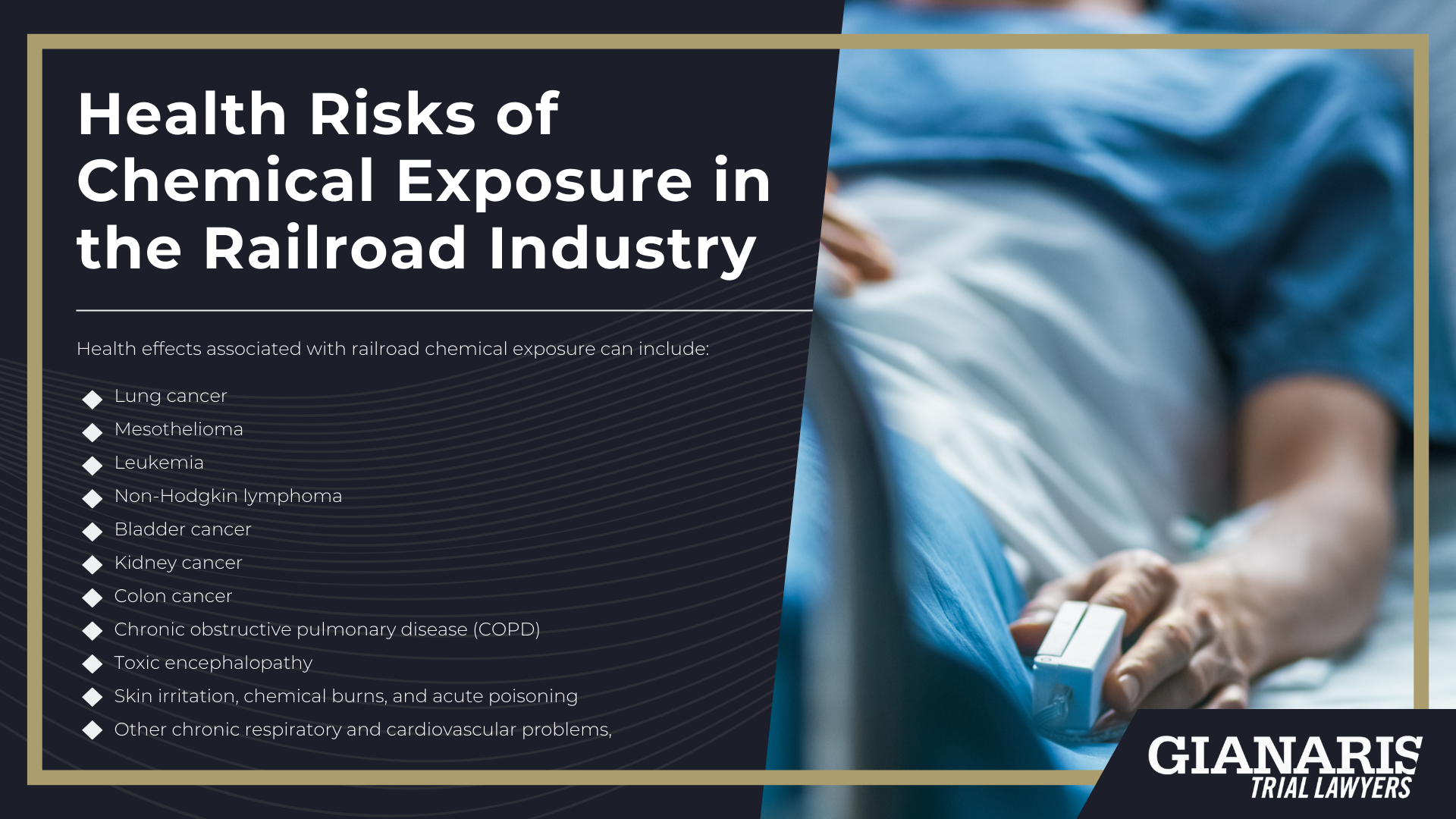
Health effects associated with railroad chemical exposure can include:

  • Lung cancer, often linked to years of diesel exhaust and silica dust exposure
  • Mesothelioma, caused by inhaling asbestos fibers from insulation and other asbestos-containing materials
  • Leukemia, associated with long-term benzene exposure in fuels and solvents
  • Non-Hodgkin lymphoma, which has been reported in workers exposed to certain solvents, pesticides, and other toxic chemicals
  • Bladder cancer and other urinary tract cancers in workers exposed to certain petroleum products and chemicals
  • Kidney cancer, which can be associated with chronic exposure to some industrial chemicals and diesel-related contaminants
  • Colon cancer, reported in some workers with long-term exposure histories in heavily contaminated or diesel-heavy environments
  • Chronic obstructive pulmonary disease (COPD), chronic bronchitis, and other serious lung diseases from inhaled dusts and fumes
  • Toxic encephalopathy, a brain and nervous system disorder caused by chronic exposure to industrial solvents and similar chemicals
  • Skin irritation, chemical burns, and acute poisoning, including episodes of dizziness or unconsciousness after high-level exposures
  • Other chronic respiratory and cardiovascular problems, which may be aggravated by long-term inhalation of diesel exhaust and fine particulates

For many railroad workers, these conditions appear years or even decades after their heaviest exposure, making the connection to past rail work easy to overlook.

Careful review of a worker’s job history, the substances present in specific yards or shops, and the timing of symptoms is often needed to understand whether chemical exposure played a role.

When serious diagnoses like leukemia, lung cancer, bladder cancer, or mesothelioma arise in people who spent their careers in railyards, chemical exposure in the railroad industry becomes an important part of the medical and occupational history.

How Different Types of Rail Operations Contribute to Injury and Exposure Risks

Different types of rail operations shape how, where, and how often railroad workers are exposed to hazardous substances on the job.

In busy classification and flat switching yards, crews spend long hours on the ground next to idling locomotives, coupling cars and lining switches, which increases day-to-day diesel exhaust exposure and long-term cancer risk.

Intermodal yards layer locomotive emissions with truck traffic, container handling, and occasional cargo leaks, so railroad workers exposed there can encounter both exhaust and chemical releases from hazardous freight.

Passenger and terminal yards place cleaners, car inspectors, and servicing crews in close contact with idling engines, industrial cleaners, and waste systems, often in partially enclosed tracks where fumes and vapors accumulate.

Maintenance, repair, and fueling facilities concentrate hot work, solvents, fuels, and exposure to diesel exhaust in tight shop spaces, creating intense local hazards for mechanics, carmen, and fueling crews.

Track and maintenance-of-way operations add silica dust from ballast, creosote from treated railroad ties, and herbicides along the right-of-way to the mix of risks faced by workers who maintain infrastructure leading into and out of railyards.

Legacy and redeveloped yards can expose workers and contractors to contaminated soil, groundwater, and vapors even after the most active rail operations have ended.

Taken together, these different rail settings create overlapping patterns of acute injury risk and chronic chemical exposure that follow railroad workers exposed throughout their careers.

How Railroad Workers Can Seek Justice For Chemical Exposure

Railroad workers who spent years in railyards, shops, and along the tracks and later received a cancer diagnosis often face questions about whether their illness is tied to work conditions that could have been made safer.

When evidence shows that railroad employers allowed hazardous exposures to continue without adequate protections or warnings, injured workers may have options to obtain compensation for the harm they now live with.

These options can cover medical bills, lost income, and the broader impact that a serious disease has on a person’s life and independence.

In fatal cases, surviving family members may also be able to pursue claims related to a loved one’s death if long-term chemical exposure on the railroad played a role.

Understanding these rights is the first step for workers and families who believe that years on the railroad contributed to a life-changing diagnosis.

What is the Federal Employers Liability Act (FELA)?

The Federal Employers Liability Act (FELA) is a federal law that gives injured railroad workers a path to seek compensation when their injuries or illnesses are caused, at least in part, by the negligence of their railroad employer.

Unlike ordinary no-fault workers’ compensation systems, FELA is fault-based, so railroad workers must prove negligence to receive compensation for their injuries or occupational diseases.

Legal actions under FELA often focus on the railroad company’s negligence, such as failing to provide proper ventilation, ignoring known chemical hazards, or not supplying adequate personal protective equipment.

Railroad workers are covered by FELA for injuries and illnesses caused by hazardous chemical exposure, including long-term contact with diesel exhaust, solvents, asbestos, and other toxic substances in railyards and shops.

Plaintiffs in FELA claims typically must demonstrate a link between chemical exposure and resulting illnesses using work records, exposure histories, and medical documentation.

If negligence is proven in FELA claims, individuals may recover economic damages such as medical expenses and lost wages tied to their disability or reduced earning capacity.

FELA also allows significant awards for pain and suffering and other non-economic harm, a category of recovery that standard state workers’ compensation systems generally do not provide.

Workers must file FELA claims within three years after they knew, or reasonably should have known, that their illness or injury was related to railroad work, which is especially important in slow-developing cancer and lung disease cases.

FELA generally covers:

  • Employees of interstate freight railroads engaged in common carrier service
  • Passenger railroad employees, including those working for national or regional passenger rail systems
  • Yard workers, switch crews, and other employees assigned to railyards and terminal operations
  • Shop and maintenance personnel, such as mechanics, carmen, electricians, pipefitters, and fueling crews
  • Track and maintenance-of-way workers responsible for inspecting, repairing, and maintaining railroad infrastructure
  • Other railroad employees whose job duties are tied to the operation of trains and railyard facilities, even if they do not ride the trains themselves

Evidence for a FELA Exposure Claim

Gathering evidence is critical in any FELA exposure case, because injured railroad workers must show both that they were exposed to harmful substances on the job and that the railroad’s negligence contributed to their illness.

Strong documentation helps connect specific jobs, locations, and time periods to known hazards such as diesel exhaust, asbestos, solvents, or contaminated soil and ballast.

Medical records and expert opinions then link those exposures to diagnoses like cancer, lung disease, or blood disorders, while timelines help show when the worker first learned the condition was work-related.

Together, this evidence creates the foundation a court or railroad company will use to evaluate whether a chemical exposure claim is credible and supported by the facts.

Examples of evidence in FELA chemical exposure cases include:

  • Detailed employment and union records showing job titles, assignments, and years worked in specific railyards or facilities
  • Work schedules, yard diagrams, and crew sheets that show how often the worker was near locomotives, fueling tracks, shops, or contaminated areas
  • Safety manuals, internal memos, and training materials that reveal what the railroad knew about diesel exhaust, asbestos, benzene, and other toxic substances
  • Incident reports, complaint records, or union grievances about air quality, ventilation problems, or chemical spills in the workplace
  • Regulatory inspections, citations, and agency reports describing hazardous conditions or safety violations at particular railyards or shops
  • Air monitoring data, environmental studies, or industrial hygiene reports documenting diesel particulates, solvents, or other chemicals in work areas
  • Medical records, pathology reports, and physician notes tying the worker’s diagnosis to occupational exposure patterns
  • Expert opinions from industrial hygienists, occupational physicians, or toxicologists explaining how the worker’s exposure history relates to the disease in question

Damages in FELA Claims

Damages in a FELA claim are the legally recognized losses that an injured railroad worker or family can ask a railroad to pay when negligence contributed to an illness or injury.

Lawyers assess damages by looking at medical records, work history, expert opinions, and the worker’s day-to-day limitations to understand how the condition affects health, income, independence, and relationships.

They then project those losses into the future, including medical needs and reduced future earning capacity, and present that picture through testimony, documents, and experts to advocate for fair compensation.

In fatal or severe disease cases, lawyers may also work with medical and economic experts to address decreased life expectancy and the long-term impact on a worker’s spouse, children, or other dependents.

Examples of damages in FELA chemical exposure claims can include:

  • Past medical expenses for diagnosis, treatment, surgery, hospitalization, and medications
  • Future medical costs, including ongoing treatment, monitoring, rehabilitation, or end-of-life care
  • Past lost wages during periods when the worker could not safely remain on the job
  • Loss of future earning capacity when illness or disability prevents a return to prior railroad work or any work at all
  • Physical pain and suffering tied to cancer, lung disease, and other serious health conditions
  • Emotional distress, anxiety, depression, and loss of enjoyment of life associated with chronic illness or disability
  • Loss of household services, care, and guidance provided by the injured worker to family members
  • In wrongful death cases, loss of financial support and benefits for surviving family members, along with the loss of companionship and guidance
  • Damages related to decreased life expectancy where evidence shows the illness will shorten the worker’s lifespan

Gianaris Trial Lawyers: Investigating Railyard Chemical Exposure Claims

Gianaris Trial Lawyers reviews railyard chemical exposure cases with a focus on the real conditions workers faced in yards, shops, and along the tracks, not just what the rulebooks say should have happened.

Our firm looks closely at job duties, yard assignments, safety practices, and medical records to understand whether long-term exposure to diesel exhaust, asbestos, solvents, creosote, silica, or other toxic substances may have contributed to a cancer or serious lung disease diagnosis.

When the evidence supports it, those findings become the basis for pursuing accountability from railroad employers that failed to provide a reasonably safe workplace.

If you or a loved one spent years working in railyards and later developed lung cancer, leukemia, mesothelioma, or another serious illness, you do not have to sort through those questions alone.

An attorney can help reconstruct your exposure history, explain your options under FELA, and advise whether a claim is worth pursuing.

To have your situation reviewed, contact Gianaris Trial Lawyers today for a confidential evaluation of a potential railyard chemical exposure claim.

Frequently Asked Questions

  • What kinds of chemical exposure risks do workers face in railyards?

    Railyards bring many sources of contamination into the same place, so workers can be exposed to more than just diesel exhaust during a normal shift.

    Day after day, that mix of fumes, dusts, and residues can build into a meaningful health risk, especially over a long career.

    Common chemical exposure risks in railyards include:

    • Diesel exhaust and soot from idling locomotives and yard engines, which can contribute to lung cancer, COPD, and chronic bronchitis
    • Asbestos insulation and components in older locomotives, cars, and shop buildings, which can cause mesothelioma and other asbestos-related diseases
    • Benzene and other solvents in fuels, degreasers, and cleaning products, linked to leukemia and other blood disorders
    • Preservatives in wooden railroad ties, such as creosote, which can irritate skin and increase certain cancer risks with long-term contact
    • Silica dust from ballast handling, grinding, and track work, which can scar the lungs and increase lung cancer risk
    • Lead and other heavy metals from old paint, equipment, and contaminated soils, which can affect the nervous system and kidneys

    Even when no major spill or accident occurs, being around these substances for years can increase the chances of serious illness later in life.

    Workers who develop cancer or chronic lung disease after long service in railyards should discuss their exposure history with a doctor and consider speaking with a lawyer familiar with railroad chemical exposure cases.

  • Does a retired railroad worker still have options if they are diagnosed with cancer years later?

    Yes, many retired railroad workers are living with the consequences of years spent in toxic work environments, and a late cancer diagnosis does not automatically close the door on a potential claim.

    Many illnesses related to railroad work develop slowly, with symptoms emerging years or even decades after the initial exposure to diesel exhaust, asbestos, benzene, and other toxic substances.

    Benzene exposure, in particular, has been conclusively linked to blood-related cancers such as leukemia and multiple myeloma, which often appear long after a worker leaves the job.

    Points for retired workers to understand include:

    • Long latency periods are common in occupational cancers and serious lung diseases tied to railroad work
    • A detailed work and exposure history can still be reconstructed with job records, union records, and co-worker testimony
    • Railroad cancer cases have resulted in a wide range of verdicts and settlements, depending on the evidence and circumstances
    • Filing a claim can help workers and their families access the medical support and fair compensation they deserve after a life-altering cancer diagnosis

    Because every case turns on specific facts, retired workers and surviving family members should speak with a lawyer familiar with railroad cancer cases to see whether a late-arising diagnosis might still be connected to years of exposure on the railroad.

  • Do I need to know exactly which chemicals I was exposed to before talking to a lawyer?

    No.

    Most railroad workers do not have a complete list of the toxic substances they were around in railyards, shops, or along the tracks, and the law does not expect you to.

    A lawyer can help reconstruct your exposure history using your job titles, yard assignments, time periods, and what is known about diesel exhaust, asbestos, benzene, weedkillers, and other chemicals used in those locations.

    Industrial hygiene reports, environmental studies, and company or regulatory records often fill in the details that workers were never told at the time.

    Your main job is to describe where you worked, what you did, and what health problems you are facing, so the legal and medical team can investigate the chemical side.

  • What should I do if I think my illness is linked to railyard chemical exposure?

    If you suspect your cancer or lung disease is related to years of work in railyards, it is important to treat both your health and your work history as critical information.

    You do not need every document on day one, but taking a few organized steps can make it easier for doctors and lawyers to evaluate the connection.

    Helpful steps include:

    • Tell your doctor about your railroad work, including yards, job titles, and how long you were around diesel exhaust, solvents, asbestos, or treated railroad ties
    • Write down a basic work history, listing railroads, locations, dates, and the main tasks you performed in each job
    • Gather key medical records, such as pathology reports, imaging, and discharge summaries related to your diagnosis
    • Collect any paperwork you have from the railroad, like union records, safety training materials, or incident reports involving fumes or spills
    • Talk with former co-workers, who may remember similar conditions, complaints, or health problems among others at the same yard

    Once you have a rough timeline and some core records, you can share that information with both your treating physicians and a lawyer familiar with railroad chemical exposure cases.

    They can help determine whether your illness fits known exposure patterns and whether a claim is worth pursuing.

  • Does it matter if I worked in more than one railyard or for more than one railroad?

    Yes, it can matter, but it usually strengthens the exposure history rather than hurting it.

    Many railroad workers spend decades moving between different railyards, divisions, or companies, and each stop can add to the total amount of diesel exhaust, asbestos, benzene, and other toxic chemicals they encountered.

    In a cancer or lung disease case, lawyers look at your full railroad career, not just one yard, to see how long you were in high-exposure jobs and which operations created the greatest risks.

    Medical and legal experts then use that lifetime exposure picture to assess whether your illness is likely related to railroad work.

Published by:
Share
Picture of Ted Gianaris
Ted Gianaris

With nearly 30 years of legal experience, Attorney Ted Gianaris has secured over $350 million in compensation for Illinois injury victims, car accident victims, and surviving family members of wrongful death victims.

This article has been written and reviewed for legal accuracy and clarity by the team of writers and attorneys at Gianaris Trial Lawyers and is as accurate as possible. This content should not be taken as legal advice from an attorney. If you would like to learn more about our owner and experienced Illinois injury lawyer, Ted Gianaris, you can do so here.

Gianaris Trial Lawyers does everything possible to make sure the information in this article is up to date and accurate. If you need specific legal advice about your case, contact us. This article should not be taken as advice from an attorney.

Additional Railyard Chemical Exposure Lawsuits resources on our website:
All
FAQs
Injuries & Conditions
Legal Help
Occupations
Settlements & Compensation
You can learn more about Railyard Chemical Exposure Lawsuits below:
Illinois Railyard Chemical Exposure Lawsuit

Other Railyard Chemical Exposure Lawsuits Resources

All
FAQs
Injuries & Conditions
Legal Help
Occupations
Settlements & Compensation