No fees unless we win.
Get a free consultation
128 Reviews
5.0
★★★★★

The #1 Kansas City Railroad Cancer Lawyer

We Represent Railroad Workers Exposed to Toxic Chemicals

A Kansas City railroad cancer lawyer from Gianaris Trial Lawyers helps railroad workers and their families evaluate whether long-term exposure to diesel exhaust, benzene, asbestos, or other job-related hazards may be connected to a cancer diagnosis.

These cases are typically pursued under the Federal Employers’ Liability Act (FELA), which allows injured railroad workers to seek compensation when workplace negligence contributed to an occupational illness.

Gianaris Trial Lawyers has experience handling cancer claims involving those who worked in the railroad industry and later developed serious disease.

Kansas City Railroad Cancer Lawyer; Railroad Cancer Claims in Kansas City Often Involve Long-Term Toxic Exposure; Common Carcinogens Linked to Railroad Work Environments; How Kansas City Railroad Workers Are Exposed to Toxic Substances; Cancers and Serious Diseases Commonly Associated With Railroad Exposure; Do You Qualify for a Railroad Cancer Lawsuit; Gathering Evidence for a Railroad Cancer Lawsuit; Gianaris Trial Lawyers_ Railroad Cancer Attorneys

Do You Qualify for a Railroad Workers Cancer Lawsuit? Contact Gianaris Trial Lawyers

Kansas City is one of the country’s most active freight rail hubs, with thousands of people working in railroad operations across yards, terminals, locomotives, and repair facilities on both sides of the state line.

These railroad jobs involve different exposure environments, and many affected workers spend years around diesel exhaust, fuel vapors, solvents, and other industrial toxins that may contribute to an increased risk of serious disease.

Over time, repeated workplace exposures can accumulate through routine contact with railroad equipment, maintenance chemicals, treated ties, and diesel-heavy yard conditions, even when exposure is not the primary focus of the job.

Some workers later developed cancer, including blood cancers, lung cancer, bladder cancer, and, in some circumstances, asbestos-related diseases such as mesothelioma.

When a cancer diagnosis is tied to railroad work, the claim is typically pursued as a Federal Employers’ Liability Act (FELA) case rather than a workers’ compensation claim, and the legal focus becomes whether railroad employers and railroad companies failed to reduce preventable hazards.

Under FELA, workers may be able to pursue compensation for losses tied to occupational cancer, including medical costs, lost wages, and the physical and emotional impact of treatment.

These FELA claims often rely on medical records, work history, and expert testimony to explain how toxic exposures in railroad environments can contribute to long-term illness.

A Kansas City railroad cancer case typically centers on whether the employer’s failure to protect workers from known hazards contributed to an occupational disease that later appeared years after the exposure period, much like other serious workplace injuries litigated under FELA.

If you or a family member were exposed to toxic chemicals while working in the railroad industry in Kansas City, you may be eligible to file a railroad workers cancer lawsuit.

Contact Gianaris Trial Lawyers for a free consultation.

You can also use the confidential chat feature on this page to find out if you qualify for a railroad cancer lawsuit.

Railroad Cancer Claims in Kansas City Often Involve Long-Term Toxic Exposure

Railroad cancer claims in the Kansas City region often involve railroad employees who spent years working in yards, terminals, locomotive cabs, and maintenance environments where carcinogenic hazards were part of the daily work setting.

Many of these cases center on prolonged exposure to diesel exhaust fumes, especially in switching areas and other confined or low-ventilation spaces where engines idle, equipment is serviced, and air quality can remain compromised throughout a shift.

Kansas City’s role as a high-volume freight hub means workers may be exposed to diesel emissions from running locomotives, generators, and other heavy equipment operating continuously in close proximity.

In mechanical and maintenance roles, exposure concerns can expand beyond diesel exhaust to include solvents, fuels, and industrial chemicals used to clean and repair components.

Some claims also involve asbestos exposure, particularly for workers who handled or worked around older locomotive parts manufactured with asbestos-containing materials such as insulation, gaskets, and brake components.

Over time, repeated contact with these hazards can increase cancer risk, especially when exposure occurs daily over many years and combines multiple carcinogenic sources.

Railroad Cancer Claims in Kansas City Often Involve Long-Term Toxic Exposure

These exposures are associated with serious health issues that may not appear until long after a worker’s highest exposure period, including lung cancer, blood cancers, and mesothelioma in cases involving asbestos.

Because occupational cancers often involve long latency periods, many railroad workers are diagnosed after retirement or after they have moved on from yard or shop work.

When disease progression is aggressive, the impact can be profound, including extended treatment, inability to work, and, in some cases, decreased life expectancy.

Why Cancer Diagnoses May Appear Years After Yard, Shop, or Locomotive Work

Latency is the time between a person’s first meaningful exposure to a carcinogen and the point when a diagnosable illness appears, and it is a well-recognized feature of occupational cancers tied to railroad work environments.

In rail settings, workers may be regularly exposed to carcinogens through diesel exposure in yards and cabs, toxic fumes from fuels and solvents, and historical asbestos-containing components, but disease often develops slowly as cellular damage accumulates over time.

The National Cancer Institute notes that mesothelioma symptoms may not appear until 20 or more years after initial asbestos contact, which explains why many affected workers are diagnosed later in life rather than during active employment.

Diesel exhaust is classified as carcinogenic to humans by IARC, with large studies supporting an increased risk of lung cancer in workers exposed to diesel emissions over time, risks that can persist even after the exposure period ends.

Benzene-related illnesses can also involve long latency, with public health authorities explaining that chronic exposure is associated with bone marrow suppression and leukemia, meaning workers may experience abnormal blood counts and blood disorders before a formal leukemia diagnosis is made.

Because of this delay between exposure and diagnosis, latency becomes a central issue in railroad cancer claims, shaping how work history is documented, how exposure is reconstructed, and why workplace safety measures (ventilation, hazard communication, and exposure controls) matter long before symptoms appear.

Kansas City Rail Yards and Facilities Where Exposure Can Occur

Kansas City has long been one of the most important freight rail centers in the United States, with industry and public agencies consistently ranking it just behind Chicago as a national rail hub.

The Missouri Department of Transportation states that Kansas City is the second largest rail transportation center in the nation, reflecting the scale of freight traffic and workforce activity in the region.

The Kansas City rail network is defined by a multi-carrier terminal ecosystem, and the Kansas City Terminal Railway Company (KCT) confirms it is owned by four Class I railroads: Union Pacific, BNSF, Norfolk Southern, and CPKC.

Railway Age reports that more than 2,100 railcars arrive and depart every day at BNSF’s Argentine Yard, which illustrates the constant freight activity that can create sustained exposure environments in yards, locomotive areas, and maintenance zones.

The volume of freight and density of yard operations matters because workers often spend years in areas where diesel exhaust, fuels, solvents, and other industrial substances are part of the daily work environment.

Railroad Cancer Claims in Kansas City Often Involve Long-Term Toxic Exposure;

Major Kansas City rail yards and facilities where exposure can occur include:

  • BNSF Murray Yard (North Kansas City, Missouri): A major Missouri-side BNSF facility tied to staging, sorting, and yard operations.
  • CPKC Knoche Yard (Kansas City, Missouri): A major CPKC yard and operations center in Kansas City, MO.
  • Kansas City Terminal Railway (KCT/KCTR) terminal and switching network (Kansas City, Missouri and Kansas City, Kansas): Shared terminal infrastructure supporting Union Pacific, BNSF, Norfolk Southern, and CPKC interchange traffic.
  • BNSF Argentine Yard (Kansas City, Kansas): A large regional classification yard that serves as a primary freight hub for the metro area and supports constant railcar and locomotive activity.

Common Carcinogens Linked to Railroad Work Environments

Rail yards and railroad facilities are dynamic industrial environments where workers spend long shifts around heavy equipment, idling engines, repair operations, and chemical handling that can create sustained occupational exposure conditions.

Even when a worker’s primary job is not “chemical work,” routine tasks can involve contact with fuels, solvents, treated materials, and airborne emissions that are treated as hazardous materials in industrial hygiene and litigation contexts.

These cases often center on cumulative exposure: the reality that risk builds through repeated, daily contact with carcinogens over years of railroad employment.

That cumulative exposure often occurs in predictable locations, including locomotive cabs and yards where diesel engines idle, shops where parts are repaired and cleaned, track areas where treated wood and ballast dust are handled, and fueling and servicing zones where vapors and liquids are present.

Railroad Cancer Claims in Kansas City Often Involve Long-Term Toxic Exposure; Common Carcinogens Linked to Railroad Work Environments

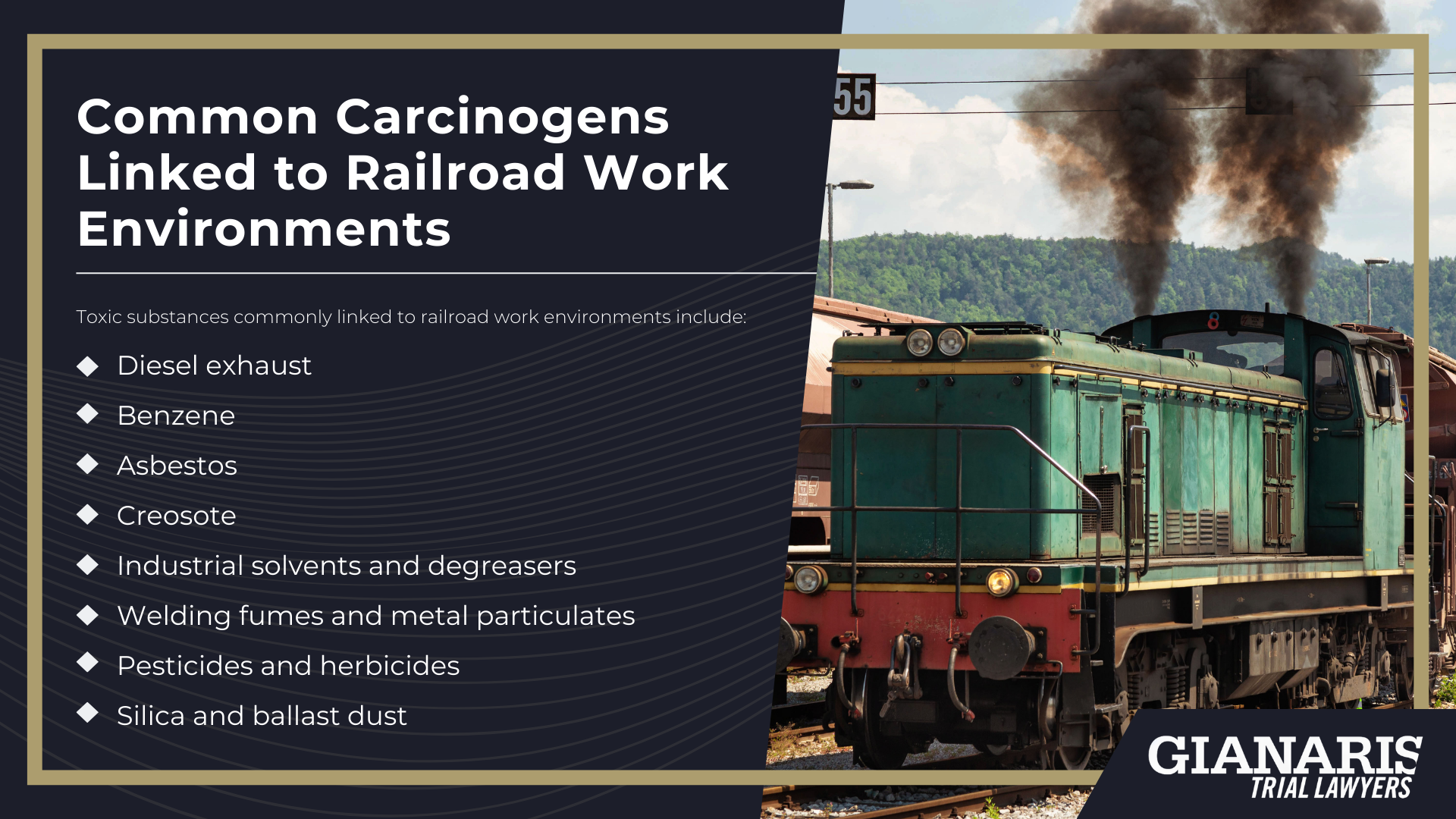
Toxic substances commonly linked to railroad work environments include:

How Kansas City Railroad Workers Are Exposed to Toxic Substances

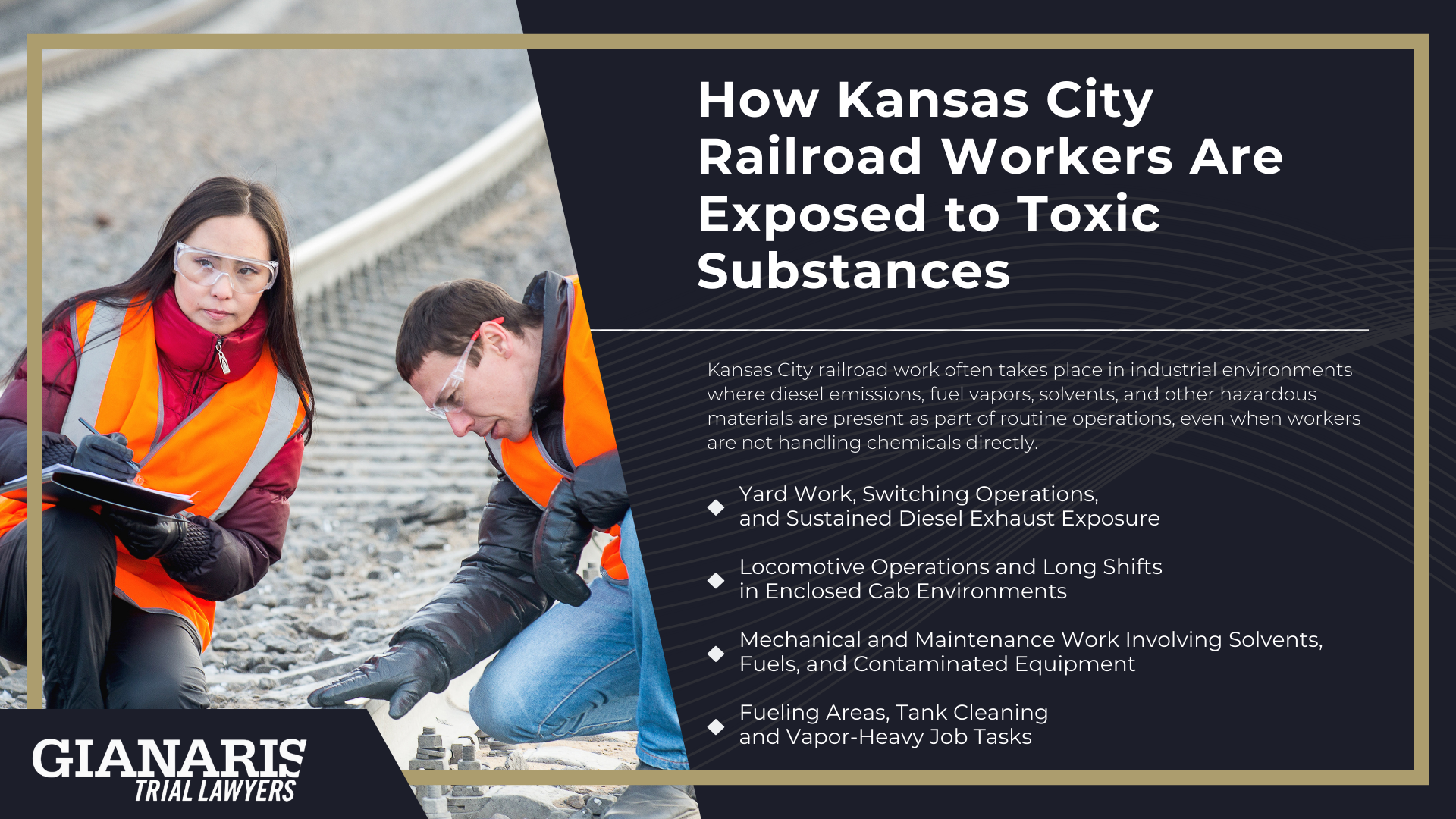
Kansas City railroad work often takes place in industrial environments where diesel emissions, fuel vapors, solvents, and other hazardous materials are present as part of routine operations, even when workers are not handling chemicals directly.

Exposure can occur through inhalation of exhaust and airborne particulate matter in yards and terminals, through contact with fuels and degreasers used during maintenance, and through dust and fumes generated by repair and fabrication work.

For many workers, risk is not tied to a single event but to repeated daily contact: cumulative exposure that can build over a career and contribute to long-term cancer risk.

This applies across a wide range of railroad roles, including locomotive engineers operating around idling engines, mechanical employees working around chemical cleaners and diesel equipment, and crews performing repair work where welding fumes and metal particulates can become routine.

It also includes trades such as sheet metal workers, electricians, and other shop-based workers whose tasks involve cutting, grinding, insulation removal, and component repair in enclosed or poorly ventilated settings.

Because these environments often involve multiple overlapping exposures, claims typically require careful review of job duties, worksite conditions, and the substances present over time when evaluating whether exposed and injured workers developed cancer linked to railroad employment.
Railroad Cancer Claims in Kansas City Often Involve Long-Term Toxic Exposure; Common Carcinogens Linked to Railroad Work Environments; How Kansas City Railroad Workers Are Exposed to Toxic Substances

Yard Work, Switching Operations, and Sustained Diesel Exhaust Exposure

Yard work and switching operations are often central to railroad cancer claims because they place workers in close proximity to idling engines, heavy equipment, and constant locomotive movement, creating repeated exposure to diesel exhaust over long periods.

The International Agency for Research on Cancer (IARC) classifies diesel engine exhaust as carcinogenic to humans (Group 1) based on sufficient evidence that it causes lung cancer, with additional evidence supporting an association with bladder cancer.

In the railroad industry, these exposures frequently occur in the same areas where diesel-powered equipment runs continuously (yards, terminals, and switching zones) where workers may breathe diesel particulate matter and gases throughout each shift.

In a long-term U.S. railroad worker cohort study published in Environmental Health Perspectives, lung cancer mortality was elevated in jobs associated with trains powered by diesel locomotives, supporting the conclusion that diesel exhaust contributed to lung cancer risk in this population.

Because diesel exhaust is a combustion byproduct of petroleum fuels derived from crude oil, workers in yard environments may also encounter additional fuel-related exposures during refueling, equipment servicing, and spill-related events.

When a railroad fails to reduce preventable exposure, through ventilation practices, engine-idling controls, or protective measures, these cases may be evaluated as potential employer negligence under FELA, particularly when a worker later develops a cancer diagnosis or other serious illness consistent with diesel exposure science.

Common yard and switching exposure conditions that often matter in these claims include:

  • Prolonged time near idling locomotives and heavy equipment during switching and staging operations
  • Working in areas where exhaust accumulates due to limited airflow, temperature inversions, or enclosed yard layouts
  • Repeated exposure over years (“cumulative exposure”) linked to increased lung cancer risk in occupational studies
  • Fuel-handling activities in yard environments where diesel vapors and liquid contact may occur during servicing and refueling
  • Exposure reconstruction based on job title (yard worker, conductor, switchman, engineer) and years of diesel-era service, consistent with how railroad cohort research evaluates risk

Locomotive Operations and Long Shifts in Enclosed Cab Environments

Locomotive engineers and other train crew members can spend long shifts inside enclosed or semi-enclosed cabs where diesel exhaust enters through doors, windows, ventilation systems, and leakage points, especially when trains idle in yards or operate near other locomotives.

NIOSH exposure assessments aboard diesel locomotives found that crew exposure to diesel particulate matter can vary substantially depending on cab conditions and operational factors such as ventilation and window use.

These findings matter because cab exposure can be repetitive and sustained over a working lifetime, particularly for employees with years of diesel-era service.

IARC classifies diesel engine exhaust as a Group 1 carcinogen, concluding it causes lung cancer and is positively associated with bladder cancer, which is why locomotive work histories are closely reviewed in railroad cancer claims.

Peer-reviewed railroad worker cohort research has also examined diesel-era occupational exposure and reported elevated chronic obstructive pulmonary disease (COPD) and lung cancer risk patterns in diesel-exposed jobs, supporting diesel exhaust as a medically relevant hazard in railroad operations.

Common locomotive cab exposure factors that often matter in these claims include:

  • Long shifts in enclosed spaces where exhaust can accumulate during idling, staging, and yard operations
  • Cab ventilation and window/door practices that affect diesel particulate levels, as documented in NIOSH crew exposure assessments
  • Proximity to exhaust sources, including trailing units and other locomotives operating nearby in terminals and yards
  • Cumulative exposure over years of service, which is how occupational research and FELA claims evaluate diesel-related risk
  • Overlapping exposures (fuel vapors, solvents, shop contaminants) depending on routes, duties, and time spent in terminals and maintenance areas

Mechanical and Maintenance Work Involving Solvents, Fuels, and Contaminated Equipment

Mechanical and maintenance work is a recurring exposure pathway in railroad cancer cases because it often involves daily contact with fuels, degreasers, cleaning agents, and residue on equipment that has been exposed to exhaust and petroleum products for years.

In these environments, exposure can occur through inhalation of vapors and aerosolized particles during cleaning and repair tasks, and through skin contact when workers handle liquids, rags, parts, or chemical mixtures without full protection.

Public health authorities recognize that benzene can be absorbed through both inhalation and the skin in occupational settings, which is why solvent and fuel work is evaluated carefully when a worker later develops leukemia or other blood-related disease.

This matters because gasoline and other petroleum-derived products contain benzene, and research referenced in environmental exposure literature notes that modern gasoline typically contains roughly 0.5%–2.0% benzene by volume, while diesel contains benzene at much lower concentrations, still relevant when exposures are repeated over many years.

Even when a product is not labeled as “benzene,” exposure can occur through solvent mixtures and cleaning agents, which is consistent with how OSHA regulates benzene in industrial settings and why its standard recognizes benzene exposure risks across multiple operations where benzene or benzene-containing materials may be present.

Common mechanical and maintenance exposure scenarios include:

  • Using degreasers and cleaning solvents during locomotive and railcar repair, creating inhalation and skin contact risks consistent with NIOSH and ATSDR exposure descriptions.
  • Handling fuel system components and working around refueling and transfer activities where diesel fuel contains trace benzene and fuel vapors may accumulate in enclosed work areas.
  • Cleaning equipment coated with petroleum residue, grime, and exhaust-related contamination that can become airborne during scraping, sanding, grinding, or compressed-air cleaning.
  • Repeated skin contact with liquid fuels and solvent mixtures, which ATSDR recognizes as an important pathway for benzene absorption in occupational settings.
  • Maintenance tasks performed in shops or enclosed spaces where ventilation is limited and chemical vapors can accumulate across long shifts.
  • Spill response and cleanup involving fuels and solvent-based products, which can create short-term high-intensity exposure events layered on top of long-term routine exposure.

Fueling Areas, Tank Cleaning and Vapor-Heavy Job Tasks

Fueling areas and vapor-heavy tasks are important in railroad cancer cases because they can involve concentrated exposure to fuel vapors and liquid petroleum products during routine operations.

OSHA’s benzene standard specifically recognizes that workers can be exposed during the storage, transportation, distribution, or sale of benzene or liquid mixtures containing benzene, and it addresses exposure issues tied to loading and unloading operations where vapors are present.

Public health agencies also recognize that benzene can be absorbed by inhalation and skin contact, which means fueling and cleanup tasks can create both respiratory exposure and dermal absorption risk.

These exposures are often evaluated as cumulative career exposures, but spill events, confined-space work, and tank cleaning can create short-term high-intensity exposure episodes layered on top of routine fuel handling.

Common fueling and vapor-heavy exposure scenarios include:

  • Refueling operations and fuel transfer tasks where gasoline or fuel mixtures can release vapors in enclosed or poorly ventilated areas
  • Tank cleaning and confined-space work involving equipment or containers that held fuel or benzene-containing mixtures, where vapors may remain trapped or re-release during cleaning
  • Handling fuel-soaked rags, hoses, and components that can create dermal exposure as well as continued vapor off-gassing
  • Spill response and cleanup involving liquid fuels or solvent mixtures that can lead to direct skin contact and concentrated vapor exposure
  • Working near intact fuel storage and transport systems where leaks, venting, or degraded seals allow intermittent vapor release over time
  • Uncontrolled vapor conditions during loading/unloading in bulk fueling or distribution operations, which OSHA recognizes as an exposure scenario addressed through compliance and monitoring requirements

Why Toxic Exposure Can Occur Even Without Direct Chemical Handling

Railroad workers do not need to handle chemicals directly to experience meaningful toxic exposure, because many hazardous substances are present in the air, on equipment surfaces, and in the surrounding work environment.

Diesel exhaust is generated constantly in yards, terminals, and along active tracks, and workers may inhale exhaust from idling locomotives and nearby equipment even when their primary duties are operational rather than mechanical.

In repair shops and terminals, solvents, degreasers, fuels, and other industrial products can produce vapors that spread beyond the immediate work area, particularly in enclosed spaces or where ventilation is limited.

Toxic residues can also collect on locomotive exteriors, railcars, tools, and work surfaces, creating dermal exposure pathways when workers handle parts, connect hoses, climb ladders, or perform routine inspections.

Creosote-treated railroad ties and ballast dust can release contaminated particles during track work, maintenance, or disturbance of old materials, even when a worker is not mixing or applying chemicals.

In older equipment and facilities, asbestos-containing components may release airborne fibers during routine repairs, retrofits, or disturbance of insulation materials, which can expose nearby workers not performing the work themselves.

For many railroad employees, the risk comes from cumulative exposure over years, where small daily exposures add up across multiple sources rather than one identifiable event.

This is why railroad cancer claims often focus on jobsite conditions and work environment hazards: what was present in the air and on equipment, not only what a worker personally handled.


Cancers and Serious Diseases Commonly Associated With Railroad Exposure

Railroad cancer claims often involve workers who spent years in environments where diesel exhaust, benzene, asbestos, creosote, solvents, and other hazardous substances were part of routine job conditions.

These cases are typically evaluated as cumulative toxic exposure claims, where risk builds through repeated daily inhalation of fumes, contact with contaminated equipment, and long-term work in yards, shops, fueling areas, and locomotive cabs.

Because railroad carcinogens affect different organ systems, occupational cancer claims are not limited to one diagnosis and can include both solid tumors and blood and immune system cancers.

Asbestos-related disease remains a major category in older equipment and shop exposure cases, and some workers developed mesothelioma decades after handling or working around asbestos-containing materials.

Diesel exhaust exposure has also been closely linked to lung and bladder cancer risk in occupational settings, which is why diesel-heavy job histories are frequently reviewed in railroad cancer claims.

Benzene exposure is also a recurring focus because of its established connection to leukemia and other blood cancers, particularly for workers exposed through fuels, solvents, and prolonged industrial conditions.

Railroad Cancer Claims in Kansas City Often Involve Long-Term Toxic Exposure; Common Carcinogens Linked to Railroad Work Environments; How Kansas City Railroad Workers Are Exposed to Toxic Substances; Cancers and Serious Diseases Commonly Associated With Railroad Exposure

Cancers and serious health conditions commonly discussed in railroad exposure cases include:

Do You Qualify for a Railroad Cancer Lawsuit?

You may qualify for a railroad cancer lawsuit if you can document significant workplace exposure to toxic substances and have been diagnosed with a cancer or serious disease consistent with railroad work environments.

These cases often involve long-term exposure to diesel exhaust, benzene, asbestos, solvents, and other industrial hazards in yards, locomotive operations, or maintenance facilities.

Qualification also depends on whether the claim can be pursued under FELA, which requires showing that the railroad’s negligence contributed to the exposure conditions and resulting illness.

A diagnosis alone is not enough; the strength of a claim usually depends on employment history, job duties, medical records, and expert review supporting causation.

Railroad exposure and injury claims can involve years of work history and long latency periods, which makes accurate timelines and documentation especially important.

Because FELA cases can involve a complex process, an experienced FELA lawyer from Gianaris Trial Lawyers can review the facts and determine whether your work history and diagnosis support a claim worth pursuing.

Railroad Cancer Claims in Kansas City Often Involve Long-Term Toxic Exposure; Common Carcinogens Linked to Railroad Work Environments; How Kansas City Railroad Workers Are Exposed to Toxic Substances; Cancers and Serious Diseases Commonly Associated With Railroad Exposure; Do You Qualify for a Railroad Cancer Lawsuit

If the claim is viable, the legal strategy may include preparing for litigation while also evaluating opportunities to resolve the case through settlement talks.

A strong case can help protect your legal rights and pursue fair compensation, but the outcome depends on the evidence and the ability to prove negligence and damages under FELA rather than any guaranteed result or maximum compensation promise.

Gathering Evidence for a Railroad Cancer Lawsuit

Railroad cancer cases are evidence-driven because the claim must show not only a diagnosis, but also a credible work history and exposure pathway that supports causation under FELA.

The strongest cases document where the worker spent time, what tasks were performed, what substances were present, and how long exposure continued over a career.

Medical evidence is equally important because occupational cancers often have long latency periods and require objective records confirming diagnosis, treatment, and disease progression.

Early evidence collection also matters because rail facilities change, records can be lost, and coworkers retire, making exposure reconstruction more difficult the longer a case is delayed.

Railroad Cancer Claims in Kansas City Often Involve Long-Term Toxic Exposure; Common Carcinogens Linked to Railroad Work Environments; How Kansas City Railroad Workers Are Exposed to Toxic Substances; Cancers and Serious Diseases Commonly Associated With Railroad Exposure; Do You Qualify for a Railroad Cancer Lawsuit; Gathering Evidence for a Railroad Cancer Lawsuit

Common evidence used in a railroad cancer lawsuit may include:

  • Employment records showing railroad employer(s), job titles, dates of service, and locations worked
  • Union records, payroll records, pension records, and benefit statements
  • Job descriptions and work history summaries detailing duties and work environments
  • Worksite information tied to yards, terminals, shops, fueling areas, and locomotive assignments
  • Training materials, safety manuals, and written policies addressing hazardous materials and protective measures
  • Industrial hygiene records, air monitoring data, or internal exposure assessments (if available)
  • Safety Data Sheets (SDS) and product documentation for solvents, degreasers, fuels, and chemical agents
  • Maintenance logs, work orders, and equipment service records relevant to exposure tasks
  • Witness statements from coworkers or supervisors confirming typical working conditions
  • Incident reports documenting spills, releases, or unusual high-exposure events
  • Medical records confirming diagnosis and treatment (oncology/hematology notes, imaging, pathology)
  • Personal documentation (photos, journals, calendars) showing work conditions, job sites, or equipment used

Potential Compensation in Railroad Cancer Cases

In a railroad cancer case, “damages” refers to the categories of loss a worker or family may seek to recover after an occupational disease allegedly caused by toxic workplace exposure.

Because cancer treatment often involves prolonged care, relapse monitoring, and life-altering limitations, damages are typically built from objective records and supported by medical and economic evidence.

A law firm helps assess and calculate damages by collecting and organizing proof of medical expenses, future care needs, work disruption, and the full impact of the illness, then presenting that evidence in a way that supports negotiation and trial advocacy.

This damages analysis is also used to advocate for maximum compensation supported by the facts, particularly where the worker faces long-term disability, reduced life expectancy, or the need for ongoing treatment.

When liability and causation can be proven, railroad cancer cases may result in significant compensation through settlement or trial, including recovery for both economic and non-economic harm tied to the disease.

Potential damages in railroad cancer cases may include:

  • Past and future medical expenses, including oncology care, surgeries, chemotherapy, radiation, medications, transfusions, and specialist visits
  • Hospital bills and costs associated with inpatient treatment, emergency care, and extended hospitalization
  • Diagnostic and monitoring costs (imaging, biopsies, lab testing, follow-up appointments)
  • Out-of-pocket expenses (travel to treatment centers, lodging, home care, medical equipment, home modifications)
  • Lost wages and loss of earning capacity (including disability leave and permanent work restrictions)
  • Pain and suffering (physical pain, treatment side effects, reduced quality of life)
  • Emotional distress (anxiety, depression, trauma associated with diagnosis and treatment)
  • Loss of normal life (limitations on daily activities, independence, and routine functioning)
  • Loss of consortium (spousal and family impacts recognized under applicable law)
  • Wrongful death damages (funeral costs, loss of financial support, loss of companionship, survivor losses)

Gianaris Trial Lawyers: Railroad Cancer Attorneys

Railroad cancer cases require more than a diagnosis and a job title.

They require a careful investigation into where exposure occurred, what substances were present, how long the worker was exposed, and whether the railroad failed to take reasonable steps to reduce known hazards.

Many of these claims involve long latency periods, which means workers are often diagnosed years after the most intense exposure, and critical evidence can disappear if the case is not evaluated early.

A strong FELA claim is built through medical documentation, exposure reconstruction, and expert testimony that connects workplace conditions to the illness in a way that holds up in litigation.

Gianaris Trial Lawyers represents railroad workers and families pursuing FELA cancer claims tied to long-term toxic exposure in yards, locomotive operations, and maintenance environments.

Railroad Cancer Claims in Kansas City Often Involve Long-Term Toxic Exposure; Common Carcinogens Linked to Railroad Work Environments; How Kansas City Railroad Workers Are Exposed to Toxic Substances; Cancers and Serious Diseases Commonly Associated With Railroad Exposure; Do You Qualify for a Railroad Cancer Lawsuit; Gathering Evidence for a Railroad Cancer Lawsuit; Gianaris Trial Lawyers_ Railroad Cancer Attorneys

If you or a loved one worked in the railroad industry and has been diagnosed with cancer or a serious blood or lung disease, contact Gianaris Trial Lawyers to request a confidential case review.

You can also use the chat feature on this page to get in touch with an experienced FELA lawyer.

Frequently Asked Questions

  • How much does it cost to hire a Kansas City railroad cancer lawyer?

    Gianaris Trial Lawyers works on a contingency fee basis, which means there are no upfront attorney’s fees and the firm is only paid if it secures compensation for you through a settlement or verdict.

    This fee structure benefits clients because it allows railroad workers and families to pursue a FELA claim without taking on added financial pressure while dealing with a cancer diagnosis, lost income, and ongoing treatment.

    Most reputable FELA lawyers operate the same way (no recovery, no fee), because railroad exposure cases require significant investigation, medical review, and expert analysis before a claim can succeed.

    Kansas City railroad injury firms also frequently offer free consultations, giving workers a chance to evaluate their legal options and understand whether a claim may be viable before committing to anything.

    Hiring a specialized railroad cancer lawyer can significantly improve the chances of obtaining fair compensation, and a survey reported that more than 90% of people with legal representation received a settlement or award, compared to about half of those who handled their claims on their own.

    An attorney also helps make sure the evidence is gathered and presented correctly (employment records, exposure history, medical records, and expert testimony) which is critical in toxic exposure cases where causation must be proven under FELA.

    Filing a claim under FELA can help railroad workers and their families pursue compensation for medical care and lost income after a cancer diagnosis, but the outcome often depends on how well exposure, negligence, and damages are documented and supported.

  • What are average railroad cancer settlement amounts?

    Railroad cancer settlements vary widely because every claim turns on different facts such as diagnosis type, severity, duration of exposure, wage loss, and how clearly the evidence shows the railroad’s failure to protect workers.

    Based on past railroad cancer lawsuit outcomes, settlements and verdicts are often discussed in tiered ranges, rather than a single “average” number.

    In general, railroad cancer settlement amounts commonly fall between $100,000 and over $1,000,000, with some cases exceeding $2 million, especially when the cancer is aggressive or fatal and exposure history is well documented.

    On the lower end, cases may fall in the $100,000 to $300,000 range when exposure documentation is limited, the duration of exposure is shorter, or the causal link is more contested.

    Mid-range cases often fall between $300,000 and $600,000, commonly involving severe cancers like kidney or bladder cancer supported by stronger exposure evidence.

    Higher-value cases frequently fall between $600,000 and over $1,000,000 (and sometimes beyond $2 million) when they involve aggressive or fatal cancers such as mesothelioma or advanced lung cancer, long-term toxic exposure, and substantial damages.

    Important disclaimer: These settlement ranges are estimates based on past railroad cancer claims and should not be interpreted as a guarantee of compensation or a prediction of what any individual case will resolve for.

    Each case is evaluated on its own facts, and outcomes can vary dramatically based on the strength of the evidence, the worker’s exposure history, the medical diagnosis, and jurisdictional factors.

  • What carcinogens are railroad workers commonly exposed to?

    Railroad workers are commonly exposed to carcinogens because rail yards, locomotive operations, and maintenance facilities involve diesel-powered equipment, fuel handling, chemical cleaning agents, and historically contaminated materials used in railroad construction and repair.

    Many exposures occur through inhalation of fumes and particulate matter, skin contact with fuels and solvents, and repeated handling of contaminated equipment, especially in shop environments where hazardous materials are used daily.

    Certain railroad job roles, particularly machinists, electricians, and other mechanical trades, are often more vulnerable because their work involves prolonged time in repair areas, cutting and grinding tasks, electrical component servicing, solvent use, and close contact with older locomotive parts.

    Many illnesses related to toxic exposure in railroad work develop slowly, with symptoms emerging years or even decades after initial exposure, which is why workers are sometimes diagnosed long after leaving the job.

    Carcinogens railroad workers are commonly exposed to include:

    • Diesel exhaust (diesel particulate matter and combustion byproducts)
    • Benzene (fuel vapors, solvents, degreasers, petroleum products)
    • Asbestos (older equipment, insulation, gaskets, brake components, shop materials)
    • Creosote (treated railroad ties and bridge timbers)
    • Industrial solvents and degreasers (cleaning and maintenance chemicals)
    • Welding fumes and metal particulates (repair shops, cutting/grinding work)
    • Silica and ballast dust (track work, yard dust, crushed stone exposure)
  • Where may Kansas City railroad workers be exposed to toxic chemicals?

    Kansas City railroad workers may be exposed to toxic chemicals and diesel-related carcinogens in and around major yards, terminals, switching corridors, and shop environments where locomotives idle, equipment is serviced, and fuels/solvents are used.

    Kansas City–area locations where exposure may occur include:

    • BNSF Murray Yard (North Kansas City, MO)
    • CPKC Knoche Yard (Kansas City, MO)
    • Kansas City Terminal Railway (KCT/KCTR) switching and interchange network (Kansas City, MO core terminal corridors)
    • Union Pacific Kansas City intermodal / yard operations (Kansas City, MO footprint historically tied to Neff Yard operations)
    • BNSF Argentine Yard (Kansas City, KS — major metro hub that often affects Missouri-based workers)
    • Fueling and servicing areas near major yard complexes (KC metro terminal zones where locomotives are staged and refueled)
    • Mechanical shops and repair facilities connected to yard operations (areas where solvents, degreasers, welding, and parts work occur)
    • Switching corridors and staging tracks near the Missouri River industrial rail zones (areas with sustained locomotive idling and diesel exhaust accumulation)
  • What types of cancer are linked to toxic exposure in the railroad industry?

    Toxic exposure in the railroad industry has been linked to several cancers because railroad work environments can involve long-term contact with diesel exhaust, benzene, asbestos, creosote, and industrial solvents.

    These exposures often occur in yards, locomotive operations, and maintenance facilities where fumes and residues are present daily, and risk may build through cumulative exposure over years of employment.

    Many of the cancers associated with railroad work are respiratory or digestive cancers tied to inhaled carcinogens, while others involve the blood and immune system due to benzene-related marrow toxicity.

    Asbestos exposure remains a major concern in older equipment and shop environments and is closely associated with mesothelioma and lung cancer.

    Diesel exhaust exposure has also been studied as a carcinogenic hazard and is frequently evaluated in claims involving lung and bladder cancer.

    Because symptoms can appear years after exposure, these claims often involve workers diagnosed long after the most intense exposure period.

    Cancers commonly linked to toxic exposure in railroad work include:

    • Lung cancer
    • Bladder cancer
    • Kidney cancer
    • Colon cancer
    • Leukemia (including AML and other blood cancers)
    • Non-Hodgkin’s lymphoma
    • Multiple myeloma
    • Mesothelioma (asbestos-related)
    • Stomach and esophageal cancers (in some exposure histories)
Published by:
Share
Picture of Ted Gianaris
Ted Gianaris

With nearly 30 years of legal experience, Attorney Ted Gianaris has secured over $350 million in compensation for Illinois injury victims, car accident victims, and surviving family members of wrongful death victims.

This article has been written and reviewed for legal accuracy and clarity by the team of writers and attorneys at Gianaris Trial Lawyers and is as accurate as possible. This content should not be taken as legal advice from an attorney. If you would like to learn more about our owner and experienced Illinois injury lawyer, Ted Gianaris, you can do so here.

Gianaris Trial Lawyers does everything possible to make sure the information in this article is up to date and accurate. If you need specific legal advice about your case, contact us. This article should not be taken as advice from an attorney.

Other cases we handle in Missouri
You can learn more about other cases we handle in Missouri below:
FELA Lawyer Missouri

Other Missouri Personal Injury Cases

All
Car Accidents
Chemical Exposure
FELA
Motorcycle Accidents
Other Accidents & Injuries
Railroad
Truck Accidents
Local Missouri Resources
Education
Emergency Services
Courthouses
Department of Motor Vehicles
Sights to See